
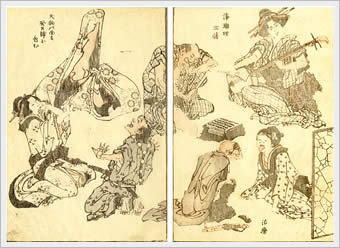
Above are two pages of manga by the originator of the term, ukiyo-e artist Katsushika Hokusai. I bought these yesterday for 3,000 yen ($24 USD) at Hara Shobo in Kanda-Jimbocho (I wrote briefly about this gallery here). I had been considering buying one of the gallery’s two-page spreads of manga sketches by Hokusai for a while now. The prints date from the Meiji era (roughly 1889, according to the gallery), but were struck from the original woodblocks. Hokusai in all created 15 volumes of manga in his lifetime. When he coined the term manga way back in 1814, he meant something akin to “whimsical sketches,” not necessarily a far cry from today’s popular manga, but certainly different nonetheless. Hokusai’s manga really were sketches, without much of a narrative element. As you can see from the above image (click for a larger image), there isn’t any real connection between the various scenes depicted (three separate ones in the case of this print).
There’s a wonderful humor to many of the sketches, often of quite a ribald nature. In the scene on the left, two people are laughing their heads off at a huge tengu (mountain goblin known for their long noses) mask that has been wrapped up in a furoshiki (wrapping cloth). On the right page, top, a women plays a shamisen and sings, lyric sheets in front of her. (Frankly, I’m not sure what the man to her right is doing, perhaps beating out a rhythm?) In the bottom right picture, a doctor is examining a patient, who has her tongue stuck out.