
A few of my (early) New Year’s resolutions focus on my Japanese studies. Of these, one in particular I’ve been getting a head start on recently: my writing. It has been bothering me for some time that while my reading of Japanese has improved tremendously over the past few months (in good part because I’ve banished romanized transliterations from my study), I have not kept my writing in step. I can probably recognize roughly 300 or so kanji characters at this point, but put a gun to my head and write out any of them and it’s doubtful I would be able to write 10 of them.
Part of this problem derives from my recent studying for the Nihongo Nouryoku Shiken, or Japanese Language Proficiency Test (Level 3). The JLPT has no kanji writing component, so in the interest of having more time to devote to preparing for the grammar sections, I didn’t bother with kanji writing, but rather only with recognizing them and being able to produce their various readings (kun-yomi and on-yomi). In retrospect, knowing how to write the kanji I studied would have helped me deal with the many trick questions the kanji reading section throws at you (including some fake kanji characters). (Oh well, all water under the bridge….)
The other problem, which Japanese themselves are all too familiar with, is that with the advent of PC’s and now cellphones, as long as one can read kanji, one doesn’t really need to know how to write the characters, for the most part. Input the hiragana for the word, and then choose the correct kanji from the pop-up. The software does the bulk of the work. So I can type out an email dense with kanji, but I can’t write even a basic sentence with pen and paper to save my life. (I should just add that despite the above, writing emails in Japanese has done wonders for my reading skills).
At any rate, I’m determined now to learn how to write kanji as well as read it, which has necessitated a kind of going back to basics approach. This means having to create kanji flashcards for such basic words like hana (flower), gaku (learning), and tama (gem, sphere), and to spend a lot of time writing them over and over again in a notebook, and then testing myself that I can write them from memory. Frankly, it’s all a bit humbling, but necessary.
To keep myself from going insane, however, I’ve also been creating flashcards for new kanji characters I’ve never learnt before, from within the 1006 kanji that every Japanese is supposed to know by the time they finish 6th grade (and which I need to know if I have any hope of passing the 2nd level of next year’s Japanese Proficiency Test). In the process, I’ve stumbled onto a new method of study (new to me, at any rate), which I thought I would share.
One of the problems with studying kanji, for me that is, is that there’s usually very little context to the studying in the beginning. You simply have to plow through the characters, using rote memorization (and a lot of testing!) to build up the supply of kanji you can read (and hopefully write as well). But as any Japanese learner knows, what makes up the bulk of Japanese vocabulary are not individual kanji characters, but rather kanji compounds, that is words which are made up of two, three, etc. kanji characters. So, as part of my current self-study, I’ve been concentrating more on not just a single character, but rather as many words as possible that use that character. So, in a day of studying, while I might be learning only 3 or 4 new characters, I’m actually learning anywhere between 15 to 20 new words using those characters in combination with other characters I already know. Let’s look at an illustration which might help to explain what I mean:
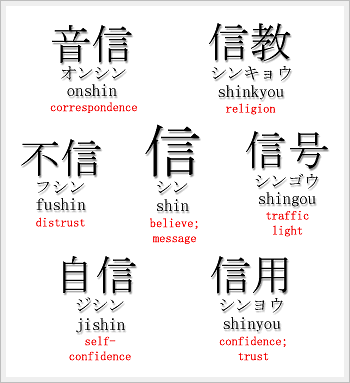
In the center is the kanji for shin (believe; message), which is used to form shinjiru (to believe; to place trust in), and surrounding it are some other words that use the shin character in combination with other characters. So while studying shin and hopefully committing it to memory, I’m also looking around for other words that use this kanji. Among those other words, I look for those where shin‘s partner(s) — so to speak — are other kanji I’ve already learned, and these combinations I also commit to flashcards (all the compounds surrounding shin above, for example). If I find a partner kanji I’m unfamiliar with but think the word is important to know at this stage of my learning, I then make the effort to learn that particular kanji. And with that kanji, I repeat the whole entire process I just described. So you can see that in very short order, just by learning only 2 or 3 single characters, my vocabulary grows by leaps and bounds.
Of course, creating flashcards doesn’t really get you anywhere near mastering kanji. One needs to review these endlessly before they seep into the brain, and it’s important to not get a false sense of mastery if you can flip through the cards and seamlesslessly recall each character or compound and it’s reading. Turn those cards over (if you’ve written the readings on the back like I do), and test yourself to now write all those characters from memory, based on the reading. Until I can do that, I don’t consider the character (or compound) mastered.
In a little over two weeks of my project, I’ve already created at least a couple hundred flashcards. I’m now at the point where I need a “system” so that the kanji I mastered last week doesn’t fly away from my brain this week. M-san of Nippon Daze and Hajimemashou has what sounds like a good method (admittedly I have yet to put it into practice myself).
I’m using several books at the moment to assist me in my Kanji “project,” including:
* Doraemon kokugo omoshiro kouryaku utatte kakeru shougaku kanji 1006 (published by Shogakukan), which displays all the 1006 kanji Japanese youth need to learn in grade school, organized by grade. There are several books of this type readily available at any Japanese bookstore (and perhaps overseas at Kinokuniya stores and the like?). I find this one, aside from being irresistably kawaii (cute), to have good tips on how to write each kanji (focusing on stroke order, balance, and using the correct stroke endings — eg. does the stroke employ a little flourish at the end (hane) or come to a complete stop (tome)), and it also provides the all important list of select words using each kanji.
* The Kodansha Kanji Learner’s Dictionary edited by Jack Halpern. This book covers all 1,945 Joyo kanji, plus the 285 characters in the official Jinmei Kanji (for names). I love this book, in no small part due to it’s very attractive design. The SKIP method it employs for kanji look-up is somewhat laborious to get used to, but once that is overcome it makes looking up kanji a very quick process (it also expediates stroke counting and becoming familiar with the main radicals). Theres a wealth of information on each kanji (I particularly like the frequency index, which is based on a year’s worth of Japanese newspapers), but what really is useful is that most entries are loaded with examples of other words that employ the character, which helps me and my “project” immensely. About the only drawback I can think of with respect to this dictionary is that it uses romanized Japanese throughout.
* Shin Nihongo no Kiso Japanese Kanji Workbook II. This is just a workbook I selected pretty much at random, and there are others out there (Bojinsha’s Basic Kanji series is one). Each two pages the book introduces 7 or 8 individual characters, with another two pages testing one’s reading and writing of these (and other) characters. I didn’t really want to proceed with my kanji learning in a straight line (eg. from Grade 1 to Grade 6, in that order), but jump around, and make connections on my own. The above workbook serves that trick quite nicely.
One of my teachers described me as a kanji otaku, or kanji freak. This post may make that sound like a true statement, but I don’t really think I am. I do however find kanji to probably be the most appealing aspect of the language to me (and the most frustrating, to be sure), which probably relates to my art background, and back to my first Japanese learning experience, in 9th grade, where we used sumi-e to draw out various characters. But what keeps me motivated beyond proficiency exams is the hope that one day I may be able to read Soseki Natsume or Oe Kenzaburo novels in the original, or peruse the various Shukan Weeklies that line Japan’s convience store shelves. At that point I might then be able to say “I’ve arrived.”
Kurt, what a great post – not only for the tip (which makes perfect sense and seems so obvious, but you’re the first to mention it) but also your last paragraph. I’ve already done the “foreigner in Japan” thing. It’s going to be a huge amount of work, but I too hope to read the weeklys or casually understand the tv news playing in the background. Ah, to be able to read Murakami without spending an hour for two pages.
I know it happens. One day you look around and realize, wow I can read just about everything in eyesight.
-Jason
Just for fun. Rikai can make these connections for you:
http://www.rikai.com/perl/KanjiMap.pl
I am also aiming for the 1006 this year. I have taken to writing out all of the 1006 a few at a time.
When I first started learning I did a lot of writing and some stuck and I remembered many others but after that I stopped writing and kind of got despondent. I figure that if I write them all out some will stick. I have a more methodical method of learning but my new goal is simply to say I have written every one of the 1006 kanji.
HI, first of all sorry for my English, I´m Spanish and I need my name in Japanish is a thing of live or die. My name is Jesús. Thanks for all and sorry for my english another time.
i want to learn japanese language soon
but i do not know how
please help me as soon as you can
thank you…………..
You might be interested in the Kanji Flashcards on sale below, which would save you making a similar item yourself. They show 6 compound kanji words per card, giving you a vocabulary of 1,700 words – and there’s no romanised script to be seen!
http://www.jbox.com/STUDYAIDS/
I am strongly tempted to get these when I’ve finished a book I’m using to learn Japanese at the moment.
The Four-Letter Japanese Words Mini Dictionary on the same page also looks good!
Hi there. A detailed and interesting read! I like your flashcards but seriously doubt I’d have the patience for making them myself.
I’m one of those people who likes to write kanji in order to learn them, though lately I’ve been trying other methods.
Through email my kanji recognition has also improved incredibly but just like you were, when asked to write something with a pen…
As you wrote this post a long time ago I’d like to know how much your kanji has improved since the time of writing. Is there light at the end of the kanji tunnel?
This is really inspirational. Why? I’ve been learning Japanese for 5 years and i am not where i want to be. Believe it or not, i only know 5 kanji and still speak very little Japanese. I’m am proud of how far i have come but i notice that i could do better. I just need that thing called “time”. Now that it is 2004, how is everything? I want to know what else have you accomplished within these two years from this post.
please sent to me jlpt level 3&4 pass papers