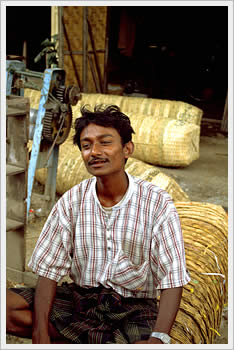
Thazi, Burma (Myanmar) (June, 2001). 35 slide film, type forgotten.
The palette around here has turned decidedly grey in recent days (weeks, really), so let’s throw a little spanner change-up into the works, shall we. I’ve been thinking a lot recently about black and white vs. color, analog photography vs. digital, people in photographs vs. photographs of buildings, cityscapes, and cultural minutiae. About displacement, belonging (or not), adapting (or not). And about diasporas and orientalism. Thoughts that don’t resonate with each other strongly enough for me to be able to congeal them into a coherent and unified front of thought, so for now they remain disconnected, a Maginot Line, perhaps not worth the scrap of web space they’re now occupying.
What does an ethnic Indian man in longhi and betelnut-red mouth living in Burma have to do with this? He’s an appropriation, for this blog, this piece, this point I can’t quite seem to make. An appropriation taken by a white man of privilege travelling in a poor post-colonial country against the wishes of the country’s elected but emasculated leader. A tourist, skipping and skimming along the surface, earnest to be sure, a do-gooder, but here today and gone tomorrow. Got what I needed, thanks.
Perhaps you can see where I wanted to go with this.
Language is being hijacked at every turn, by you know who and Co. They can do that, you know, these days they have the power, and the freedom, and the money to do that. Here too, we’re not immune. I started this wanting to write about dislocation and displacement but I lost the straight path somewhere in the middle of going from there to here. For between the idea and the reality falls the shadow that covers everything, permeating the thoughts of good men and women who don’t know they’re being taken for a ride.
(Inspired by Ken Loo and Robert Brady, for different reasons. Don’t hold my glib ramblings against them.)