
There seem to be a rash of articles on camera-equipped cellphones lately, mostly about the potential misuse of them and attempts by various bodies and associations to legislate their use.
Yesterday, Gen Kanai posted about two of them:
Japan’s ‘digital shoplifting’ plague
Korea Concerned over Cameraphones
Last week, Business 2.0 ran an article entitled “Are Camera Phones Ready for Their Close-Up?”, the subhead of which read “Everyone loves the new devices. But their misuse is raising questions.”
The BBC article that Gen linked to is about a new campaign by the Japanese Magazine Publishers Association to stop what they sensationalistically call “digital shoplifting” or “information theft,” that is, taking photos of magazine spreads with one’s camera phone. These publishers feel that if someone snaps a photo of a new item in a fashion mag to send to his/her friends (“look at this new Louis Vuitton bag!”), they are being deprived of magazine sales. Excuse me while I roll my eyes!
As I pointed out in a comment on Gen’s site, it seems to me that this snapping of photos of magazines like this is just an extension of the tachiyomi phenomenon seen in convenience stores across Japan. tachiyomi means to read while standing up, and refers to the prevalent practice among all generations of folks here in Japan to read magazines and comic books in stores (while standing up), without ever buying them. While not exclusive to Japan of course, this phenomenon does seem to reach new heights here. (Aside: I would love to know more about this cultural phenomenon. Are their any good sociological articles in English anyone can point me to?)
While many convenience stores, and bookstores, display signs admonishing customers not to peruse magazines without buying them, it seems to be hardly ever be enforced. My sense is that this new “campaign” against taking pictures of magazines with cellphones will end up the same way. After all, are they going to install surveillance cameras for this purpose, or assign a security guard cellphone watch duty? I hardly think not. And furthermore, according to the BBC article,
Japan’s bookshop owners have already said their staff cannot tell the difference between customers taking pictures and those simply chatting on their phones.
(The use of “chatting” might be misleading. Surely what the owners are referring to is text chatting by phone, rather than verbally chatting). Nevertheless, that the publishers consider this a serious enough problem that needs addressing via a “campaign” should give one pause.
As is often the case in Japan, when certain folks want to legislate behavior, they tie it to manaa, or “manners.” The posters the publishers will be asking bookstores and the like to put out supposedly, according to the BBC article, warn shoppers to “be careful of their ‘magazine manners’.” Additionally, in the BBC article, there was this paragraph near the bottom that amused me:
And only this weekend, newspaper ads warned phone users to avoid walking and writing emails at the same time.
And sure enough, in today’s Yomiuri Shinbun is such an ad:
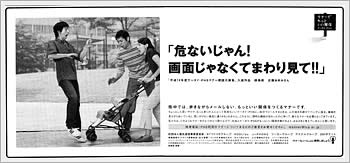
The headline of the ad campaign, which apparently was chosen among entries solicited from consumers during a “cellphone/phs manner campaign” last year, and is sponsored by all the major cellphone service vendors (DoCoMo, KDDI, Vodaphone, etc.) reads abunai jyan! gamen jyanakute mawari mite!!. A rough translation would be: “Hey watch it! Look around you, not at your cellphone screen!!” Not surprisingly, a baby in a stroller is featured in the ad. (Aside: Am I the only one who thinks they messed up with the framing of the picture in the ad? The couple on the right is partly cut off and there’s a lot of “empty” space on the left hand side of the photo. Click on the image above for a larger scan and see for yourself.)
In jest, I wonder if Adam and co. shouldn’t hastily add a panel discussion to this Saturday’s International Moblogging Conference line-up about this new “manner” campaign. Surely I’m not the only moblogger who has typed up a moblog post while walking down the street. Hell, I ‘ve moblogged from my bicycle on past occassion, and I’m not the only one to do so.
Seriously though, all this recent focused attention on the possible ills of camera phones is surely something that will come up at the conference. It’s easy to turn up one’s noses at the reactionaries in our midst, but there are some important issues about privacy and ownership and copyright, and manners to be discussed, and the sooner they’re discussed, the better equipped we’ll all be to proceed rationally towards acceptable uses of this new-fangled technology.
in response to your aside about the framing of the ad, i’m sure it was intentional. the extra space in the ad belongs to the cell phone user, and he is abusing it. had he been paying attention, he would have made use of that space to place his body out of the path of the family of three who clearly possess very little space of their own, for they have just barely managed to enter into the frame therefore had no possibilites for avoiding the first character. had they collided, however, it seems the baby was prepared to break the fall of the cell phone user with it’s little arm.
This is an excellent post. I’ve always wondered what the bookshops thought of people standing there reading their material. A lot of publications are plastic wrapped (as you know) to keep people out of them. I find it laughable that anyone is seriously considering that people taking snapshots of articles to send to their friends is going to decrease their circulation. They should think of it as free advertising.
As for the mannaa advertisement. I haven’t seen that yet. Very interesting. I like Mark’s take on the meaning of the space in the frame etc.
Andrew
i’ve heard that the magazine stands are purposefully placed by the window so that passers-by will be tempted to stop in and join the tachiyomi crowd. After all, this country is the epitomic example of “safety in numbers”…
Regarding the “borrowing” of reading material etc at the convenience stores, it seems very similar to me to Tsutaya allowing people to rent CDs for one night, and putting blank MD discs on sale next to them. In Japan, and maybe in other parts of Asia as well, there is no strong sense of respect for published material. It is not frowned upon culturally to borrow a book and photocopy it’s contents, or record a CD, or read the complete contents of a magazine in the shop. In terms of music, I think Napster and the like have changed the way people thik about recorded music, but in the West,written material is still, by and large protected both by copyright, and by cultural habits.
gary-
i think this is changing though, with “help” from the US, not surprisingly. Joi Ito reported here (http://snurl.com/1q2l) that Japan quietly passed a DMCA-like bill a couple of weeks ago extending copyright from 50 years to 70 years, and that tools to get around copy protection like DeCSS are now illegal here. Also, Sam’s Tokyo Blog reported last week the recent apparent arrest of a Tokyo U. student for illegal copying using WinMX (see here: http://www.neurogrid.net/sam/archive/000051.html)
i second that framing analysis by mark up above. the extra space does indeed show the cell phone user has moved through the area, while the poor family has had nearly no time/move to survey and adequately size up threats. i love how the father is going in for the defensive blocking move, while the mom, like all moms in japan, seems – despite mouth open in some sort of admonishing yelp – continues forward, undaunted.
It seems the new digital world we are creating has thrown the entire concept of protections and fair use into turmoil, and it will take much thought and consideration until we can straighten it out
Does this message site work just checking (test message)
Does this message site work just checking (test message)
I want to know something but first the the concept of people reading magazines in stores for free is good.
It brings to awareness the products in those magazines and people go out and buy them (products).
If they like the magazine through reading it and find out it is quality they will buy it without reading they might not know they want it. Unless they read the whole thing which i feel isnt so great.
I go into book stores alot and have paid over $1,000 for a digital organiser. It has a high resolution compact camera on it I have to say the quality is immensely clear.
So clear when I take a picture of a page on a book i can load that image from the organiser into the the computer and view the whole page(s) at home on a big screen to read word for word.
It is no different from standing in the book store reading a paragraph word for word all im doing is using that free option they give to read books in the store. But reading that page from outside the store (at home).
I am not distributing the material and am not edititng it and do not claim it as my work and i delete it after i have read it (within 30 days). This sounds reasonable.
I would like to know the exact law if anybody knows concerning this matter.
From what i know using it for private use and not editing it or distributing it makes it legal. Plus the actual book has not been stolen from the book store.