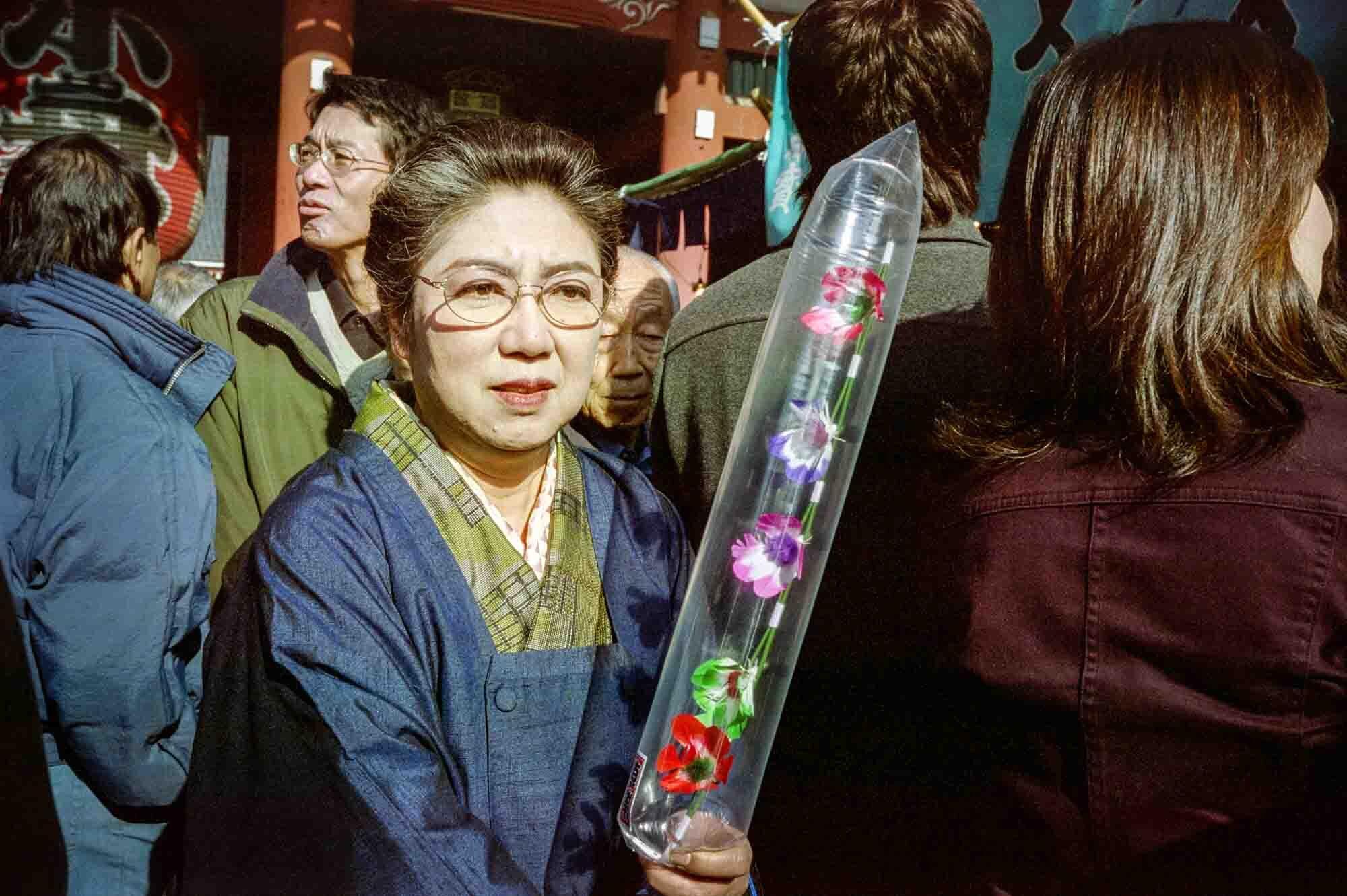
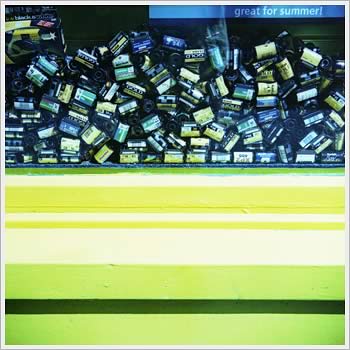
1-hour photo lab, London, October, 1998. Lubitel 166U, Fujichrome 64T, cross-processed as color negative.
Lil of esthet was asking at dinner last night after a local Japan Photographer photo shoot if anyone knew where one could get film cross-processed in Tokyo. I couldn’t help her with that question, not having done it here (yet), but I was reminded of my brief foray into this alternative process a few years back, and so I dug this image out tonight. And because Lil was also pestering me to teach her how to use her new Kyrgyzstan-bought Lubitel 166U 2¼ TLR (aka “Lomo”), this image seemed more than appropriate seeing as it was also one of the first images I shot with my own Lubitel 166U back in 1998.
My brother, a freelance photographer, had bought me the Lubitel when I was visiting him in LA. At that time, about all my brother shot in terms of color was cross-processed Tungsten film (he was doing a lot of fashion stuff at the time), so at his instigation, the first rolls I ran through the Lubitel were Fujichrome 64T slide film, exposed for later cross-processing as color negative. Much of it came back underexposed, and way too blue; this is one of the few images from that batch where the cyan didn’t completely dominate the shot.
With respect to the Lubitel, well, it ain’t rocket science, so get out there and shoot a roll or two Lil! My best advice actually is to get a new strap for the thing. The day I took this image in Shinjuku, I had the camera strapped around my neck. At some point the chintzy strap buckle came loose and the camera crashed to the sidewalk. Took nary a beating, and for sure has kept on ticking since then, but the bemused stares of passersby who stopped in their tracks upon hearing the collision between Russian plastic and Japanese pavement is not something I’d like to endure again.
Any C-41 lab (i.e. colour negative process) can process the film. Although you may have difficulties convincing the folks at the lab that they can do it. It shouldn’t do any damage to their chemicals or whatever. But the average operator may not know that. And their efforts to produce colour balance may get challenged. 🙂
You could try it by stealth and obscure the process spec or film name on the film can…
As for the Lubitel: I used to own one, also for play purposes, but now I would recommend against it. If you really get a good shot one day, you will be disppointed by the image quality after all and regret you haven’t taken it with a proper camera. Also the fact that its back opened unexpectedly from time to time exposing the whole film didn’t contribute to the photographic pleasures. I ended up giving it to a novice, I hope it didn’t spoil his/her passion for photography for life.
Dirk
Thanks for posting that shot, Kurt. I’m flattered that I inspired a post 😉 Regarding cross-processing, I know that any lab “can” do it, but I’ve yet to find one in Tokyo that is willing to do it with 35mm slide film. I have asked at numerous places such as DPE55, Bic Camera and Pro Lab Create. Same answer…”dekinai”. Dirk, if you know of particular ones that will, please let me know.
My Lubitel (166B actually) is not quite yet ready for prime time action and just taking it out and shooting as I fear there are one or two missing parts…particularly the little “nub” that holds the takeup reel in place. Ultimately I want to use this camera in order to experiment with and become better at yet one more form of photography and one more type of camera, rather than looking at it as a way to shoot my very best images.
Maybe my suggested stealth approach works best then, trying to camouflage the canister and move from lab to lab, cause after processing, they will have found out.
Chances are, that the whole “technique” (ahem) of cross process has passed by Japanese photographic history, so there is a dent waiting to be made… and be really avant-garde.
Good luck challenging yourself with the Lubitel.
Dirk
I don’t know Dirk, I think I have to disagree with you a bit. Sure enough, there’s a whole segment who tiresomely triumph the “lo-fi” appeal of the Lubitel or Holgas, as if somehow one’s images were more “honest” or “down to earth”, not to mention more interesting, because they were taken with these cheap toy cameras. And let’s be honest, a Rolleiflex it is not.
But, I don’t think, despite what amounts to a cheap plastic box, it takes such subpar pictures. Especially if one’s intention is to publish to the web, the photos are quite fine. Maybe I got lucky with my model, I don’t know.
As is oft said, that great once-in-a-lifetime picture is not a picture if you left your camera at home because it’s too heavy, or you were afraid it might get stolen, or it was raining outside, or whatever. Sure, if I had my druthers I’d love to have my very best equipment with me at all times, but it ain’t going to happen. I’d also love to have the right choice of film with me, with the right ASA, and the right lighting, and the right…well, you get my point. And if that had been a Rolleiflex 6008 AF that fell to the sidewalk that rainy day in Shinjuku, the stares of passersby would have been the least of my concerns. (I’m not implying I actually have this camera, just picking one of the more rarified — and extremely expensive — models out there to make my point).
Like my new toy the Yashica, which I bought in part to see how I feel about rangefinders, a thing like the Lubitel is great for getting one’s feet wet in a given medium or film type, and capturing nice pictures with as well. Sure there are better “starter” TLR models like the YashicaMat 124G, Minolta Autocord, or a Rolleicord, but in reality once you add in a CLA you’re basically talking about $250 USD at least. That’s a lot to pay just to see if you like framing things backwards, the square frame, a bigger negative, etc.
An update to cross-processing: I have two failed attempts of submitting a Trojan film canister (with the film label removed) to Bic camera.
They take it very seriously, as you would expect in this country, while they take it in at first, you will find a friendly message on your answering machine that the lab refused to develop it.
Although in Japan you never know whether they fear for their chemicals or just don’t want to mess up a customer’s film.
Needless to say, in London they just did it, no questions asked…
Dirk
do you recommend cross proceessing tungsten slide film?
will my effects come out too blue and cartoony?
just curious
It’s a bit silly to be worried about accurate colours when cross-processing.
Besides since you print it like any other neg, you can do anything at print stage.
Guess what, a Photoshop cross-processing action:
http://www.shanzcan.com/photoshopahol.html
(go to Shanzscan Tutorials and scroll down to item #23)