
If I wanted to start a blog — or concentrate this one — on the Japanese language, I would have more than enough material for it to thrive. Among the many adjustments or changes one has to make when living as a foreigner in Japan, there are few as challenging, frustrating,
demanding, demoralizing, exasperating — and every once in a while, exhilarating — as learning its language. I suppose this is true for most immigrants, but the challenges seem particularly acute when learning Japanese, with its twin kana syllabaries (hiragana and katagana), and its thousands of kanji, the ideographic characters borrowed from Chinese roughly 1400 years ago, which themselves have multiple readings (called yomi), not to mention all the compound words, or jukugo, formed from combining two or more kanji characters. Phew, that’s just one part (albeit quite large part) of learning Japanese. Recounting all that is enough to make me throw up my hands in defeat!
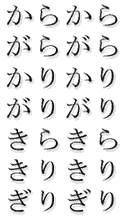
Fortunately, learning how to function conversationally is much more within the realm of possibility, and can be, well, if not exactly exhilarating, at least fun. One part of Japanese I particularly enjoy and am frustrated by at the same time is the abundance of onomatopoeic words, or ideophones, such as those I’ve reproduced in the image accompanying this post. In English we have onomatopoeic words like buzz and hiss, and it has been argued that some “sq” words like squat, squish, and squeeze have onomatopoeic origins.
In Japanese, however, where there are three types of onomatopoeia (gisei-go, language imitating the sound of nature; gitai-go, for words imitating states of the external world; and gijoo-go, for internal mental states and sensations), most of the words involve doubling up of the syllables, for example (from the image above) kara-kara, kira-kira, gara-gara, and giri-giri. (These latter two are words I particularly hear a lot of, and have grown to be among my favorites, although I can never keep their respecting meanings straight (gara-gara means “rattling sound” or “empty,” while giri-giri means “just in time”). I also like beta-beta, meaning “sticky,” a word used a lot in the ridiculously hot and humid Japanese summers).
So you can see how listening to native Japanese speaking pera-pera (fluent) Japanese can be entertaining. However, due to their hard to distinguish sounds and the sheer volume of them, learning them is a bit frustrating. Or put another way, Moshi watashi ga Nihon’go o kotsu-kotsu benkyou sureba, pera-pera ni naru ka, tabun ira-ira suru dake. (If I study Japanese diligently, I will be fluent, or maybe only frustrated). By the way, I need to credit my wife Naoko with this sentence. My Japanese ability is far too nascent to have produced this sentence on my own!
Although I don’t have them, there appear to be a few interesting dictionaries or books about these onomatopoeic words or ideophones, including the two-volume Dictionary of Iconic Expressions in Japanese by German publisher Walter de Gruyter; Flip, Slither and Bang : Japanese Sound and Action Words (part of Kodansha’s Power Japanese series, now out-of-print); and Nihongo Pera Pera!: A User’s Guide to Japanese Onomatopoeia from Charles E. Tuttle.
Online, you might take a look at Onomatopoetic Words in Japan, or J-Slang: Japanese Onomatopoeia. A bit off the beaten path, there’s a webring consisting of nothing but web domains that are made up of Japanese onomatopoeia!
UPDATE (July 28): I came across another book that might be of interest if you’re keen to delve further into Japanese onomatopoeia. While browsing at Sanseido in Jimbochou yesterday, I found Waku Waku Onomatopoeic Photo Book by Belgian Tom Felingden (not sure about the last name), who lives in Tokyo.
