Love at first write

Came across A Fish In Japan the other night and proceeded to spend time I simply don’t have reading the entire damn thing from start to finish. Can’t say that’s ever happened before, really. And for the last few days, at various spontaneous moments, I have found myself thinking about it, it’s writer, her story. That, I can tell you, has never ever happened before. (With an Rohmer film or a Woolf novel, sure. But a blog? No fucking way, as they say.)

The blog’s tagline said something about “the love of my life moved blindly to Japan” and I was intrigued, so I went to the beginning to find out how this came to pass. In the end, it’s still something of a mystery, how this woman — a Brit named Maria who has lived in Japan for 13 years, lives in Aichi-ken somewhere, owns a sailboat she named Jack Daniels, has false teeth, teaches English at the cushiest job in Japan (it seems), and who just a few short months ago was pining away about whether she would ever find Mr. Right — ends up falling in love with an Italian living in Namibia that she’s never met before and declaring that she and he will spend the rest of their life together. All I know is that around November 18th of last year he first (obliquely) pops up in the blog, and two months later he’s here in Japan to be with her. Phew! It does leave one a bit breathless, doesn’t it?

She has only had the blog going since October, but this woman is a posting fiend, with 5 or 6 entries, daily! As she writes,

It may seem like I am addicted to blogging. However, I feel the need to defend myself. As I am a fast typist, it doth not take me that long to throw down some words. Typing also keeps my mind off things. As I write this, I am trying to avoid looking at the woman who is sitting opposite me. She is devouring her lunchbox with the ferocity of somebody who has just returned from 40 days and 40 nights in the UK. This woman absolutely loves speaking with her mouth full of food. When her gob is empty, she is quiet. But as soon as she puts a boiled knob of broccoli in her mouth, she starts talking.

The writing is by turns poetic and prosaic, with healthy doses of self-deprecation. While the tone is light for the most part, these are not the frivilous musings of some JET-ster reveling in a Japan-is-so-weird haze or a honeymoon-is-over ex-pat complaining about how fucked up the country is. I found her entry on Shosei Koda, the shamefully all but forgotten young Japanese man taken hostage in Iraq last October and subsequently beheaded, particularly heartfelt:

Dearest Shosei-kun. I knew you. You were every 24 year old male student that I’ve met in my 13 years in Japan. I knew what kind of bike you rode to junior and senior high school. I knew where you went after school. I knew what colour cell phone you had. I knew that you dyed your hair. I knew that you ate onigiris.[…] I’m pretty hardened to the death that humans throw at each other.I think the world is populated by an ever-increasing bunch of idiots. But you, Shosei-kun, your death is making me cry. I can’t stop thinking about you. This morning at the train station, I burst into tears thinking about everything that you had lost. Very few people know what Japan is about. They laugh at the Japanese. They talk about the tours they take. About their affection for cameras. About their goofy teeth. They know nothing.

As of this writing, Maria’s dream lover — Francesco — has been in Japan a week (consequently, her blog output has dropped to a measly 2 entries per day) and there seems to be no sign of a letup in their mutual head-over-heels love for each other. (Even coffee enemas don’t seem to drive any wedge between them.) Though the cynic in me can’t help but wonder if at some point we’ll get the “it was all a hoax” post, the latent romantic has been utterly captivated by this only-in-Hollywood story. As she writes, “What a love story! How smooth is has all been. How perfect. How true. For it all to have finally happened is surely the stuff that is usually only created in movies.” I have no idea where they are going from here, to Namibia, to sail around the world, but this is one romance page-turner I won’t be putting down anytime soon.
Intelligent and entertaining writing about Sumo stable life

sumo101804_02_36_2S.jpg

With the first Sumo basho of the year just a few days away now, I crossed paths tonight with this wonderful ii timingu (good timing) find:

In the Hall of the Mountain Kings: One little man’s journey into the world of sumo wrestling

It’s by one Jacob Adelman, a grad student at UC Berkeley who has just spent a couple of weeks at Hanaregoma Beya in Tokyo’s Suginami Ward, not with the purpose of becoming a professional sumo wrestler but just to write about it for his Master’s thesis, and write about it he has done for the last 3 weeks in this blog. As Adelman explains it in his first post:

The idea for this project, like many things in my life, was born out of laziness. The two masters’ degree programs I’m in—journalism and Asian studies—each require me to write a thesis. When I started considering thesis topics, I tried to think of something that I could count for journalism and Asian studies, thereby saving myself the trouble of writing a second thesis. Everyone I ran the idea past was intrigued by it, though no one thought I might actually get a sumo “stable,” as the training houses are called, to let me in.

Through some tenuous connections Adelman is eventually allowed to temporarily join the Hanaregoma Beya. He is clear with his hosts as to what he’s up to (and even had he not, his uh, not exactly sumo-ish build would’ve let the cat out of the bag fairly quickly), and as he himself notes, it seems that many of the wrestler’s in the stable are eager to chat. And while Adelman originally had wanted to be treated as a rookie within the stable, in effect he was treated as a guest, and therefore had access to parts of the heya (and conversations with some of the rikishi) that most rookies will never have.

Adelman has used a blog to host his writings of the experience so as such, you’ll have to go to the December 2004 archive and scroll to the bottom to read the first post and then up from there if you want to read the story from beginning to end (seems he’s now left the heya but hasn’t written that post yet). I’ve made my way through about half of it and not only is it rather entertaining, but it gives good insight into the inner goings-on within a heya, the harsh conditions the rikishi (sumo wrestlers) live in (especially the lowest ranked among them), and the stratified atmosphere where the heya’s lone sekitori (salaried wrestler) verbally abuses the underlings as part of his de facto job description. (Adelman doesn’t mention him by name but this is Ishide, who won the Juryo yusho (championship) at the November basho in Fukuoka.) As Adelman writes,

I’ll bet that, once you get to know him, the Sekitori probably isn’t even such a bad guy. He probably spends so much time holed up alone in his room because he gets tired of being a creep. Being responsible for the torture and humiliation of a sprawling house full of overweight jocks is hard work. But it’s part of his job description and the prerogative of his rank.

If you have the slightest interest in the sport of sumo or in Japanese culture, I highly recommend reading some of Adelman’s posts. These aren’t your usual snippet blog posts either, each one is more or less an article unto itself. I look forward to reading the rest of it (particularly intriguing is some yakuza-ppoi character named “Iki” that drops into the heya from time to time) and seeing what conclusions Adelman has come to after his journey.

~ ~ ~

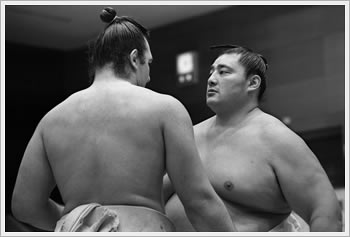
The above photo, just to be clear, does not depict any rikishi from Hanaregoma Beya but rather Kotonowaka (right), the elder sekitori of Sadogatake Beya (talking with his taller but rather young heya mate Kotooshu, from a jungyou (exhibition Sumo event) I attended last October. If you click on the above photo you’ll be taken to a gallery of photos I shot at this event that I recently uploaded.

The abridgement of America

Sako points to this stinging op-ed piece on the incarcerations at Guantanamo Bay by the Washington Post’s Richard Cohen (the WP unfortunately requires registration but it’s worth it to read this for yourself).

A tiny excerpt:

The revelations coming out of Guantanamo are hideous. The ordinary abuse of prisoners, the madness instilled by gruesome incarcerations, the incessant lying of the authorities, plus the mock interrogations staged for the media, in which detainees and their interrogators share milkshakes — all this soils us as a nation. It’s as if the government is ahistorical, unaware of how communists and fascists also strained language and ushered the world into torture chambers made pretty for the occasion. We now keep some pretty bad company.

The whole thing is damning, especially the parallels drawn to other totalitarian systems of the past the US has always so smugly and self-righteously denounced. Reminded me of another powerful piece of writing I re-read last week by the late Susan Sontag, who wrote (and not surprisingly, was subsequently villified for doing so) in the wake of 9/11:

The unanimously applauded, self-congratulatory bromides of a Soviet Party Congress seemed contemptible. The unanimity of the sanctimonious, reality-concealing rhetoric spouted by American officials and media commentators in recent days seems, well, unworthy of a mature democracy.

It’s hard to say exactly being so far away and cut off from the US body politic as I am (and more or less cut off from much of it’s mainstream media, though I think this is generally a blessing), but it seems to me that there isn’t a hue and cry about Gitmo commensurate with this clear-as-day travesty of justice and human rights that the Bush administration is perpetrating. Am I wrong about this? Do people not see the self-evident nonsense of a policy that insists that 9/11 was an “act of war” and so consequently the US is fighting a “war on terrorism,” yet the prisoners at Gitmo are NOT “prisoners of war” but rather “enemy combatants” (and therefore not subject to the Geneva conventions regarding torture and inhumane treatment)?

And this week, fresh on the heels of allegations of prisoner (er, “detainee”) abuse at Gitmo, are stories about long-term considerations with respect to what to do with these folks, most egregious among them the idea that these detainees will be held for life. Since I don’t comment much anymore on politics and such around here, let me make the most of the opportunity and tell my fellow American citizens who might still be on the fence on this one, GET YOUR HEADS OUT OF YOUR FUCKING ASSES and wake up and smell the real shithole Bush, Rove, and Gonzales, Inc. is making out of our country. They are re-writing, literally, the laws of the land to suit their totalitarian interests, and with them, re-writing everything good and decent about America. Soon those hallowed Amendments will be worth less than the proverbial paper they were written on: perfect fodder for the much needed toilet paper. It will not be the only pulp laying around though.

As Cohen writes in his piece, Orwell and Kafka are looking on. And if 50-plus years from now “Owellian” is replaced with “Bushian,” and “Newspeak” has become “Bushspeak,” it will be regrettable. But the tragedy will be when the dictionaries of the future asterisk the meanings as we now know them of words like “awe,” “coward,” and “rendition,” with ARCHAIC. Merriam Webster: The abridged Big Brother version. As George Orwell himself wrote, “But if thought corrupts language, language can also corrupt thought.”