The private space of fast food restaurants

There’s a veritable plethora (or cornucopia, if you prefer) of Japanese photography sites out there, that it’s impossible for me to keep track of them all (the same might be said for the list of Japan-based blogs to the right, but I digress). I don’t have the time, nor always the interest, to be frank, to wade through them. But for the most part, I do find them interesting, or perhaps intriguing might be the better word (which is of course not to say that I find the photography always inspiring, because oftentimes I don’t). I find that a lot of sites have a theme or essay-based schema to them that is unique, and sometimes downright strange. We’re not talking your basic portraits / landscape / still life / etc. categorization here, that’s for sure.

Take for example this site I found today, ssfugnt.com, the digital photography home of one Takehiro Ujiie. He has several photo essays linked up on that page (actually, “mini photo blogs” might be a more apt description). One I was particularly fascinated by, both for the concept as well as the actual photographs, as there are some really nice gems contained within, is an essay entitled “First Food Scene” (the site uses frames, so go to the above link and click on the title). This is a series of photographs Ujiie took over a 3 month period, documenting his visits to various fast food restaurants in Tokyo (and one, interestingly enough, in South Korea), grouped by the day of the visit. (I don’t know if Ujiie’s title for the series is some kind of word play, or if he is mistaking “first food” for “fast food”.) Each day has between around 8-10 shots, featuring the particular establishment Ujiie has visited that day, most taken in a “shoot from the hip” style with the store’s staff and customers seemingly unaware.

From looking at the various days, McDonald’s and Lotteria seem to be Ujiie’s fast food restaurants of choice, although more endemic restaurants like Yoshinoya or train station tachigui (place where one eats while standing) do make appearances. Anyone who has lived in or visited a large Japanese city is familiar with the image of the Japanese worker/commuter, generally male though not exclusively so, hunched over his ramen or udon in a tachigui, more often than not alone with their meal and thoughts. What’s particularly striking about Ujiie’s photos taken in these types of places, although it does permeate all the photos to some extent, is how well this solitariness of the experience of eating out for the customers has been captured.

Not unlike photos taken of passengers on commuter trains à la Walker Evans’ subway photos, there’s something fascinating for me in the way that the photos probe, intentionally or not, the intersection between public and private space that is fundamental to the dining out experience. How people comport themselves in public spaces, on the one hand maintaining a certain public “face” or guard while at the same time trying to carve out a private space which can afford them some small measure of privacy, interests me.

ADDENDUM: Ujiie has another series on his page that is worth checking out, called “Unknown Person,” which comprises a series of shots (again, grouped by day) taken as he follows some presumably unknown (and it should be pointed out, presumably unwitting) person through the streets of Tokyo (with one day’s worth shot in a South Korean city). It’s doubtful the subjects, who are mainly seen from the back, are aware that they’re being, in effect, stalked. With the exception of three days, the subjects are all men, and I think it’s interesting how my feelings of mystery and suspense when viewing the photographs of the men, turned into something not unlike dread when I looked on as women were being followed. (It made me think of Yoko Ono’s film Rape, about a woman happened upon by a film crew, who then follow her relentlessly.) I don’t know what Ujiie has intended with this series, but clearly I, as the viewer, have a different set of assumptions of how these narratives might play out depending on the gender of the subject, and being forced to acknowledge this made the series all the more compelling for me.
The vernacular of old family photos

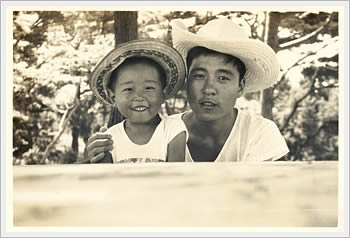
Randomentality recently posted a wonderful page of photos entitled “Where I Began”. These are not photos taken with his usual wonderful and eclectic eye, but rather old family portraits and snapshots. I haven’t yet put my finger on why this type of vernacular photography appeals to me, but it does so immensely. I suppose part of it is that after a certain age and acquisition of a certain education, I can only approach photography and documentation from a point of view that is antithetical. That is to say, I think before I shoot. Which is not to say there is anything wrong with that, or that I feel my work is somehow tainted because of this. It’s simply my point of view which can never be the same as the point of view that took these old portraits, or the photo above. But then again, I think it naive to presuppose that whoever took these old family photos was an innocent bystander. And that camera in the middle of the subject and shutter-presser? As guilty and culpable as sin.

The above photo is of my father-in-law (on the right), taken when he was around 16, which would place the photo from 1960 or so. He’s with one of his nephews, and they’re in Yamagata prefecture. I like this photo because, rather than timeless, it feels to me place-less. With those hats, they could be characters in a Cormac McCarthy or Larry McMurtry novel, growing up somewhere in a small Texas town like Anson or Iowa Park, towns my father grew up in.

The Noble Flower blooms no more — a grand champion retires

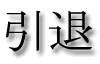
Japanese kanji for intai, meaning to retire

If you live in Japan, then it is doubtful that you haven’t heard by now that the most popular Sumo wrestler in Japan, Yokozuna Takanohana, retired yesterday, in the midst of the current New Year Grand Sumo Tournament being staged in Tokyo, in which he had struggled with a less-than-100% healthy knee and injured shoulder to a 4-3 record. With his retirement, the 30-year old Takanohana tacitly acknowledged that he could no longer live up to the honor of being a yokozuna, sumo’s top ranking.

Takanohana’s news conference announcing his retirement was broadcast live on all 5 networks this afternoon, and was the lead story on tonight’s news programs. Though I’m a little late to this party, it was hard not to get caught up in the nation-stops-what-it’s-doing nature of the event, in the emotional reporting on the champion’s attempts to battle back from a crippling knee injury in 2001, and in the grandeur of Takanohana’s career that saw him turn professional at the age of 15, progress through a series of “youngest ever” victories, claim 22 Emperor’s Cup wins in the course of his career (4th best in history), and overall win 794 bouts to just 262 losses.

For me Japan’s national sport of sumo still resides on the other side of a cultural fence, full of mysterious (and occassionally maddening) pre- and post-bout rituals, extremely long and drawn out (though not interminably but rather fascinatingly so) psychological match-before-the-match sizing up and psyching out sessions, and a complicated melange of stables houses (called heya), stable masters, divisions, ranks, OB’s (old boys, former wrestlers), and wrestlers with flowerly, poetic and difficult to remember fighting names (called shikona).

But perhaps just as slowly as the bashos (tournaments) take place, I’ve been finding myself inexorably drawn to this inpenetrable sport. In fact, I think it’s its very inpenetrableness that has piqued my interest. Like so much of Japanese culture for me, I am still in the superficial stages of education and enthrallment with sumo, but with a sport as old as this, and so firmly rooted in Japanese Shinto traditions, I don’t feel there’s any need to hurry. That said, I cannot help but feel a little sad that my enthusiasm is flowering at this time of torch passing (but to whom?) and uncertainty over the sport’s future. And too late to witness or fully understand the impact of Takanohana’s career, nor that of his brother, Yokozuna Wakanohana — who together ushered in the “Waka-Taka” boom that looked for a while like it might revive the sport’s sagging image and ticket sales — nor of The Hawaiians, as the trio of American wrestlers from Hawaii (Konishiki, Akebono, and Musashimaru) are refered to, for that matter.

I think it’s fairly obvious to observers here that no small part of the attention to and sadness at the retirement of Takanohana has to do with the fact that he’s probably the last Japanese yokozuna we’re likely to see for awhile, in a sport that has already lost much of its grip on the sports consciousness of Japan to first baseball and now football (soccer). The other current yokozuna, Musashimaru, is of course from Hawaii, and in any event he too has been plagued with injuries (he is sitting out the current tournament) and may not be long for the dohyo (sumo ring) either. Where the 1,500-year old sport goes from here is anyone’s guess, but it seems certain that already tough times will get tougher.

Poised to be next promoted to the rank of yokozuna is Mongolian Asashoryu, who was promoted to his current ozeki rank last September and who won his first grand tournament last November in Fukuoka. Ironically, after starting off the current basho strong with 8 straight victories, he stumbled today and suffered his first lost. Perhaps the pressure of what is there for the taking should he choose to grab it got to him. I don’t know enough at this point to write about what Japanese wrestlers may be out there to pick up where Takanohana left off, though chances are good he’s not anywhere on the radar screen yet. One wrestler who has however caught my attention and that of a growing number of fans, is maegashira Takamisakari, who psychs himself up for each bout by slapping himself violently. Takamisakari is part of the Azumazeki stable which is run by Takamiyama, the first American (as Jesse Kuhaulua of Hawaii) to be a professional sumo wrestler in Japan (debuting in 1964), and later the driving force behind the careers of Konishiki and Akebono. Takamisakari may never progress toward the vaunted yokozuna (although he is doing quite well for himself in the current tourney, for the moment being 7-2), but his unorthordox style and shy, almost geek-ish outside-the-ring personality, might help to recapture some of the under 30’s crowd the sport needs if it is to survive.

Amid the rapid-fire flashbulbs at today’s news conference, seemingly lying in wait ready to pounce with even more voraciousness at the first sign of a tear from Takanohana’s eyes that never did come (in the part I saw), the retiring yokozuna bowed out as rikishi (wrestler) saying simply “I have reached the limit of my physical strength and I want to retire.” Perhaps now he will follow in the footsteps of his father, an ozeki in his day, become a coach and maybe even the eventual stable master himself. And like he did with his father, taking his father’s shikona Takanohana for himself, perhaps one day another Noble Flower from the Hanada Dynasty will bloom again.