Teigin Incident: How a painter was convicted for mass murder

Self-portrait by Sadamichi Hirasawa on the occasion of his 88th birthday
米寿 (beiju, 88 years old), a self-portrait by Sadamichi Hirasawa on the occasion of his 88th birthday

From Bloomberg comes this fascinating account of a well-known Japanese tempera painter, Sadamichi Hirasawa, who was convicted of mass murder during the American Occupation following World War II. It was called the Teigin Incident. As this short New York Times story on the occasion of Hirasawa’s death in 1987 recounts,

In the robbery, a man posing as a Government health worker entered a Teikoku Bank branch and told 16 employees that post-World War II occupation forces had ordered them to drink medicine because of an outbreak of dysentery. The workers obeyed, and, as they collapsed, the robber scooped up the equivalent of $600 and fled.

Twelve bank employees died. The drink was found to contain cyanide.

At the time, Hirasawa confessed but later claimed this was forced under torture. (As an aside, Japan has long had a problem with forced confessions.) At any rate, through various appeals and loopholes and indecision, he was never hanged for the crime and ended up spending 39 years in prison, 32 of them on death row. The NY Times article quoted above notes that at that time (1987) he had been on death row “longer than any other prisoner in the world.”

While the case is sensational no matter how you look at it, what caught my eye in the Bloomberg piece was the suspicion that someone from the infamous Unit 731 of the old Imperial Japanese Army might have been involved in the incident (called Teigin as the bank where it occurred was a branch of the Teikoku Ginko (Imperial Bank). This was written about in a book by William Triplett called Flowering of the Bamboo as well as in Mark Schreiber’s Shocking Crimes of Postwar Japan.

According to this page (via Google Book Search) of Schreiber’s book, a “novel” by famed crime mystery writer Seicho Matsumoto that appeared in 1959 alleged that “a former member of the Imperial Japanese Army’s Unit 731 […] had been involved in the killings, but GHQ [the American occupying authorities] had given him a blanket amnesty in exchange for data on the experiments”.

Sadamichi Hirasawa being arrested in his hometown of Otaru (Hokkaido)
Sadamichi Hirasawa being arrested in his hometown of Otaru (Hokkaido), 1948

There is a rather large Japanese site that deals with the incident, from which the two images used in this post come from. (I believe this is the “Society to Save Hirasawa” website but I’m not sure). Even if you can’t read the site, the photos of Hirasawa, the crime scene, and the evidence introduced that are in the photo gallery are fascinating to cycle through (click on the first link in the left column, and then the “next” arrow after that). The site also features a small selection of Hirasawa’s paintings, the majority of which, according to the Bloomberg article, have been lost. There are more Hirasawa works pictured throughout the site but they are not organized in any way. Your best bet is to browse via this Goo image search. (More Hirasawa work can also be seen here.)

60 of those works are now traveling in Japan as part of an exhibition organized by Hirasawa’s adopted son, Takehiko, which is what occasioned the Bloomberg piece. Takehiko is the biological son of one of Hirasawa’s most ardent defenders, writer Tetsuro Morikawa, who arranged for Hirasawa to adopt his son partly in an effort to help with the appeals process (according to Schreiber) . Morikawa was the founder of the Society to Save Hirasawa, and he was well-known for his books on Japanese history (tantalizingly, one of his books deals in part with the Yakuza presence in Manchuria). It is yet another twist in a fascinating and tragic episode in post-war Japanese history.

According to the Bloomberg piece, the exhibition will take place in Otaru from October 3 – 8 (unfortunately, I couldn’t find a link), and there will also be a documentary about Hirasawa on Japan network TBS on September 30th.
Sponsored by Nike and Nikon, where the power lies

The 11th IAAF World Championships in Athletics (or Track and Field as I would call it) are going on in Osaka this week, and because the games are being staged somewhat unusually in the morning and evening — to avoid the summer heat — I’ve been able to follow them both before and after work. How convenient! It’s about the only bright spot to a season that is otherwise unremittingly oppressive.

I’ve long been a casual fan of track and field, probably due to my father’s influence. We often would watch not only the Olympics together but also many other track events on ABC’s Wide World of Sports when I was a kid. Track and Field was one of his “beats” as a sports writer for the Honolulu Star-Bulletin so I used to accompany him to the high school track and field championships. I can still remember his familiar refrains about the sport, like “No one will ever beat Beamon‘s record” (in the long jump — it was eventually broken, in 1991 by Mike Powell).

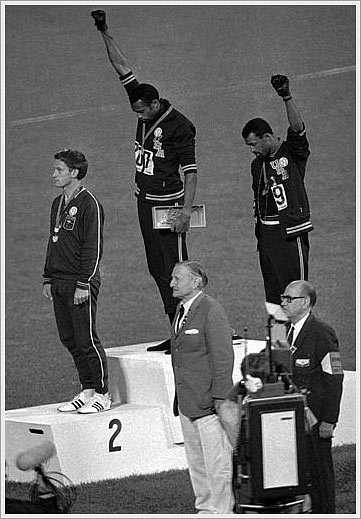
Tommie Smith and John Carlos give the Black Power salute

In addition to Beamon, who set his record at the 1968 Mexico Olympics, I can remember him educating me about another 1968 winner, 200-meter sprinter Tommie Smith. My father would always extol Smith’s world-record breaking performance in that Olympic’s 200-meter event, but he would also explain about what came after, Smith’s and bronze-medal winner John Carlos’ black-gloved salute, on the podium. I don’t think it would be hyperbole to say my father admired both deeds. Of course many people, when it happened in 1968, didn’t view it the same way, certainly not the International Olympic Committee itself, which stripped Smith and Carlos of their medals and banned the athletes from the Olympics for life. A spokesman for the IOC said that the act was “a deliberate and violent breach of the fundamental principles of the Olympic spirit.”

Tyson Gay after winning the 200-meter event in Osaka, 2007

The other night, American Tyson Gay won the men’s 200-meter event at these Osaka championships. Like every other winner in every other event from every other country, he went over to the stands where someone, probably his coach, tossed him his country’s flag and he paraded around the track with his red, white, and blue cape. I suppose this has gone on for years but I hadn’t realized until now that it had become de rigeur. The uniformity of the gesture tends to even out the patriotism field a little, which I suppose is a good thing, but it also makes the gesture essentially empty, ritualized behavior. It seems to me that many of these flags are being produced from shrink-wrapped packages at the bottom of the coach’s bag. Perhaps by Beijing 2008, the athletes will be tucking them into their jockstraps and sports bras to save time. Perhaps by London 2012, those flags will be sponsored by Nike and Nikon.

The black fist is a meaningless symbol. When you open it, you have nothing but fingers — weak, empty fingers. The only time the black fist has significance is when there’s money inside. There’s where the power lies.
Jesse Owens

In Owens’ day, his skin color precluded him from cashing in on his achievements. For Smith and Carlos, their bold gesture precluded them from even taking their “silverware” home, to say nothing of cashing in. For today’s generation of Black athletes like Gay and Allyson Felix, you can’t help but get the feeling that they’ve got their hands on Owens’ fistful of dollars, but that The Power still lies elsewhere.

Creep: by any other name

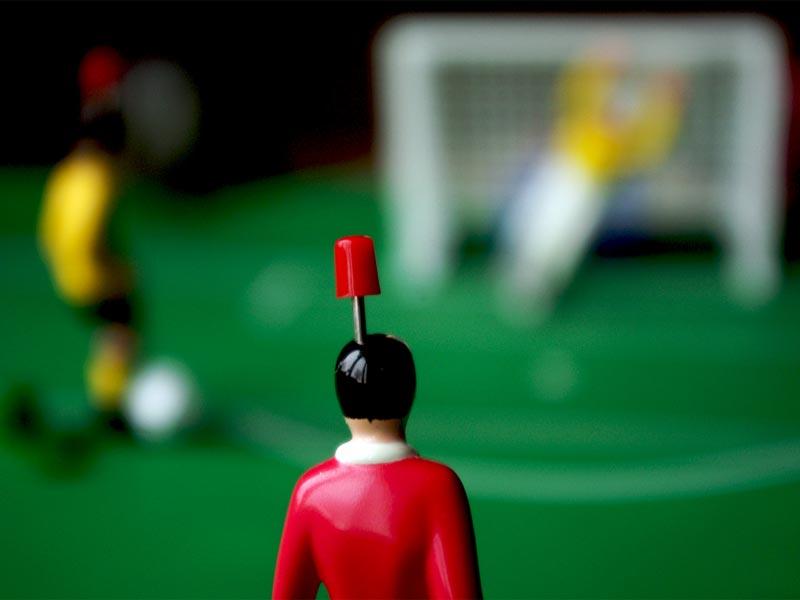
Table Soccer Game, by user JR3 of www.sxc.hu

(Above photo by JR3, and used according to the terms of SXC.hu.)

The usually decent SoccerBlog.com has a slightly misguided post about how the language of soccer — here comes the obligatory “ahem, football to most of you” acknowledgment — is suffering from “insidious word creep” because there has been an upsurge in in-the-throes-of-Beckham Americans taking to talking about “assists” (in the sense of the person whose kick or touch sets up or directly leads to the resulting goal), a term, and indeed a concept, that has heretofore not been part of the game in any codified sense.

Never mind that SoccerBlog messes up on the proper etymology of the term “soccer” in his first paragraph (the short story being that it wasn’t Americans who coined the blasted term, but Brits themselves), but really, is the growing use of the word “assist” that insidious (defined by the Cambridge Dictionary of American English as “gradually and secretly causing harm”). Although I myself haven’t heard this term used, probably because I don’t watch any American soccer or have much of a chance to hear American broadcasters (local cable outfit JSports has started showing a few of the Beckham L.A. Galaxy games on delay, but I haven’t watched them), I have no problem with it nor can I imagine why anyone would, unless they were worried about American “creep” on the global game. (Curiously, I do hear the word “assist” being used by Japanese soccer sportscasters — アシスト(ashisuto) — in the exact context that we’re talking about here.)

I suppose the same people who prescriptively declare that a “math teacher” should be a “maths teacher,” or can’t get over how aubergine begot the eggplant in American usage (“Where the fuck is the egg?” as someone not so delicately once asked me) would be crying in their Imperial teacups should “pitch” become “field,” “fixture” become “game,” “touch line” the “out of bounds” line, and so on. And I probably would too. But it seems to me that if “assist” is actually trying to make a push for inclusion, and I think the jury is still out of that one (I certainly have not heard any Sky Sports broadcaster using the word), it isn’t trying to supplant anything, merely supplement and add to the discussion. But that isn’t what “word creep” implies.

Truth be told, the post’s author Shourin Roy has it more in for the “creep” of the “assist” statistic itself then the word, but on this score too I have to wonder what the fuss is about. Isn’t it meaningful — insofar as any stat is actually meaningful — to know that x player contributed more to his team by way of assists than actual scoring. Wouldn’t some people find that stat useful — again, if we assume that stats in general are actually useful?

Watching Nakamura for Celtic last year, as great as his free kicks were, it seemed that he also contributed directly to the scoring of goals by other means, such as corner kicks, yet that these were usually quickly forgotten as soon as the first slow-motion replay of the goal was shown. I’m sure I wouldn’t even be able to look up how many “assists” he had to make a comparison between these and the goals he ended up scoring. Oops, not so fast. It seems that, according to Nakamura’s Wikipedia entry, someone has been keeping track and according to that entry (no source given, sadly), Nakamura had 12 assists in Scottish Premier League play last season, as opposed to 9 goals. Naturally one would expect his free kicks against Man U (two of them! — here and here) and his Championship-winning one against Kilmarnock to remain in Celtic fans’ hearts for a long time, but could not a case be argued that his 12 “assists” contributed just as much. (And speaking of argued cases, could we not argue that in that season-winning Kilmarnock game, it was Nakamura who assisted himself in that it was he who drew the foul that led to the free kick?)

To be fair, Roy does ask this question when he writes that “it does make a difference as to who set up the goal and why their contributions shouldn’t be recognized more fully.” But that’s all he seems willing to concede, and ultimately he thinks “assist” is no more than jargon and something that keeps journalists lazy (easier to write “an assist from Beckham” than “Beckham guided a lovely pass to Donovan”). I doubt the impetus for this new stat is coming from lazy journalists, though.

The charge that Americans over-emphasize the statistic (especially individual ones) is probably fair, especially when it comes to America’s pastime sport of baseball in this day and age of “Moneyball” and “Sabermetrics.” There are all sorts of arcane measurements which make an old fogey like me who is content with RBI’s, batting average, ERA, etc. scratch his head. In addition to General Managers though, I’d say a lot of these new stats are driven by rotisserie baseball.

Baseball does use the “assist” statistic, but in a relatively minor way as a defensive stat. The main usage of assist comes I think from basketball, where it has been recorded as a statistic in the NBA since at least 1946 (interestingly enough, it predates the rebound stat by a few years, something I usually would pay more attention to).

Perhaps we should ask two-time NBA Most Valuable Player Steve Nash of the Phoenix Suns, who averages 7.6 assists per game and is ranked (currently) 28th all-time for career assists, for his opinion on the assist statistic for soccer. Not only does Nash know his assists from his shots, he may well be a soccer player trapped in an NBA uniform. At any rate, it would seem insane to strip basketball statistics down to goals and free throws made, though it is ultimately only those that matter in terms of winning or losing.

If Major League Soccer ever got to the point where it could support rotisserie leagues, with fantasy owners punching up Excel spreadsheets detailing assist stats on their laptops on “draft day,” then I’d say Beckham did his job and the popularization of the sport in America was complete. Sadly I don’t see that happening for a long time, if ever. However, if assists are recorded as diligently as “Posh and Becks” every move in America has been so far, then I hardly think that is a bad thing for the sport, in America, or globally.

You’ll rarely ever catch me arguing for more American influence in matters global, but at the same time, just because the culture does tend to act like the biggest kid in even the tiniest of sandboxes shouldn’t preclude it from participating and perhaps even, ahem, assisting the global game a little bit. I can see why some would view that as creep or just plain creepy, but I would probably give them a yellow card for overreacting.

Now, how about for some real influence. Let’s see, the game needs to institute a system of keeping time that isn’t from the 19th century, and instant replay wouldn’t be a bad idea, and yellow cards for writhing in pain from a love tap….