The slow, slow climb towards Japanese proficiency

I haven’t commented much on the Japanese Language Proficiency Test (or Nihongo nouryouku shiken) I took last December, which is ironic, considering that my preparation for it caused me to temporarily put this site on hiatus last Fall. And truth be told, although it was only a scant two months ago that I was one of over 100,000 Japanese learners worldwide that took the test across its 4 levels, it already seems like a distant memory.

But the distant memory popped its head up today, when I received (finally!) via the post notification from the AIEJ (Association of International Education, Japan) about how I did. In short, I PASSED! (Sorry for screaming). Now, mind you, I only took the Level 3 test, which depending on how you look at it is either third level down from the top, or second level up for the bottom (there are only 4 levels in all). So no great shakes. But it’s a start, and considering that in actuality the test was quite a bit above the Japanese proficiency level I was at when I applied to take it 3 months prior, I’m proud of how I did.

I also passed by a respectable margin, which makes me happy. For Level 3, one need only get 60% or higher to pass, and I felt that just squeaking by with a low-60’s percentage would be a bit disappointing, so I was pleased to score 81% overall. As I expected, the Listening section was my poorest section, although even there I managed to pass. (Not surprisingly, I did best in the Kanji and Vocabulary section — 90%).

As with most tests of this type, how well one can speak Japanese in real-life situations is not tested, so I’m not kidding myself that I’m in any way, shape, or form proficient in this all-important regard. But I do feel that putting in the work I needed to in order to get to this level has given me a great foundation from which to build myself up conversationally, and for this reason I would recommend the test to any Japanese learner, even at Levels 3 and 4.

Where to from here? Well, Level 2 looms large and intimidatingly on the horizon, though I’m beginning to accept the fact that it’s highly unlikely I’ll be ready for this year’s test in 10 short months time (it’s quite a jump from 3 to 2 — for example, one needs to know roughly 1,000 kanji characters for Level 2, as opposed to only 300 or so for Level 3). 10 years time is probably a more reasonable expectation. Either way, I will get there however, someday.

ADDENDUM: Here are some useful links for anyone interested in taking the test in the future:

Association of International Education, Japan JLPT page
Japan Foundation site for the JLPT
The JapanesePage.com’s “About the JLPT” page
Ed Jacob’s Japanese Language Proficiency Test First and Second Grade Study Guide
Joe’s JLPT Page
Meguro Language Center’s JLPT free downloadables page
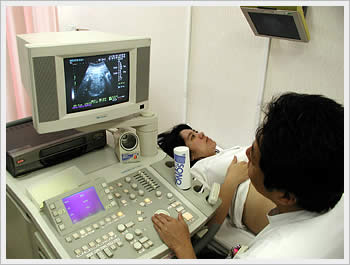

Anticipation continues to build…

Naoko had her usual bi-weekly check-up today, and I brought the video camera along as well as the digital still, and took some shots. Each time Naoko goes in, the doctor performs an abdominal ultrasound, and so by this point she’s had many of these performed on her. (In the first and second trimesters, she visited the doctor once a month; now in the third trimester, she visits bi-weekly). Each time she goes, the doctor records the ultrasound onto a videotape compilation (he actually appends each new ultrasound record to the end of one existing tape), so we now have what is in effect a 30-minute plus abstract film documenting the prenatal growth of our child. It’s fascinating and mysterious to watch.

Naoko’s pregnancy has to date been my only experience with the Japan National Healthcare system (not including a trip to the dentist which I must say did not leave me impressed), and so far I have been more or less impressed, and feeling reasonably comfortable about Naoko giving birth under such a system (obviously I’m in a good position to be comfortable, not being the one pregnant). And certainly one can’t complain about the price. Take these ultrasounds, for example. I don’t have direct knowledge, but from some web reading and information from one of Naoko’s friends who lives in the States, these ultrasound procedures can run anywhere between $200 to $300 per scan, and generally are performed only two or three times during a pregnancy. On average, Naoko pays ¥3,800 (around $31USD) for each visit, which automatically includes the scan (and the scan photos and video recording). (To be fair, obviously those with health insurance in the States would have some of that $200 to $300 reimbursed, so I’m not making the best comparison here).

In addition to detecting birth defects or abnormalities, these scans are primarily used by expectant families to determine the baby’s gender. Naoko and I have made the decision that we don’t want to know until the baby is born, but of course the doctor has known now for some time, and I always think he’s going to accidentally spit it out on one of these visits. It’s interesting, most folks I mention this too express surprise at us not wanting to know. I don’t know exactly why, but for some reason I always imagined (in those brief moments when I allowed myself the fantasy that I might one day have children) that not knowing was somehow how it “should be”, that somehow that was the natural order of things and that I wasn’t going to let modern technology disrupt that way of thinking. At any rate, I haven’t heard any compelling arguments for why it would be better to know. Naoko and I are not the type of people who believe in pink-for-girls, blue-for-boys anyway, so arguments about it being easier to buy clothes, for example, don’t cut much mustard with me. I think however that we’re in the minority on this. A “Do you want to know your baby’s sex?” poll on BabyCenter.com shows that out of 149, 469 responses so far, a whopping 71% want to know, compared to only 21% who don’t want to know (8% undecided).

Of course, one perhaps good reason to know is to stop all the mind-racing and dreaming and fantasizing that my mind has been going through all these months. It’s interesting how, despite all efforts to the contrary, my mind gets invariably locked in to certain preconceived notions (pardon the pun) about the baby’s sex. For the longest time, whenever I thought of the child-to-be, I envisioned a girl, probably because I want a girl more than a boy (Naoko has the opposite hope, by the way). So try as I might not to, when I thought about the child, had hopes for it, worries about supporting it and about a million other things, wondered how i would talk to it, and play with it, I did so with near-conviction that a girl would be coming out of the womb. But a couple of weeks ago, during one of Naoko’s hospital visits, the doctor told us that the baby is bigger than normal, perhaps around a week bigger (in other words, it’s size now at the 32nd week is what it should be at the 33rd week). Not abnormally so, but bigger than average. Not terribly surprising, given both Naoko and I’s body types (let’s be honest, “slim” and “slender” are not going to be the first words that pop into your head should you meet either of us). But now, with this mention about size from the doctor, my mind has done a complete 180° reversal, and I’m now dead sure in my mind that Naoko will be giving birth to a boy (and perhaps the next Takanohana at that!). Of course being slightly bigger than normal is not a trait exclusive to the male species, but damned if I can’t now shake my newfound conviction that in less than two months time, Naoko and I will be smiling upon a newborn boy. In any event, we’ve made our bed and we’re going to sleep in it, and are not about to ask the doctor at this stage. So stay tuned, as they say…. Click on the link below for a few more photos from today’s visit.
Continue reading “Anticipation continues to build…”

This is what I had for lunch…

kanji for 'chuushoku hourouki'

Here’s a concept that appeals to me: a daily or near-daily rundown of what one had for lunch, with a picture of the food, and a review of the joint with useful information like cost and location. You can find such a site at Chuushoku hourouki (“Diary of lunch wanderings,” loosely). Of course, it may not appeal to you if you don’t live in the Tokyo area or read Japanese (I only qualify on one count, but there’s always Excite’s barely adequate translation service).

The author, who goes by the nickname of “Taicho” or “commanding officer,” so named according to him because people think his face and aura are that of Japanese Self-Defense Forces member, makes a point of visiting a different establishment every day, and as of January 2003, had compiled an amazing 670 reviews of different lunch places in Tokyo (he started his site in 1999). Taicho also has a handy index of all the lunch places he’s reviewed up through 2001 (over 500), grouped by Tokyo subway line, with links to his review of each place.

It’s not clear what Taicho does for a living (though I think it’s safe to assume he’s a “salaryman” of some sort), but his job requires him to visit clients in various parts of central Tokyo, and therefore affords him the opportunity to visit so many different places. Occassionally there are gaps in days, for as Taicho explains, sometimes his co-workers are with him, and as his site is a secret he keeps from them, he isn’t able to take photos on such days. And sometimes he doesn’t write when he’s drunk, he explains.

Taicho isn’t interested in ranking the places he visits, and to him, they’re all good in their own way, so Zagat’s he’s not. His aim is to simply “convey to my readers the joy I experience when I come across delicious food.” If he’s ever negative, it’s usually couched in the form of a suggestion. Here’s a representative sample of his reviewing style, taken at random (admittedly loosely translated):

….By the way, the dish I had was a good idea [trying to make an autumn Korean dish with winter season food], but the impact of the taste was a little insufficient. If they add salmon to the dish, I think it would be more delicious, perhaps.

As I said, all of his reviews are accompanied by photos of the dish he ate. Taicho explains that he doesn’t ask for permission from the shop owners to take his pictures, and he admits he’s somewhat of a shoushinmono (coward) when it comes to taking them (one can imagine the looks he gets when he whips out his camera and snaps a shot of his lunch, not exactly standard salaryman behavior). He says anyone is free to use his photos, without permission — it would make him happy. As much as I enjoy his site, I can’t say I’ll be using the photos, as they do leave something to be desired, and well, make the food a little unpalatable. But Taicho can be forgiven. As I well know, it’s very difficult to take photos of food in a way that makes one want to eat what’s depicted. I’ve always been very disappointed when shooting food. (For some wonderful pictures of food, see HeidiSwanson.com. Adjectives like delectable, scrumptious, and mouthwatering come to mind.)

I’ve often thought of doing something like what Taicho has done, but with the kaiten-sushi places I go to (admittedly, it would be a fairly sporadic blog), but I can’t really write about food other than to say “it was good” or “it wasn’t good”, unlike others out there. (And of course, I don’t really need to, as others have long beaten me to it).