The push pull of the circle

'kurumaza' kanji

In Japanese, sitting in a circle is called kurumaza, literally, “wheel seating.” A kurumaza formation can put others off, since all they see of the people forming the circle is their backs, which seems to be saying, “The rest of you are outsiders.” To be sure, when the kurumaza is formed on the ground outdoors, a stranger standing on the outside of the circle can also see the faces of those on the far side. But the attention of those faces is riveted on the others in the circle. The stranger can be standing as little as a meter away from the ring, and still the group will pay virtually no attention. This obliviousness to others can easily be observed, for example, in the tightly packed groups of revelers that fill Ueno Park in Tokyo for flower-viewing parties under the trees during the cherry blossom season.

The above was taken from Sitting in a Circle: Thoughts on the Japanese Group Mentality, a lecture given a few years ago by Japanese poet and critic Makoto Ooka, at the Donald Keene Center of Japanese Culture at Columbia University (as part of the Soshitsu Sen Distinguished Lectures on Japanese Culture).

Ooka uses the Japanese word kurumaza (sitting in a circle) as the basis for a fascinating look at the oft-discussed “group” culture of Japan, seen not only in its systems (political, corporate) nor its cultural manifestations (karaoke, hanami), but also in its language and poetry. Ooka is most concerned with, to quote him, “how the traditional kurumaza society and the desire for solitude interact within the spirit of the poet….”

I was particularly struck by this paragraph of “poetic” etymology:

At one time I became aware of and took an interest in the major role the words au (to meet, to come together, to be in accord, to fit) and its derivative awasu (to bring together, to bring into accord) play in the Japanese language. What brought my attention to this was an observation that the Japanese language scholar Ono Susumu made during a round-table discussion in which we both took part. Ono pointed out that osafu, an old form of the verb osaeru (to restrain, to hold down), was formed as a compound of the verbs osu (to push) and afu, and earlier form of au. He gives a more precise explanation of the word in his laborious work Iwanami kogo jiten (Iwanami Dictionary of Classical Japanese): “To continue pushing, adjusting one’s force to that of the other party so as not to move the other party.” In other words, this single word—which is still in everyday use—has woven into it the awareness of a relationship in which the performer of the action senses the other person’s force and increases or decreases the amount of force applied so as to match it.

But read the whole thing. Rest assured, those tired old proverbial nails, you know the kind that stick up only to get hammered down, which are de rigueur in most articles about Japan and its group culture, aren’t mentioned.

The self of Shigeo Gocho

Shigeo Gocho self-portrait, 1976-77

On view for three more weeks or so at the Mitaka City Gallery of Art in west Tokyo is a retrospective of the work of Shigeo Gocho, a Tokyo-based photographer who died at the young age of 36 (1946 – 83). Born in Niigata, from the age of four Gocho suffered from caries of his thoracic vertebrae, and he would be a frail person throughout his life. The exhibit is in two parts, in two different locations, one showing his black and white work, which is comprised predominantly of his portraits and photos of children, the other showing his color work from near the end of his life, as well as some ink blots he did at that time. (A 55-minute documentary on Gocho from 2001 is also being shown continuously at the exhibition.)

The black and white prints on display are almost all from original prints Gocho himself made. The heart of this part of the exhibition are the photos from his book “Self and Others” (1977). Now mind you, I’m not a big fan of portraiture, and certainly not of photography involving children (not a priori, but outside of obvious examples like Sally Mann it just seems to tend rather quickly to sentimentality, especially in Japan — think Domon Ken or Ueda Shoji), and for me many of Gocho’s photos of children from this period verge on family snapshots, with nary any meat on them bones.

click for larger version

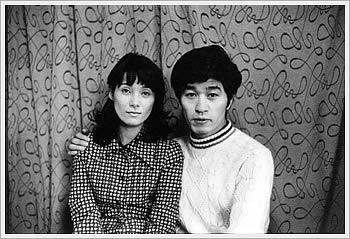
Better for me were the portraits of the adults, particularly the couples. They tend to date the photos more, on account of their hairstyles and clothing, than do the children, but I found that poignant, not merely for the nostalgic aspects of that, but because in a way you feel the adults were stuck, their futures weren’t limitless, their stares back to the camera were of resignation rather than say the fear or curiosity one finds in the children. In the above-reproduced photo, I find the expression of the man particularly moving, in a sense he seems caught between coming and going, he seems in a state of flux, wanting to bolt yet playing his part, sweater and all. He could be a son to the woman next to him, rather than husband. She’s the rock, her face chiseled with resignation, that he’s holding onto.

Shigeo Gocho, color photo circa 1981: click for larger version

But what I really liked was the gorgeous color work he shot near the end of his life, all of it of a “street” nature. I don’t know what precipitated his move to color, nor his return to the streets. Perhaps he felt after the publication of “Self and Others” that his camera had been pointed inwards long enough. Certainly coming to the color — a no doubt unintended but rather nice effect of this exhibition spread over two different locations is that after the black and white work, physically small prints exhibited under rather dim lighting so as to protect them, one has to leave this space and walk one kilometer in the fresh air before getting to the color work, exhibited in a much more open and bright space — this viewer couldn’t help but feel relieved to be back out on the street, a vibrant colorful street, and back to anonymity. The children haven’t exactly been left behind, they are here too, but now they are not children from Gocho’s neighborhood or of his friends, but rather children existing — one is even tempted to say, eking out an existence — amidst a larger social and urban context, blowing open the tension which was unstated but palpable in the earlier portraits.

Shigeo Gocho, color photo circa 1981: click for larger version

The above image was perhaps the strongest image of the color work for me, although as a color photo it was rather muted compared to the rest. (Both color images seen here — click for larger versions — were scanned by me from the exhibition catalog). Here we have a family, or perhaps several families, watching a parade or some other event, from the sidelines. Tucked away in the back, almost in their own protective cocoon, are a boy and girl sitting on a ledge, enjoying their ice cream and disinterested in whatever the event is. One might assume from the ice cream cones that the two adults with cones in the center are the childrens’ parents. But while they may be more in the forefront, more present with respect to the event, their posture — he with the blank downward gaze, she with her sunglasses and dangling cone — tells us they are no more interested in the proceedings than the kids are. And what of those kids? They may be playing their version of hide and seek, but the writing is on the wall, their future is in front of them, literally. The boy perhaps has a couple more years of idle play, but as for the girl, she’s got her handbag in her clutches and it’s already packed.

The exhibition will run through October 24 before it heads on to Yamagata. Mitaka is on the JR Chuo Line, about 20 minutes from Shinjuku.