
Kaika has taken to sticking out his tongue a lot, who knows why. Just his latest phase I suppose. More images — again taken by Naoko — here.
hmmn: musings from the far east(erwood)
Kaika has taken to sticking out his tongue a lot, who knows why. Just his latest phase I suppose. More images — again taken by Naoko — here.
I’ve often lamented about my sidebar of Japan-based blogs being so English-language centric, and expat heavy. Needless to say there are a lot of bloggers in Japan who are writing in Japanese, and I haven’t really found a way to incorporate them into the list, not the least because my limited Japanese would never allow me to keep such a list updated. Fortunately, Japan-Japan has started a “Bloggers in Japan Writing Exclusively in Japanese” list of links page, currently listing 175 blogs, along with some translation sites for those who can’t read Japanese. I’m sure this is just the tip of a bigger iceberg, so if you know of sites not represented on the list, please let them know.
Related to this, Ken Loo, who maintains blogs in both English and Japanese, recently wrote an interesting piece further exploring whether or not blogging is becoming popular in Japan. [Update (July 29, 2003): Ken has re-done his English blog and this article is no longer available.] Furthermore, Ken writes about how a whole community of web diarists or “text site” keepers that existed in Japan before weblog software applications like Movable Type became available here has resented the way that their community has been usurped, so to speak. I don’t know the ins and outs of it, though the whole thing strikes me as a bit childish (kind of a music fan bragging about how he saw so and so back in the day, in a small club, before anyone knew who they were, etc.). At any rate, JBA (Japan Blogging Association), which was sort of a list of mostly Movable Type blogs, has closed (there’s an ominous looking — but unreadable to me — message at the site), apparently a casualty of this so-called burogu soudou (“blog war”).
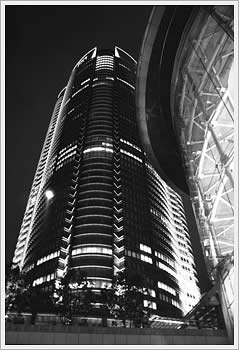
Adam Greenfield, who has just shuffled off these islands of Japan, sums up his two-year stint here, using the new Roppongi Hills project as metaphor:
Here is where I see the greatest, saddest parallel between this building project and my daily experience of contemporary Japan: in the clamor of these voices, and all the superlatives they evoke, Roppongi Hills is absolutely desperate to fill every space, to shut out doubt with affirmations not even of its specialness, but of its simple existence. Like an idiot beacon shrieking “I’m here! I’m here!” into the humid night, Roppongi Hills inserts itself into every possible vista, spoors the entire neighborhood with its sonic effluvium.
Read the whole thing. Sobering. (Above image of Roppongi Hills shot on July 5, 2003, on Fuji Neopan 1600 film).