Taking the country’s pulse through its language

Kanji for 'kaeru', meaning 'return': click for page about the 'Kanji of 2002' (in Japanese)

This kanji, kaeru, meaning return, was recently selected as the “Kanji of the Year” for 2002 by over 60,000 voters in a “Sign of the Times” poll sponsored by the Japan Kanji Proficiency Testing Foundation. The reasons for its top ranking in the survey are obvious to anyone living in Japan, as surely 2002 will always be remembered here as the year that 5 Japanese nationals abducted by North Korea in the 1970’s returned home to Japan. This event also accounts for kita (north) and ra (the first character in ratchi (abduction)) coming in 2nd and 3rd respectively. The placement of the ra character so high is interesting in that it is not one of the 1,945 general-use kanji (called jouyou kanji) “approved” by the Education, Culture, Sports, Science and Technology Ministry (formerly Ministry of Education).

According to some, it was at the insistence of the Americans during the post-World War II Occupation that the then Japanese Ministry of Education decided to limit the number of kanji students were required to learn, and it began to weed out rarely used characters. At that time, there were some 4,000 characters that one needed to know in order to effectively read newspapers or magazines, and some dictionaries listed as many as 50,000 characters. Initially the Ministry decided upon 1,850 characters, a number that was increased in 1981 to the current 1,945. As this article points out, however, while Japanese learners such as myself thankfully don’t have to contend with learning 4,000 characters (to say nothing of 50,000!), there are still plenty of non-jouyou characters out there to give me fits and ensure that I will never get close enough to be burned by the proverbial light at the end of the kanji-learning tunnel.

In other language news I never got around to blogging, last December Japanese publisher Jiyukokuminsha published their 2003 Encyclopedia of Contemporary Words, a huge tome I’ve salivated over in the bookstore (but sadly, can’t read, so haven’t bought). In conjunction with the book’s publication, Jiyukokuminsha formed a committee and they came up with a top 10 list of new and popular words to enter the Japanese language in the last year. tamachan and waarudokappu (nakatsuemura) were chosen as the top 2 from this list. tamachan was coined by Fuji Television reporter Yuko Kurozumi to describe the seal that was discovered in the Tama river on August 7th of last year. waarudokappu (nakatsuemura) is for the small village in Oita prefecture that hosted the Cameroon team during the World Cup, an undertaking which quickly thrust the tiny village into the national spotlight.

(Kanji poll link found at Sydney Notes.)

Vocabulary building with Kanji

A few of my (early) New Year’s resolutions focus on my Japanese studies. Of these, one in particular I’ve been getting a head start on recently: my writing. It has been bothering me for some time that while my reading of Japanese has improved tremendously over the past few months (in good part because I’ve banished romanized transliterations from my study), I have not kept my writing in step. I can probably recognize roughly 300 or so kanji characters at this point, but put a gun to my head and write out any of them and it’s doubtful I would be able to write 10 of them.

Part of this problem derives from my recent studying for the Nihongo Nouryoku Shiken, or Japanese Language Proficiency Test (Level 3). The JLPT has no kanji writing component, so in the interest of having more time to devote to preparing for the grammar sections, I didn’t bother with kanji writing, but rather only with recognizing them and being able to produce their various readings (kun-yomi and on-yomi). In retrospect, knowing how to write the kanji I studied would have helped me deal with the many trick questions the kanji reading section throws at you (including some fake kanji characters). (Oh well, all water under the bridge….)

The other problem, which Japanese themselves are all too familiar with, is that with the advent of PC’s and now cellphones, as long as one can read kanji, one doesn’t really need to know how to write the characters, for the most part. Input the hiragana for the word, and then choose the correct kanji from the pop-up. The software does the bulk of the work. So I can type out an email dense with kanji, but I can’t write even a basic sentence with pen and paper to save my life. (I should just add that despite the above, writing emails in Japanese has done wonders for my reading skills).

At any rate, I’m determined now to learn how to write kanji as well as read it, which has necessitated a kind of going back to basics approach. This means having to create kanji flashcards for such basic words like hana (flower), gaku (learning), and tama (gem, sphere), and to spend a lot of time writing them over and over again in a notebook, and then testing myself that I can write them from memory. Frankly, it’s all a bit humbling, but necessary.

To keep myself from going insane, however, I’ve also been creating flashcards for new kanji characters I’ve never learnt before, from within the 1006 kanji that every Japanese is supposed to know by the time they finish 6th grade (and which I need to know if I have any hope of passing the 2nd level of next year’s Japanese Proficiency Test). In the process, I’ve stumbled onto a new method of study (new to me, at any rate), which I thought I would share.

One of the problems with studying kanji, for me that is, is that there’s usually very little context to the studying in the beginning. You simply have to plow through the characters, using rote memorization (and a lot of testing!) to build up the supply of kanji you can read (and hopefully write as well). But as any Japanese learner knows, what makes up the bulk of Japanese vocabulary are not individual kanji characters, but rather kanji compounds, that is words which are made up of two, three, etc. kanji characters. So, as part of my current self-study, I’ve been concentrating more on not just a single character, but rather as many words as possible that use that character. So, in a day of studying, while I might be learning only 3 or 4 new characters, I’m actually learning anywhere between 15 to 20 new words using those characters in combination with other characters I already know. Let’s look at an illustration which might help to explain what I mean:
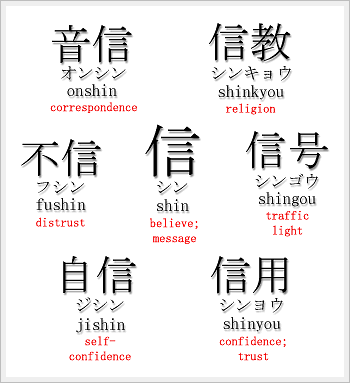
kanjishin_350.gif

In the center is the kanji for shin (believe; message), which is used to form shinjiru (to believe; to place trust in), and surrounding it are some other words that use the shin character in combination with other characters. So while studying shin and hopefully committing it to memory, I’m also looking around for other words that use this kanji. Among those other words, I look for those where shin‘s partner(s) — so to speak — are other kanji I’ve already learned, and these combinations I also commit to flashcards (all the compounds surrounding shin above, for example). If I find a partner kanji I’m unfamiliar with but think the word is important to know at this stage of my learning, I then make the effort to learn that particular kanji. And with that kanji, I repeat the whole entire process I just described. So you can see that in very short order, just by learning only 2 or 3 single characters, my vocabulary grows by leaps and bounds.

Of course, creating flashcards doesn’t really get you anywhere near mastering kanji. One needs to review these endlessly before they seep into the brain, and it’s important to not get a false sense of mastery if you can flip through the cards and seamlesslessly recall each character or compound and it’s reading. Turn those cards over (if you’ve written the readings on the back like I do), and test yourself to now write all those characters from memory, based on the reading. Until I can do that, I don’t consider the character (or compound) mastered.

In a little over two weeks of my project, I’ve already created at least a couple hundred flashcards. I’m now at the point where I need a “system” so that the kanji I mastered last week doesn’t fly away from my brain this week. M-san of Nippon Daze and Hajimemashou has what sounds like a good method (admittedly I have yet to put it into practice myself).

I’m using several books at the moment to assist me in my Kanji “project,” including:

* Doraemon kokugo omoshiro kouryaku utatte kakeru shougaku kanji 1006 (published by Shogakukan), which displays all the 1006 kanji Japanese youth need to learn in grade school, organized by grade. There are several books of this type readily available at any Japanese bookstore (and perhaps overseas at Kinokuniya stores and the like?). I find this one, aside from being irresistably kawaii (cute), to have good tips on how to write each kanji (focusing on stroke order, balance, and using the correct stroke endings — eg. does the stroke employ a little flourish at the end (hane) or come to a complete stop (tome)), and it also provides the all important list of select words using each kanji.

* The Kodansha Kanji Learner’s Dictionary edited by Jack Halpern. This book covers all 1,945 Joyo kanji, plus the 285 characters in the official Jinmei Kanji (for names). I love this book, in no small part due to it’s very attractive design. The SKIP method it employs for kanji look-up is somewhat laborious to get used to, but once that is overcome it makes looking up kanji a very quick process (it also expediates stroke counting and becoming familiar with the main radicals). Theres a wealth of information on each kanji (I particularly like the frequency index, which is based on a year’s worth of Japanese newspapers), but what really is useful is that most entries are loaded with examples of other words that employ the character, which helps me and my “project” immensely. About the only drawback I can think of with respect to this dictionary is that it uses romanized Japanese throughout.

* Shin Nihongo no Kiso Japanese Kanji Workbook II. This is just a workbook I selected pretty much at random, and there are others out there (Bojinsha’s Basic Kanji series is one). Each two pages the book introduces 7 or 8 individual characters, with another two pages testing one’s reading and writing of these (and other) characters. I didn’t really want to proceed with my kanji learning in a straight line (eg. from Grade 1 to Grade 6, in that order), but jump around, and make connections on my own. The above workbook serves that trick quite nicely.

One of my teachers described me as a kanji otaku, or kanji freak. This post may make that sound like a true statement, but I don’t really think I am. I do however find kanji to probably be the most appealing aspect of the language to me (and the most frustrating, to be sure), which probably relates to my art background, and back to my first Japanese learning experience, in 9th grade, where we used sumi-e to draw out various characters. But what keeps me motivated beyond proficiency exams is the hope that one day I may be able to read Soseki Natsume or Oe Kenzaburo novels in the original, or peruse the various Shukan Weeklies that line Japan’s convience store shelves. At that point I might then be able to say “I’ve arrived.”

Adjusting my Japanese reception

It may seem a crazy notion that living in Japan I feel the need to further surround myself with things Japanese, but this is the situation I feel I’m now in. Having had to seriously apply myself to learning Japanese these last couple of weeks, I now am slowly starting to feel things come together in ways they haven’t before. Sure enough, I have miles to go before I sleep, but the future is starting to be paved more in emeralds than it has been up to this point.

One problem I have had is that in general, I’m a poor listener. Not just with foreign languages, but in general I have a hard time concentrating on what’s being said to me (or around me) and my mind tends to wander, or skip over what it considers non-essential information. (Admittedly, we all do this to some extent, but perhaps I tend to think of more input as non-essential than others might). With foreign languages, I tend to let pass over my head or through one ear and out the other any words or phrases I haven’t heard before, only putting up the stop sign when a familiar face rears its head. (Sorry, I seem to mixing metaphors left and right). Eventually I hear certain words or phrases enough that either by context I derive meaning, or I ask someone (usually Naoko) to explain them to me.

Now that the grammar structures I’m learning are getting more complex and starting to incorporate plain forms to a greater extent (for lack of a more extensive grammatical explanation, lets just explain plain forms as non-polite or casual speech), almost overnight I’m starting to make greater sense of the conversations I hear around me on a daily basis, at home, at work, on television, and on the train.

(On another tangent, the trains and environs are an interesting microcosm of the different speech levels one gets exposed to in Japan. At one end of the extreme are the high school girls with their slang-inflected kitanai Japanese of which “maji” seems to comprise about 50% (roughly corresponding to “really?” or “for real!” depending on intonation). At the other end are the station conductors and train drivers whose announcements are in a humble customer-centered language that for the most part still escapes me. Unfortunately, those in the middle, the salarymen, office workers, housewives, who’s Japanese comes closest to what I can understand and desire to speak myself, are also the ones most likely to be concerned that their conversation might be intruding upon someone else’s aural space and therefore it’s usually at too low a volume for me to hear.)

So now I find myself yearning for even more sources of input, and turning to various media to help satisfy this urge. Of course television is a great at-hand resource, and cheap too, but for the most part the typical line-up of variety shows, food shows, or home-renovation shows is a bit beyond the pale of what I’m willing to tolerate. Dramas are probably best, but I have yet to find one that appeals to me during the time I have available to watch tv (admittedly I haven’t yet searched very hard for these).

Today, however, I borrowed a couple of videos from the library, and watched one of them this afternoon before heading off to work. Boy did it hit the spot of what I was looking for. It’s one of a series of films (about 15 have been made so far, I believe) called Tsuribaka nisshi (roughly “Diary of a Fishing Nut”), starring Toshiyuki Nishida as Hama-chan, a salaryman with an obsessive fishing habit. It wasn’t an unknown commodity, for I had seen one of these videos before on a bus tour. Basically it has all the requirements for me to watch it subtitle-less: a formulaic storyline (in a nutshell, Hama-chan would rather fish than work, and usually through some sub-plot love story involving one of his co-workers which leads to some type of conflict, connives a way to both fix the problem and sneak off to do some fishing) so that even when I don’t understand exactly what’s going on, I pretty much know how the story will end up; a great humorous funnyman in Nishida, whose various mannerisms and facial expressions are enough to send me tittering, and therefore make the whole thing eminently watchable. (I think it goes without saying that if these were American films, I wouldn’t be touching them with a 10-foot fishing pole). But perhaps the best thing about these films is that they’re a great way to be exposed to both casual and polite speech, and indeed much of the humor of the films is derived from this conflict. You see, the owner of Hama-chan’s construction company also happens to be a fishing nut, and outside of work, he and Hama-chan are best friends. But inside work, a strict heirachy is maintained, with the appropriate language that goes along with that heirarchy.

Today’s episode also happened to unexpectedly feature prominently Hama-chan’s wife’s pregancy and subsequent childbirth, so that was an added bonus (particularly funny — and understandable to me without Naoko’s explanation — was Hama-chan’s arguments pro and con for whether of not he and his wife should find out the gender of the fetus).

I also borrowed a video of one of Yasujiro Ozu’s later films that judging from the boxcover I haven’t seen yet, though I’m expecting that this will be considerably harder for me to understand, and that it will probably be more an exercise in analysing Ozu’s film style and techniques rather than a Japanese lesson. One of my benchmarks I’ve set for myself with respect to fluency in Japanese is being able to watch an Ozu or Kurosawa film in Japanese with no subtitles and being fulfilled with it as I would if I was watching it in translation. A long time from now I’m sure, but watching an Ozu now will give me a good idea of how far off that time will be.

My last media item from the library was a CD by Yosui Inoue, a singer recommended to me by my classmate. I was looking for the album of his with some famous song about umbrellas (something like “kasa ga nai…”) but they didn’t have it. Oh well, this one will fill in quite nicely. Stylistically all over the map, and again probably something that back home I wouldn’t give any attention to, but it will suit my language learning purposes perfectly. Actually, I want to start listening more to enka, which I’ve heard referred to occassionally as Japanese “blues” although musically it sounds nothing like blues music. I have a hard time describing it, but from what I gather, most of the songs are about loneliness or heartbreak (it appears to me that it’s a prerequisite to have namida (tears) in the lyrics somewhere), and the singing style is distinguished by a delayed vibrato and the use of melisma.

Naoko hates enka, and most of my students that I ask about it don’t like it either, which I think is a shame. I absolutely adore it, and fortunately so do my in-laws so I sometimes watch one of the few programs on tv that features enka, and listen as they sing along to these old, mournful songs. (These programs always have the lyrics on the screen, so they make a great way to practice Kanji recognition). I want to get into enka more, become familiar with some of the stars, some of the old standards, and now having discovered the library’s CD collection, am looking for a good place to start, so should you have any recommendations, please post a comment.

Lastly, on the productive skills front, Melissa of Nippon Daze, home to some wonderful writing about her time in Japan 10 years ago, has started a blog in Japanese to further advance her learning of the language. I’m officially jealous! But as I posted in a comment on her first entry, I think rather than start my own, I may start using her comments area as a place of writing practice for myself (with Melissa’s permission, and on topic, of course).