
The continuing Japanese to English trade imbalance

One could say that Japanese is a very absorbent langange, meaning that it has taken, appropriated, and made its own countless number of loan words, or gairaigo as they are known in Japanese. Most gairaigo entered the language from Chinese 1500 years ago, with a certain amount also coming in slightly more recent times from Portugese Jesuit priests (tempura, for example) and Dutch traders (eg. kaban, meaning bag, satchel, or briefcase).

Most of these words have long been assimilated into the language to the point where their origin, at least to an outsider or non-native speaker, is obscured. However, it is the more recent English imports, like waishatsu (business shirt, not necessarily white), pasokon (personal computer), conbini (convenience store), or tsuaa kondakutaa (tour conductor), that get the most attention these days (popularized as either “Japlish” or “Engrish”), often because their meanings — to say nothing of their pronunciation — are at odds with that of the original word (manshon — ahem, “mansion” — for apartment building is one of my favorites).

If I may borrow an economics analogy, we could say that with respect to the English and Japanese languages, it is English that enjoys a considerable trade surplus. Japanese words that have entered into the English language are few and far between, and most of them directly refer back to some item or element of Japanese culture, eg. futon, origami, sushi, kimono, tofu, sake, zen, etc. However, there are two words in English that entered the language from Japanese whose entry I find curious and amusing, in part because not only are their meanings somewhat related, but their etymologies are mutually resonant as well. These two words are tycoon and honcho.

According to Dictionary.com, tycoon has a particularly fascinating history of how it entered into English, going back to Commodore Perry in the 1850’s:

Tycoon came into English from Japanese, which had borrowed the title, meaning “great prince,” from Chinese. Use of the word was intended to make the shogun, the commander in chief of the Japanese army, more impressive to foreigners (his official title shgun merely meant “general”). It worked with Matthew C. Perry, who opened Japan to the West in 1854; Perry carried out his negotiations with the shogun, thinking him to be the emperor. In fact, the shogun did rule Japan, although he was supposedly acting for the emperor. The shogun’s title, taikun, was brought back to the United States after Perry’s visit. Abraham Lincoln’s cabinet members used tycoon as an affectionate nickname for the President. The word soon came to be used for business and industry leadersat times being applied to figures like J. P. Morgan, who may indeed have wielded more power than many princes and presidents.

Honcho, which comes from the Japanese hanchou and means “group leader,” is a more recent addition to the English language, again resulting from American involvement in Japan, this time from the post-World War II occupation of the nation by the Allied Powers.

There are a couple of words or phrases in use in English that have occassionally been traced back to Japanese, though the etymology is inconclusive or at the very least fanciful: hobo, and hunky-dory (as in the expression “Everything is hunky-dory.”).

There are some who wonder if the word hobo, meaning “One who wanders from place to place without a permanent home or a means of livelihood” (American Heritage), whose etymology has always been listed in dictionaries as “of unknown origin,” might be from the Japanese word houbou, meaning “here and there”. But this seems to be pure speculation, and speculation not shared by too many at that. Merriam-Webster seems to think hobo has a purely American origin.

According to the Word Detective, there are some that believe that hunky-dory originated from a street popular among American sailors in the 19th century in Yokohama named “Honcho-dori.” The story is fascinating, but unfortunately the facts don’t add up so neatly. See this thread at Phrase Finder for more.
Apologies for the paucity

I apologize for the paucity of posts lately, I’ve been trying to kick up my Japanese language studies up a notch and this and work and some good ol’ offline reading has put the blog on the temporary back-burner.

In the meantime, you could do a lot worse for yourself than to check out the gaijin stylings of a Scot in Kanazawa who publishes Gaijinworld. Some great, humorous writing here. E.g., this dandy from his archives (scroll down to April 20th) on one of the banes of my existence, the levels of politeness in the Japanese language (called keigo):

[…] finally they are teaching us about “futsu-kei” or “ordinary form.” Which is the manner in which 96% of conversations here are conducted. For the first year or two, they teach us how to say things whose English equivalent would be something like “forsooth, my fine gentleman, sorry as I am to have to trouble your peace, wouldn’t you be so kind as to assist me in my travails as I attempt to run aground an ordinary mercantile in which one may purchase books?”

Japanese ideophones

Japanese ideophones

If I wanted to start a blog — or concentrate this one — on the Japanese language, I would have more than enough material for it to thrive. Among the many adjustments or changes one has to make when living as a foreigner in Japan, there are few as challenging, frustrating,
demanding, demoralizing, exasperating — and every once in a while, exhilarating — as learning its language. I suppose this is true for most immigrants, but the challenges seem particularly acute when learning Japanese, with its twin kana syllabaries (hiragana and katagana), and its thousands of kanji, the ideographic characters borrowed from Chinese roughly 1400 years ago, which themselves have multiple readings (called yomi), not to mention all the compound words, or jukugo, formed from combining two or more kanji characters. Phew, that’s just one part (albeit quite large part) of learning Japanese. Recounting all that is enough to make me throw up my hands in defeat!

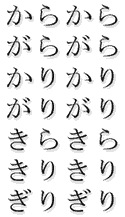
Fortunately, learning how to function conversationally is much more within the realm of possibility, and can be, well, if not exactly exhilarating, at least fun. One part of Japanese I particularly enjoy and am frustrated by at the same time is the abundance of onomatopoeic words, or ideophones, such as those I’ve reproduced in the image accompanying this post. In English we have onomatopoeic words like buzz and hiss, and it has been argued that some “sq” words like squat, squish, and squeeze have onomatopoeic origins.

In Japanese, however, where there are three types of onomatopoeia (gisei-go, language imitating the sound of nature; gitai-go, for words imitating states of the external world; and gijoo-go, for internal mental states and sensations), most of the words involve doubling up of the syllables, for example (from the image above) kara-kara, kira-kira, gara-gara, and giri-giri. (These latter two are words I particularly hear a lot of, and have grown to be among my favorites, although I can never keep their respecting meanings straight (gara-gara means “rattling sound” or “empty,” while giri-giri means “just in time”). I also like beta-beta, meaning “sticky,” a word used a lot in the ridiculously hot and humid Japanese summers).

So you can see how listening to native Japanese speaking pera-pera (fluent) Japanese can be entertaining. However, due to their hard to distinguish sounds and the sheer volume of them, learning them is a bit frustrating. Or put another way, Moshi watashi ga Nihon’go o kotsu-kotsu benkyou sureba, pera-pera ni naru ka, tabun ira-ira suru dake. (If I study Japanese diligently, I will be fluent, or maybe only frustrated). By the way, I need to credit my wife Naoko with this sentence. My Japanese ability is far too nascent to have produced this sentence on my own!

Although I don’t have them, there appear to be a few interesting dictionaries or books about these onomatopoeic words or ideophones, including the two-volume Dictionary of Iconic Expressions in Japanese by German publisher Walter de Gruyter; Flip, Slither and Bang : Japanese Sound and Action Words (part of Kodansha’s Power Japanese series, now out-of-print); and Nihongo Pera Pera!: A User’s Guide to Japanese Onomatopoeia from Charles E. Tuttle.

Online, you might take a look at Onomatopoetic Words in Japan, or J-Slang: Japanese Onomatopoeia. A bit off the beaten path, there’s a webring consisting of nothing but web domains that are made up of Japanese onomatopoeia!

UPDATE (July 28): I came across another book that might be of interest if you’re keen to delve further into Japanese onomatopoeia. While browsing at Sanseido in Jimbochou yesterday, I found Waku Waku Onomatopoeic Photo Book by Belgian Tom Felingden (not sure about the last name), who lives in Tokyo.