Saving money in Japan

Kanji for 'kau', meaning 'to buy'

Tokyo is often touted as the most expensive city in the world. A survey released a few months ago confirmed this, though what got lost in the headlines was that this particular survey was based on the cost of living of “a business executive and family sent overseas”. Hmmn, can we say “expense account”?

At any rate, whether for business executives or just your average joe, no doubt Tokyo (and Japan as a whole) is expensive to live in. But I’m here to tell you that it is far from prohibitively expensive, and indeed, for many things, my previous home of San Francisco has Tokyo beat hands down in this respect.

To wit, today I bought two “winter” suits, to replace the thin and practically see-through summer suit I’ve been wearing. So for a pair of pants together with a suit jacket, how much did we spend? 9,000-yen each, which at today’s exchange rate comes to $74 USD per suit. Mind you, we’re not talking Armani here, but we are talking about two perfectly suitable wool suits in my size (this last point should not go underestimated!). To top it off, I bought three long-sleeve dress shirts, at the extremely reasonable price of 880-yen each ($7.21 USD per shirt).

This is one example upon many I could give you that living in Tokyo doesn’t have to break the bank, provided you are a smart and disciplined shopper, willing to wait for the item to go on sale or to check if another store has it cheaper, sign up for any and every “point card” thrust your way, and aware of Japan’s gift to yen-pinching folk like us, the 100-yen store and one’s local “recycle” (read: Goodwill) shop.

Now, I have to give credit where credit is due, and thank Naoko for a) spotting the suit sale from among the newspaper inserts that she scans daily, and b) pushing and prodding me to make the dreaded trip over to the department store to actually try on the suits. This is why I’m not ashamed to admit that we are a very traditional Japanese couple in this respect: I earn most of the money, but she controls all of it! She’s extremely good at yen-pinching, and very disciplined about it. Me, I’m too lazy, and not nearly disciplined enough.

Sometimes her spendthrift ways go over the top and I get irked, like when she makes a 20-yen cellphone call from the store to her mother to check if the price of a jar of honey is cheaper there than at another store. (Says I: “Well, now that you’ve just spent 20-yen on the phone call, it ain’t cheaper anymore!”) But most of the time I just marvel at her penchant for finding great deals and saving us in the long run a boat load of money. Now that we’re really shopping and saving for three of us, I appreciate her efforts even more.

Admittedly, there are plenty of areas in which Tokyo is ridiculously expensive, especially with respect to entertainment, eg. books, cd’s and dvd’s, a night out on the town, or a rock concert. A case in point: tonight I went to see the British band Oasis in concert. For roughly $61 USD, I had the privilege of sitting at the top of the near 15,000-seat capacity Yoyogi National Stadium (and this after buying the more expensive ticket; one wonders where the cheaper seats were) with horrendous acoustics for an hour-and-half show (no opening act either). I won’t be doing that again anytime soon, I can assure you.
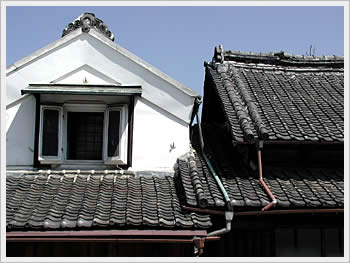
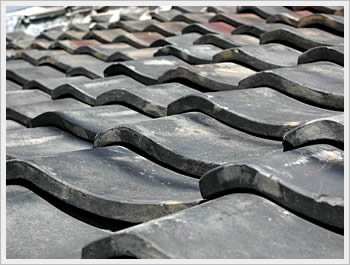
Nakasendo’s remaining vestiges of history

click for larger image

click for larger image

The above pictures are of a structure lining the old Nakasendo highway that passes through our city Warabi on its way from Tokyo to Kyoto. The highway has a history dating back to the 7th or 8th century, although its present form is linked more to the 17th century, when the Tokugawa Shogunate made it one of the 5 major highways to radiate out from Edo (present day Tokyo), to better facilitate centralized control of the country. Readers may be familiar with another one of the five, the Tokaido, which was memorialized in the Hiroshige print series “The 53 stations of the Tokaido”. Interestingly enough, the ukiyo-e artist Keisai Eisen was asked to do a similar series for the Nakasendo, which he started but never finished. Hiroshige came on to finish the project, which was entitled “69 stations of the Nakasendo”.

Mind you, on the parts of the Nakasendo that I’ve been on in this area, these old structures are few and far between, and I suspect were it not for governmental restrictions placed on their use because of their historical significance, there might be even less of these remaining. Indeed, on one stretch of Route 17 (the modern day Nakasendo), especially from Urawa to Oomiya just north of where we live, it’s quite a depressing site.

I’m not sure what this particular structure used to be, although the right part of the building has a storefront (now empty with windows darkened). Naoko suspects the left half of the structure was for storage, given the especially thick doors on the windows at top.

Here is an interesting site that features a wealth of information and commentary on the Nakasendo highway:
Nakasendo Highway: A Journey to the Heart of Japan

Half a year in Japan and more Yoshiwara

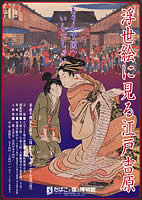
Salt & Tobacco Museum Yoshiwara Exhibit poster -- click for larger

Well, I never see anyone comment on their 6-month anniversary of anything, it does strike me as sort of lame, but excuse me while I indulge in a bit of lame-ness and pat myself on the back for having survived my first 6 months in Japan. My 6-month anniversary was last Friday, inauspiciously on a 13th. And because Naoko and I married the day after we arrived, Saturday was our 6-month wedding anniversary. We celebrated by going out on a rare “date”. Because of our wildly opposite schedules (she works early in the morning, I work at night), we don’t go out together much (finances also play a part in this — it can be prohibitively expensive just to go in to Tokyo for the day). Having had my fill of CSS designing, I proposed that we should go out, and so on her choice we went to Hiroo, an heretofore part of Tokyo I hadn’t been to. It’s home to many foreign consulates and embassies, and so many foreigners live there, and on the whole I was not terribly taken with the sight of outdoor cafes full of Americans. But it’s known for having a couple of good international supermarkets and so we bought a few things there. We then had our first Mexican (or California-ized Mexican actually) food since leaving San Francisco, and boy did it hit the spot.

Now I fibbed a bit when I said we “celebrated our anniversary with a date”. I actually hadn’t realized it was our 6-month wedding anniversary until we were eating and reminiscing about how long it had been since we’d last eaten burritos and all of a sudden it dawned on us that we had gotten married 6 months ago to the day. But silly me, I flubbed the opportunity to play it off like I knew it all along (Valentino I’ll never be). But it’s funny how fortuitous it was to arrange this date on this day (perhaps some little romantic angel was sitting on my shoulder nudging me on unbeknownst to me).

After our lunch, we went over to Shibuya to the Tobacco and Salt Museum. If you live in or visit Tokyo, you really should check out this museum, a wonderful cultural oasis in an otherwise over-the-top consumerist Shibuya, and at only 100 yen for entry, a bargain. (Kitty-corner from the museum is a 100-yen per bowl udon eatery, so this can make for an exceptionally cheap date.) I wanted to go to the museum because their current Special Exhibition is on “Edo-Yoshiwara in Ukiyo-e printings”. I’ve written about Yoshiwara before, and how I’ve long been fascinated with this old “pleasure-quarter,” which I was introduced to via ukiyo-e prints. And so it was quite a treat to see so many exquisite examples of prints documenting the area, and its various courtesans and denizens.

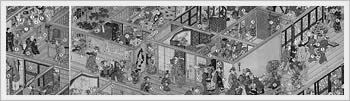
Kunisada's Yoshiwara Brothel print

Particularly wonderful were a couple of large prints by Kunisada, which provided wonderfully detailed views into the brothel establishments themselves. For one of these I’ve scanned the tiny black and white image from the exhibition brochure, but after much searching, I’ve found this print online here at the National Diet Library’s Rare Books Image Database. (On that page you’ll find thumbnails which link to decent-sized jpegs of the print in 5 parts.) It’s a cross-section of a Yoshiwara brothel and through humor and wonderful little details it really brings to life what one of these establishments must have been like. Also enjoyable were a series of 12 portraits by Keisai Eisen of various courtesan, each one representing a month of the year. I couldn’t find these online, but this is a good page on Eisen and another of his Yoshiwara prints.

Although we spent a good deal of time at the exhibit, I plan on going back soon (at 100-yen entry, why not!), and in the same day stop by one of my favorite gallery spots in Tokyo, the Ota Ukiyo-e Gallery in Harajuku, which is currently running an exhibit of prints entitled “The manners and customs of Yoshiwara”. Perhaps this might also be the time to once again wander down to the present-day remnants of Yoshiwara, a tawdry 2 blocks of “soaplands”.