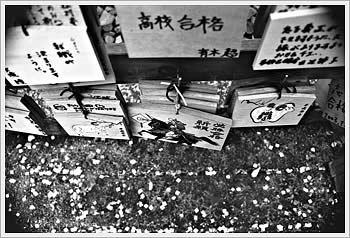
Tomioka Hachimangu Shrine, Fukagawa, Tokyo, July 26, 2003. Canon EOS Elan, Fuji Neopan 1600, with Kenko 25A Red filter.
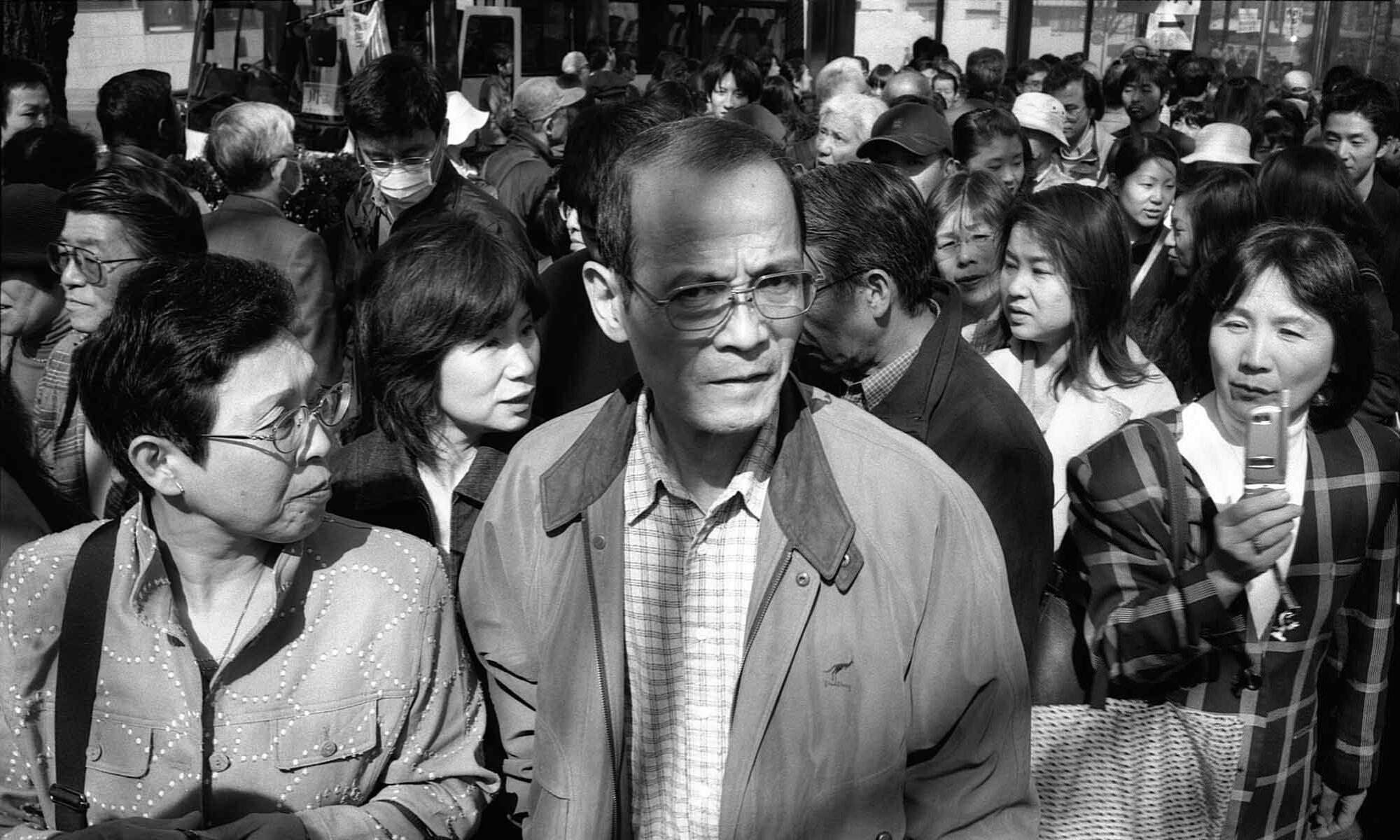
hmmn: musings from the far east(erwood)
Tomioka Hachimangu Shrine, Fukagawa, Tokyo, July 26, 2003. Canon EOS Elan, Fuji Neopan 1600, with Kenko 25A Red filter.
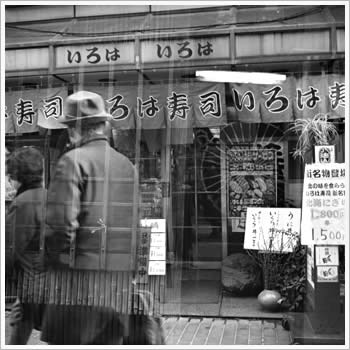
Another Lubitel image, this one from earlier this year. Filename says “Asakusa” but it was actually taken in Ueno, in Ameyoko. Lubitel 166U, Kodak T-Max 400.
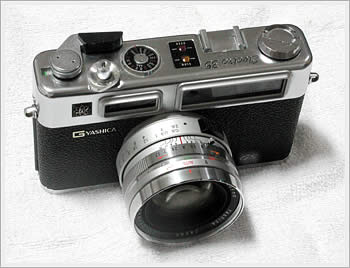
Picked up a new toy the other day, er, I mean a new camera. Toy is Naoko (my wife)-speak, for she knows well my habit of acquiring new electronic gadgets and gizmos only to tire of them after a few months. At any rate, I think toy is a good way to think of these things, if for nothing else than it seems to take the sting off the realization of how much I pay for these things.
But actually this particular toy was quite reasonable: only ¥2,800 (about $25 ever shrinking US dollars) from Map Camera in Shinjuku (it was on sale, reduced from ¥4,800). It’s a Yashica Electro 35 GS 35mm fixed-lens rangefinder camera, this particular model dating from 1970. Whoever owned this particular model took real good care of it; from a distance it looks brand new, the chrome all nice and shiny, the 45mm/1.7 lens pristine. It originally took an old mercury battery long ago discontinued, so I had to fork over for an adapter (I’m conveniently trying to forget how much I had to pay for that, it tends to lessen my excitement over how cheap the camera was 🙂 ).
I’ve been pining for a rangefinder for a long time, never having owned one before. Of late, I’ve not wanted to carry around my Canon SLR (let alone my Mamiya 645 Super), yet not go cameraless on dog walks or going to work (I’ve long since tired of my digital camera). I wanted something that I wouldn’t lose sleep over if it got stolen or I dropped it on the ground, and ideally with a relatively fast lens. The king of rangefinders, aka those made by Leica, are way beyond my means, so I’d been setting my sights on one of these 70’s-era fixed-lens rangefinders like the Canon QL17-GIII, or the Minolta 7sII. Hadn’t really heard too much of these Yashica G-series cameras, but it was there, it was on sale, it looked clean, and I had 3K burning a hole in my pocket. I was pleasantly relieved when I came home to read the positive reviews on this camera scattered about the net (here, here, and here for starters).
But the proof is in the pudding, not the box, so here are a couple of shots of Kaika during feeding time (some Gerber mashed beans, which he didn’t like!), from a roll of cheap Fuji film I ran through it yesterday afternoon (the negs were scanned on my Epson 2450 flatbed):

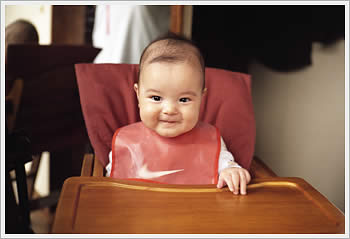
(Disclaimer: I would be remiss if I didn’t point out the that Nike bib was a gift. I tried to get Naoko to take it off for the camera but she thought I was being silly.)
What I like about the camera:
— the 1.7 lens. I couldn’t believe the shots I could get inside the house with it, on 100 asa film. One of my requirements was a fast lens, and I’m more than pleased by this one;
— the metering system is intuitive, and fun (little lights that illuminate if the setting will result in under- or over-exposures);
— speaking of metering, spot on exposures, based on the one roll I’ve shot so far. Every exposure was right on. Based on initial tests, I wouldn’t hesitate to pop in some slide film (although I must say I’m enjoying the warm tones of the color negative as shown above (too early to say whether that’s the film, or the lens on this Yashica);
— it’s retro look and feel (I am a fetishist at heart :))
— the ridiculously quiet shutter. You have to be paying attention or you won’t hear it. Doesn’t seem like it’s actually taking pictures;
— has a Bulb setting, and a self-timer
— has a flash sync (pc) terminal. I’m clueless about flash photography so don’t really know the value of this yet, but I’m eager to learn.
The not so good (but tolerable):
— only focuses to 2.6 feet. I would love to get in a bit closer, especially with Kaika. Most of these compact fixed-lens rangefinders have the same limitations;
— I would’ve preferred perhaps a 40mm lens rather then the 45mm. It’s just a tad too narrow for my tastes, but you know, there’s always that rarified technique of taken a step or two backwards;
— it weighs more than I would like (750 grams), especially at the moment as I have yet to get a strap for it;
— it’s only aperture-priority, which takes some getting used to. You can’t set the shutter speed at all. The camera simply picks it for you (apparently it can be anywhere from 30 seconds to 1/500), based on what aperture you set, the film’s ASA, etc.;
–speaking of ASA, the highest setting is only 1000. Right now I’ve got 1600 ASA film in there, so I have to trick the camera’s meter system a bit to get good exposures.
— the viewfinder is dark, although I suspect this is normal (remember, this is my first rangefinder).
All in all though, I’m very pleased with my new toy.