IKEA comes to Japan

Ikea 4.5 Museum promotion, Gaienmae: click for larger photo

This is one of a series of “installations” created by IKEA along a tree-lined boulevard that leads to the Outer Gardens of Meiji Jingu near Gaienmae subway station. Called “IKEA 4.5 Museum,” basically each box (there are 14 of them) presents a 4.5-mat tatami room and shows various ways you could decorate it with a notice displayed outside showing how much the items will cost at IKEA’s new store (I’d like to know how much this advertising is costing them!). The room pictured above is called the “Wild Animal Room.”

The new store — their first in Japan — opens April 24th in Chiba (at the location where that SSAWS indoor ski slope used to be). Naoko and I are big IKEA fans (I’m not ashamed to admit that practically my whole San Francisco apartment was from IKEA at one point), and we’ve both been following the progress of their long-overdue appearance in Japan. Most shopping outside of books and cameras leaves me bored to tears, but for some reason I do enjoy furniture and home decorating shopping. And with Costco nearby at Makuhari, we’ll now be able to kill two super-shopping birds with one car trip.

Going ’round the museums

Here’s another entry for the “Japan doesn’t have to be expensive” file:

Tokyo Museums – Grutt Pass 2004 (Japanese site here)

The “Grutt” pass in a nutshell is this: for ¥2,000 ($18USD), you get a booklet with free entrance coupons to 44 different art and history museums in the greater Tokyo area, as well as to zoos and aquariums. The entrance coupons are valid for two months from the date of your first use. This is one of those deals that’s so good you swear there’s some catch, or some fine print detail you’ve overlooked.

Naoko told me about this a while ago but I never followed through, and now I’m realizing the error of my ways. I finally bought one when we took Kaika to the Ueno Zoo last weekend (¥600 entry), and while I’ve only used it twice so far (for the zoo and for the Bridgestone (¥700)), I really only need to visit two or three more museums for the coupon booklet to have saved me money.

The list of participating institutions can be found here (in English). As I look over the list, I realize now that for many of them, the coupon will not only get me into the museum for free (eg. to see the Permanent collection), but also to Special Exhibitions. Can you see the yen savings I’m seeing in my head?

One of the nice things about this, as I discovered the other day at the Bridgestone, is that it helps to alleviate the feeling that one must see everything on display, lest one waste that sometimes hefty entrance fee. It gives one the mindset that the entrance was basically free, and lets one relax and see what one feels enough, reducing visual overload. Granted, there is a slight pressure to use the booklet, and to schedule museum visits regularly where one might not have before, but I tend to look at that as incentive rather than pressure, and I’m quite looking forward to taking in some of the more off-the-beaten path museums in the next two months. And when the two months are over, I’ll just buy another booklet. It really is a win-win as far as I can see it.

Whether you’re in town for a week or live here, this is a great deal. You can buy the pass booklet at any of the participating institutions (and use it right there and then), or at Lawson’s convenience stores, Ticket Pia, JTB offices, and a few other places. The program will run to January 31st, 2005, though as the program was done in 2003 one hopes it will continue next year as well.
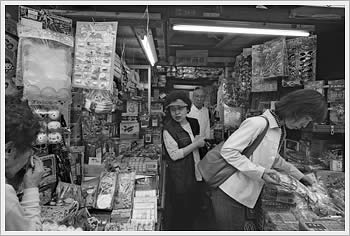
The last vestiges of a sweet tooth succor

Old style toy shop, Nippori, Tokyo, April 17, 2004: Click for additional images

Old style toy shop, Nippori, Tokyo, April 17, 2004. Bessa-L, CV 21mm f/4, Fuji Neopan 1600. Click for additional images.

Last weekend we went to see something that in a short time will be no more: the last remaining vestiges of the once thriving Dagashiya Yokochou (literally “Mom and Pop Candy Store Alley”) in Nippori, near Ueno. At its height in the Showa 30’s (1956-66), the candy and toy stores in this area numbered around 120, but now just 7 stores remain, and in a short time, these too will go, as the area to the east of Nippori station awaits the wrecking balls that will precede imminent redevelopment.

The area became one of three main “sweets and toys” districts to spring up after World War II, when sugar was rationed under the U.S. occupation and enterprising black marketers, led by the Japanese mafia or yakuza, set up shops catering to the sweet tooths of a populace sloughing off the bad taste of war and destruction. The largest of these, Ameyoko in Ueno, which numbered some 300 candy and toy stores in its heyday, still thrives today though in a much different guise. (The third was in Kinshicho, out past Ryogoku in Sumida Ward.)

If you want to see the alley, and it is just that, a narrow 2 meter-wide alley, you’ll need to hurry. The wrecking balls are slated to lower their boom sometime in June.

Click on the above image to get to a few more photos from last weekend. Photos from others, as well as more information and background on Dagashiya Yokochou, can be found at these sites (in Japanese only):
http://www.maboroshi-ch.com/rep/inq_05.htm
http://gendai.net/woman/contents.asp?c=064&id=173
http://www.mixpink.com/spot_folder/nippori_folder/nippori.html
http://www.hey.ne.jp/~kaleido/…/kalaido_topics03.htm
http://www.shitamachi.net/wa/totteoki/020616.htm