A stocking full of 30-yen film

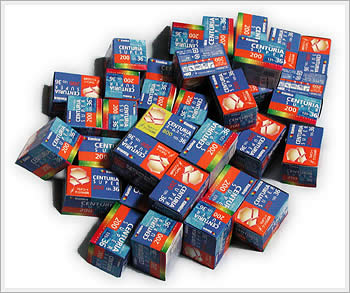
Konica Centuria film

It being Christmas and all, here’s a shoping-related post for the “Japan doesn’t have to be all that expensive” file. Yesterday I bought 39 rolls of the above-pictured Konica Centuria Super color negative film, all of them 36-exposure rolls, and all of them in-date, some not expiring until as far off as 05/2005. The outlay? ¥30 each, or ¥1170 total (at today’s exchange rate, that works out to $10.91, or $.28 cents/roll).

Just to crunch the numbers some more, for kicks let’s look at how much money I potentially saved with this purchase. I bought 36 rolls of 200 ASA film; 1 roll of 400 ASA film; and 2 rolls of 800 ASA film. Altogether, this film would have cost ¥19,560 at Bic Camera, one of the big camera/electronics superstores in Japan. So I saved a theoretical ¥18,390, or $171. Or looked at another way, the 2 rolls of 800 ASA film would have cost ¥190 more than all 39 rolls did. Granted this is all fanciful digit-pushing on my part, as it’s extremely unlikely I would ever buy 39 rolls of consumer-grade color negative at one time (in case you haven’t noticed, color is not run through my cameras that often these days), and even if I did it’s unlikely it would be this Konica stuff. But who’s to complain? I basically have my oyabaka Kaika film needs met well into 2004, and who knows, I might actually find uses for the stuff past baby pictures.

So where exactly did I buy this film? Heh, I’ll tell you after I go back there tomorrow to buy the remaining rolls I was dumb enough not to buy yesterday.
Slumming in Daikanyama

click for more photos

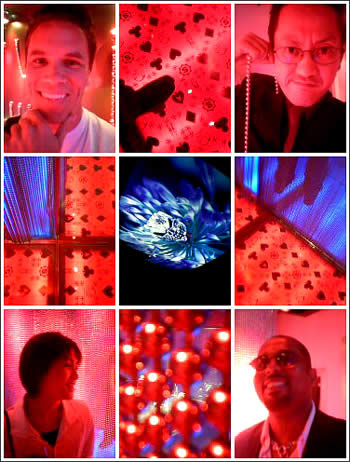
My brother Kimo is in town from L.A. with his friend Ryk, who’s apparently a big star in the hardcore silver jewelry business, and who has just opened a showroom dedicated to his designs, called Starling Gear, in trendy Tokyo neighborhood Daikanyama. I wrote earlier that I thought my brother was tagging along as “official photographer” to document the store’s opening, but it turns out that my brother actually designed the lighting for the store, and some of his photographs (of Ryk’s jewelry work) feature in the store’s decor. Before my brother became a freelance photographer and assistant to Ryk, he worked in Hollywood as a lighting best boy and grip, including a five-year plus stint on NYPD Blue.

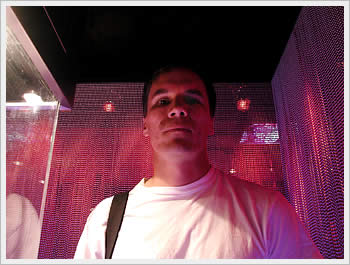
There was a party last night to celebrate the opening of the store, and as luck would have it I had the evening off due to a schedule change, so I went down to the party with a couple of friends. The photos in the composite above were taken with my mobile phone (it was fun showing it off to folks for whom the concept of a camera-embedded mobile phone is still a “wow” novelty — my brother was particularly impressed when I was moblogging from the party). I also took my “proper” digital and snapped a few more shots (see below or click the above composite), though in between catching up on things with Kimo and being introduced to way too many people, I neglected to get a shot of Ryk, nor really any shots of the merchandise, which was impressive, even though it wasn’t quite my style. Perhaps most impressive however, were the prices of some of the pieces: 28,000 yen ($235) for some chopsticks (this was probably the cheapest item in the place), 500,000 yen ($4,200) for a silver walking stick/staff sort of thing, and 980,000 ($8,235) for a table made from a chrome car wheel (rim).

My friend K-san, who couldn’t stop telling my brother he was kakkou ii (“cool”), told me later that these prices were probably less than what other manufacturers are selling their goods at, and that at any rate Ryk shouldn’t have a problem selling his stuff. This kind of hardcore jewelry is very popular here, led by a company called Chrome Hearts (do a search for “chrome hearts” on Google and you’ll get pages and pages of Japanese sites related to this brand’s jewelry). Apparently, Ryk at one time apprenticed for the guy who started Chrome Hearts.

My brother Kimo, Starling Gear, Daikanyama, Tokyo, May 2, 2003: click for larger image

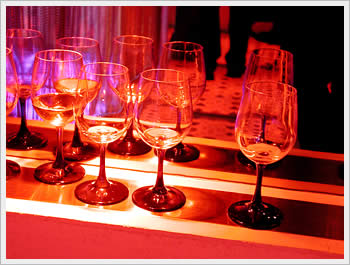
Wine glasses, Starling Gear, Daikanyama, Tokyo, May 2, 2003: click for larger image

(Click on the above composite to see a few more photos from last night’s party).

Refreshing and easy on the eyes

click for larger image (48K)

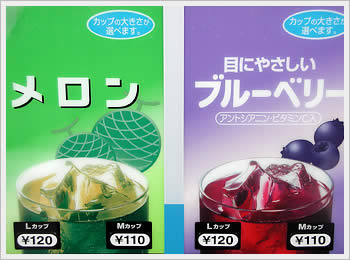
This is a detailed shot of a drink vending machine on a train station platform. I don’t know why exactly, but I find this combination of colors and imagery so potent, so irresistable, so effective. The marketing and creative boys did good on this one I think. Even though it was probably around 10ºC (50ºF) there on the platform, looking at this machine I started to feel the perverse desire for it to be one of Japan’s patented hot-and-humid summer days!

This type of open-cup vending machine is fast fading in the U.S. (I can’t even remember the last time I saw one), but is quite common here. In addition to juices, there’s the requisite machines dispensing coffee, and even machines serving up soups and such. Here we have meron (melon) and buruuberii (blueberry) drinks to choose from, available in either medium or large sizes. (The text in the blue circles at the top says “You can choose your cup size” just in case it wasn’t already apparent). The text for the blueberry drink touts me ni yasashii (“good for the eyes”), and adds that the drink contains anthocyanin and Vitamin C.

I had no idea, but studies abound about the benefits of berries like bilberries and blueberries to one’s health, especially one’s eyesight. (One such study, in Japanese, can be found here in pdf. format). In Japan in the late 90’s, there was a veritable “blueberry boom,” and a lot of blueberry products were introduced into the Japanese market. I suppose a “Hello Kitty” blueberry dessert was inevitable, but blueberry pizza or blueberry curry?