Sponsored by Nike and Nikon, where the power lies

The 11th IAAF World Championships in Athletics (or Track and Field as I would call it) are going on in Osaka this week, and because the games are being staged somewhat unusually in the morning and evening — to avoid the summer heat — I’ve been able to follow them both before and after work. How convenient! It’s about the only bright spot to a season that is otherwise unremittingly oppressive.

I’ve long been a casual fan of track and field, probably due to my father’s influence. We often would watch not only the Olympics together but also many other track events on ABC’s Wide World of Sports when I was a kid. Track and Field was one of his “beats” as a sports writer for the Honolulu Star-Bulletin so I used to accompany him to the high school track and field championships. I can still remember his familiar refrains about the sport, like “No one will ever beat Beamon‘s record” (in the long jump — it was eventually broken, in 1991 by Mike Powell).
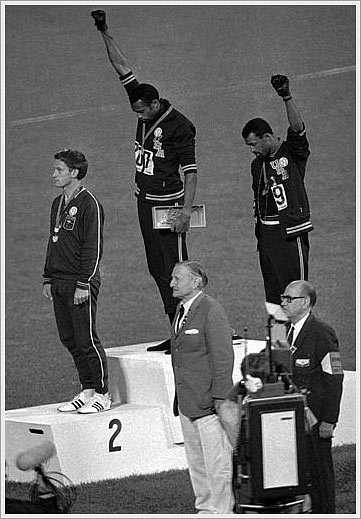
Tommie Smith and John Carlos give the Black Power salute

In addition to Beamon, who set his record at the 1968 Mexico Olympics, I can remember him educating me about another 1968 winner, 200-meter sprinter Tommie Smith. My father would always extol Smith’s world-record breaking performance in that Olympic’s 200-meter event, but he would also explain about what came after, Smith’s and bronze-medal winner John Carlos’ black-gloved salute, on the podium. I don’t think it would be hyperbole to say my father admired both deeds. Of course many people, when it happened in 1968, didn’t view it the same way, certainly not the International Olympic Committee itself, which stripped Smith and Carlos of their medals and banned the athletes from the Olympics for life. A spokesman for the IOC said that the act was “a deliberate and violent breach of the fundamental principles of the Olympic spirit.”

Tyson Gay after winning the 200-meter event in Osaka, 2007

The other night, American Tyson Gay won the men’s 200-meter event at these Osaka championships. Like every other winner in every other event from every other country, he went over to the stands where someone, probably his coach, tossed him his country’s flag and he paraded around the track with his red, white, and blue cape. I suppose this has gone on for years but I hadn’t realized until now that it had become de rigeur. The uniformity of the gesture tends to even out the patriotism field a little, which I suppose is a good thing, but it also makes the gesture essentially empty, ritualized behavior. It seems to me that many of these flags are being produced from shrink-wrapped packages at the bottom of the coach’s bag. Perhaps by Beijing 2008, the athletes will be tucking them into their jockstraps and sports bras to save time. Perhaps by London 2012, those flags will be sponsored by Nike and Nikon.

The black fist is a meaningless symbol. When you open it, you have nothing but fingers — weak, empty fingers. The only time the black fist has significance is when there’s money inside. There’s where the power lies.
Jesse Owens

In Owens’ day, his skin color precluded him from cashing in on his achievements. For Smith and Carlos, their bold gesture precluded them from even taking their “silverware” home, to say nothing of cashing in. For today’s generation of Black athletes like Gay and Allyson Felix, you can’t help but get the feeling that they’ve got their hands on Owens’ fistful of dollars, but that The Power still lies elsewhere.
World Cup 2006 on TV

I’ve suddenly found myself to be a huge soccer fan (yeah I know, only us Yanks — and the Japanese — call it soccer, despite the British English etymological origins of the word), and thus very excited about the upcoming World Cup 2006 in Germany.

I couldn’t care less that the US is in it, nor for that matter Japan, although given that I view both as underdogs, I’ll probably be rooting for them (as I will be for all the African teams, and tiny Trinidad and Tobago). I just want to watch the matches, and as many of them as I can. Fortunately I have access to the two NHK satellite channels, including the high-def BShi (which even on the cheap analog that I have looks amazing), as they will be showing all games live. Not only that, but because of the time difference between here and Germany, all games will be on TV after I come home from work (most games will be shown at 10pm, 1am, or 4am), which was not the case in 2002. Granted, some of these games are at 4 a.m., but still. Not sure what the sub-channel audio situation will be, though in 2002 many if not most broadcasts featured English on the second audio channel, so I’m crossing my fingers for that.

Mind you, I’ll listen to the Japanese, it’s not a problem, though if Japanese is the only option for the matches featuring Team Japan, I’ll probably employ the mute button — there are few worse things to listen to than completely biased Japanese commentators (except of course, completely biased American commentators!).

At any rate, mostly for myself, I’ve compiled a TV guide of the Group Stage matches as they are shown here in Japan. I’ve uploaded it (excuse the down and dirty html site) in case there are others living here in Japan who might find it useful:

World Cup 2006 Group Stage Japan TV Schedule

It’s only the Group Stage matches at this point (in brief, there are 8 groups of 4 teams each, teams play other teams in their group, the top two teams advance to the final 16). I will probably create a second guide for the “knockout stages” later when those teams are determined.

UPDATE (June 7, 2006): I’ve added a broadcast schedule of “Daily Highlights” and “Weekly Highlights” programs.

UPDATE (June 23, 2006): I’ve now added the Japan TV broadcast schedule for the Knockout Stage which begins Saturday night (technically Sunday morning at 12:00 a.m.). Not all the names are filled in of course, but I’ll update it as we go along.

Sumo dedicated to the gods

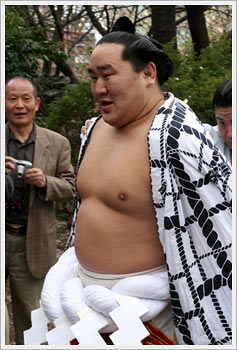
Yokozuna Asashoryu, in a relaxed mood, April 7, 2006: click for gallery

We went to the annual 奉納相撲 (hounouzumou) Sumo exihibition at Yasukuni Shrine yesterday. It was the third year in the row for me, second for Naoko and Kaika. Unlike the last two times, I didn’t wake up at an ungodly hour (for me) and be one of the first to get in at the 8 a.m. gate-opening; this year we decided to go with the flow so to speak and we got there about 10:30. Funnily enough, while we were still at home eating our breakfast there was a 生中継 (nama chuukei, or live broadcast) from the event on とくダネ, one of the morning shows, showing the usual opening rush of fans scrambling to get the seats next to the 土俵 (dohyo, ring).

At any rate, the place was quite full when we got there but we found a decent location near the makeshift 花道 (hanamichi, literally flower path) that the rikishi enter down. This was pretty much what I had wanted anyway, as when you sit in the areas down by the dohyo you must take off your shoes and you feel a bit trapped. This year I wanted to try to get more shots of the rikishi when they were just standing around or walking down the hanamichi, and it was easy to get in and out from where we were.

Despite being a very chilly and overcast day, the place was more packed than either of the two previous years, an indication that perhaps finally, the popularity of the sport is taking a turn for the better. There were of course the usual hardcore fans (I guess that would include me), the おばあさん・おじいさん達 (obaasan/ojiisan-tachi, elderly set) bussed in from somewhere, the legions of French speaking elementary schoolkids (they’re there every year, but only stay 45 minutes or so), and the tourists visiting the shrine itself who wander in wondering what all the commotion is about. But it seemed to me there were a lot more folks who enjoy Sumo on a casual level. It doesn’t hurt of course that the event is free.

Partly because where we were sitting, and partly because I’m becoming something of an old-hand at these “exhibitions,” but I must say I barely paid attention to any of the bouts, a word I use lightly. Let’s just say these guys know how to put on a crowd pleasing show, and there were an inordinate and unrealistic amount of うっちゃり (utchari, backward pivot throw) in evidence. No matter, for the fans this event isn’t really about the sumo, nor even about the ostensible Shinto “offering,” but rather more akin to a symphony-in-the-park outing, with bentos, sake, and sumo wrestlers. The latter were for the most part in a relaxed mood as you would expect, no game faces here. Yokozuna Asashoryu (that’s him above) was even more jovial that I’ve seen him before at these types of events, practically dancing his way down the hanamichi, tossing the 清めの塩 (kiyome no shio, purification salt) backwards onto the yobidashi’s head instead of onto the dohyo, and glad-handing the fans as his made he way out of the sunken amphitheater to whatever car had brought him to the proceedings. And interestingly enough, for whatever reason Asashoryu decided to don his gold まわし (mawashi, belt worn by wrestlers), which hasn’t been seen in over a year.

The only sour note, and it’s the same every year, is the question of why this event has to be at the nationalistic Yasukuni Shrine in the first place. It’s a shame such a nice event is held at such a distasteful place.

(Click the above photo for a gallery of the event).