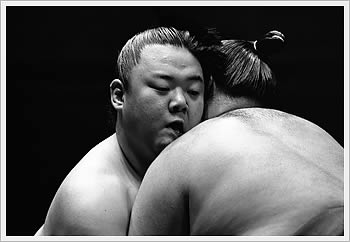
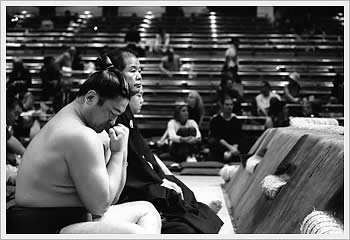
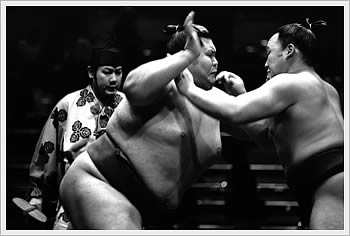
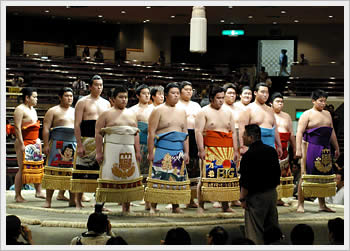
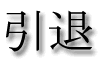
If you live in Japan, then it is doubtful that you haven’t heard by now that the most popular Sumo wrestler in Japan, Yokozuna Takanohana, retired yesterday, in the midst of the current New Year Grand Sumo Tournament being staged in Tokyo, in which he had struggled with a less-than-100% healthy knee and injured shoulder to a 4-3 record. With his retirement, the 30-year old Takanohana tacitly acknowledged that he could no longer live up to the honor of being a yokozuna, sumo’s top ranking.
Takanohana’s news conference announcing his retirement was broadcast live on all 5 networks this afternoon, and was the lead story on tonight’s news programs. Though I’m a little late to this party, it was hard not to get caught up in the nation-stops-what-it’s-doing nature of the event, in the emotional reporting on the champion’s attempts to battle back from a crippling knee injury in 2001, and in the grandeur of Takanohana’s career that saw him turn professional at the age of 15, progress through a series of “youngest ever” victories, claim 22 Emperor’s Cup wins in the course of his career (4th best in history), and overall win 794 bouts to just 262 losses.
For me Japan’s national sport of sumo still resides on the other side of a cultural fence, full of mysterious (and occassionally maddening) pre- and post-bout rituals, extremely long and drawn out (though not interminably but rather fascinatingly so) psychological match-before-the-match sizing up and psyching out sessions, and a complicated melange of stables houses (called heya), stable masters, divisions, ranks, OB’s (old boys, former wrestlers), and wrestlers with flowerly, poetic and difficult to remember fighting names (called shikona).
But perhaps just as slowly as the bashos (tournaments) take place, I’ve been finding myself inexorably drawn to this inpenetrable sport. In fact, I think it’s its very inpenetrableness that has piqued my interest. Like so much of Japanese culture for me, I am still in the superficial stages of education and enthrallment with sumo, but with a sport as old as this, and so firmly rooted in Japanese Shinto traditions, I don’t feel there’s any need to hurry. That said, I cannot help but feel a little sad that my enthusiasm is flowering at this time of torch passing (but to whom?) and uncertainty over the sport’s future. And too late to witness or fully understand the impact of Takanohana’s career, nor that of his brother, Yokozuna Wakanohana — who together ushered in the “Waka-Taka” boom that looked for a while like it might revive the sport’s sagging image and ticket sales — nor of The Hawaiians, as the trio of American wrestlers from Hawaii (Konishiki, Akebono, and Musashimaru) are refered to, for that matter.
I think it’s fairly obvious to observers here that no small part of the attention to and sadness at the retirement of Takanohana has to do with the fact that he’s probably the last Japanese yokozuna we’re likely to see for awhile, in a sport that has already lost much of its grip on the sports consciousness of Japan to first baseball and now football (soccer). The other current yokozuna, Musashimaru, is of course from Hawaii, and in any event he too has been plagued with injuries (he is sitting out the current tournament) and may not be long for the dohyo (sumo ring) either. Where the 1,500-year old sport goes from here is anyone’s guess, but it seems certain that already tough times will get tougher.
Poised to be next promoted to the rank of yokozuna is Mongolian Asashoryu, who was promoted to his current ozeki rank last September and who won his first grand tournament last November in Fukuoka. Ironically, after starting off the current basho strong with 8 straight victories, he stumbled today and suffered his first lost. Perhaps the pressure of what is there for the taking should he choose to grab it got to him. I don’t know enough at this point to write about what Japanese wrestlers may be out there to pick up where Takanohana left off, though chances are good he’s not anywhere on the radar screen yet. One wrestler who has however caught my attention and that of a growing number of fans, is maegashira Takamisakari, who psychs himself up for each bout by slapping himself violently. Takamisakari is part of the Azumazeki stable which is run by Takamiyama, the first American (as Jesse Kuhaulua of Hawaii) to be a professional sumo wrestler in Japan (debuting in 1964), and later the driving force behind the careers of Konishiki and Akebono. Takamisakari may never progress toward the vaunted yokozuna (although he is doing quite well for himself in the current tourney, for the moment being 7-2), but his unorthordox style and shy, almost geek-ish outside-the-ring personality, might help to recapture some of the under 30’s crowd the sport needs if it is to survive.
Amid the rapid-fire flashbulbs at today’s news conference, seemingly lying in wait ready to pounce with even more voraciousness at the first sign of a tear from Takanohana’s eyes that never did come (in the part I saw), the retiring yokozuna bowed out as rikishi (wrestler) saying simply “I have reached the limit of my physical strength and I want to retire.” Perhaps now he will follow in the footsteps of his father, an ozeki in his day, become a coach and maybe even the eventual stable master himself. And like he did with his father, taking his father’s shikona Takanohana for himself, perhaps one day another Noble Flower from the Hanada Dynasty will bloom again.