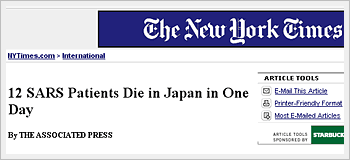
Irresponsible copy-editing

New York Times - Associated Press Online SARS story error: click for larger image

Now my father is in the biz, so I know mistakes can obviously happen in any newsroom, but for the life of me I can’t figure out how some editor (or intern?) substituted Japan for Hong Kong in the headline for a story of yet more SARS-related deaths in Hong Kong, as pictured above (the story is here at New York Times online, though I suspect the headline will be corrected fairly shortly). In the Times’ defense, I’m sure this error was committed over at Associated Press, as it’s just a wire story being picked up and published as is. But at a time when there is a lot of panic about SARS, especially here in other as-yet-unaffected parts of Asia like Japan, it seems mighty careless and irresponsible of them, no matter who originally made the mistake. These kind of glaring errors rarely happen in print editions, with gauntlets of editors and proofreaders to go through, but they seem all too common online. When will we get to the point where online editions must pass through the same scrutiny?

A political situation to be proud of: Finland’s first female prime minister

On Monday, the Finnish parliament voted Anneli Jaeaetteenmaeki into office as the next Prime Minister of Finland, the first Finnish woman to hold the post. Her appointment also means that Finland is the only country in Europe with both a female president (Tarja Halonen, elected 2 years ago) and a female prime minister.

Now, I know nothing about Ms. Jaeaetteenmaeki’s politics, and wouldn’t normally be reporting on the political makeup of a Scandinavian country of only 5 million people, but as someone who is half-Finnish, and as the son of a strong, self-willed, and politically active Finnish woman, I couldn’t help but beam with pride when I heard the news.

(Link via Robot Wisdom)

I’m in shock and awe over the destruction of language

Fred over at Fragments at Floyd wants “awe” back and offers some replacements for consideration:

Shock and Terror. Shock and Fear. Or Shock and Dread.

Here are a couple more: what about “Shock and Killing,” or “Shock and Destruction?” Oh right, one can’t be that literal, that truthful.

The real shock: the way that language has been manipulated this week, and how most just go along with the euphemistic smokescreen. “Target of opportunity,” “decapitation strike,” “embedded journalists.” I’m ashamed of my country. But must I be ashamed of my native language? No, I refuse to be.

Abstracted as they are, “shock” and “awe” read like nouns, rather than verbs, as in “to shock and to awe.” As nouns, they are used to express the emotions of the beholder, the receipient, of something shocking and awe-inspiring, and not used for the originators, the instigators, of the shock or awe. But the presumptuousness of this construct isn’t surprising. It’s a presumptuousness that says, “We’re going to rain down bombs on you, and then we’re going to tell you and the world how you feel about it, whether it’s true or not.” The presumptuousness of invaders, of imperialists. Imperialists who are extending their tyranny to language.