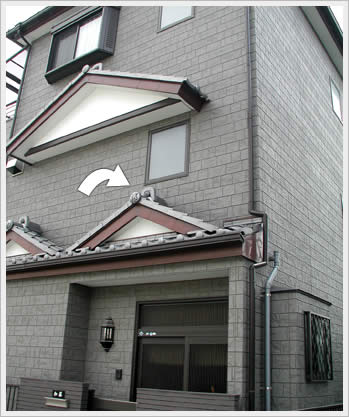
This home is just down the street from us, and on first glance it seems to be yet another modern house built according to templated plans by Japanese companies like Seiksui House, Misawa, or Hebel House. These houses dominate the modern suburban landscape with their drab boxy exteriors. But this house is a little unusual: it is the house of a family that runs a san-gawara (glazed ceramic tiles) company named “Kato Kawara-ten”. And so, as I’ve pointed out by the arrow, they have adorned the side of their house with gawara-covered gables (I believe that’s the correct architectural term) that are fronted by oni-gawara (from Antipixel: “Oni-gawara (demon plates) perform the same function as Western finials and gargoyles: they ward off evil […]”). These particular ones bear their family name. (In point of fact, I’m not sure if that qualifies them as oni-gawara or some other type of decoration).
You can click on the above picture to be taken to a close up picture of one of these oni-gawara.
Not surprisingly, there are “collections” of oni-gawara on the web, though I didn’t find as many as I thought:
Onigawara Museum
Interesting Onigawara
You might also want to take a look at the web site for Yamamoto Co. They’re a famous oni-gawara manufacturer based in the Sansyu Gawara area in Aichi prefecture near Nagoya (around 50% of all kawara is made in this area). A nice range of styles are shown there, and also pictures of the manufacturing process.
Mulling over the concept of “template” houses, I wonder if they are the next step in the longstanding Japanese tradition of prefrabrication and standardization–the tradition that developed tatami, shoji, and fusuma. Looking at one of these houses, I’m reluctant to call them traditional. But maybe they are.