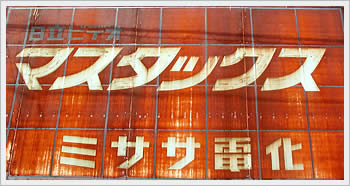
And old rusted sign above a storefront-cum-house on the small street that serves as my thoroughfare to and from the train station. I pass by this sign everyday (conservative calculations would indicate I have passed it around 700 times up to now) yet until today I paid it no mind. One gets used to such ugliness in Japan, one gets numb to it, until one decides to take a picture. What struck me today was the rust, and the fact that I couldn’t for the life of me figure out what masutakkusu was supposed to mean. (It’s rendered in katakana, which is usually reserved for foreign-imported words, so it was likely some bastardization of some English word, or so I thought.)
In the upper left it says “Hitachi Video”, and this provided enough with which to do an internet search. (The bottom characters spell out “Misasa Denka,” or Misasa Electronics, the name of the company for whom the sign is — was? — for.) Masutakkusu was the name of one of the original VCR models manufactured by Hitachi is the late 70’s in the VHS format, to compete with Sony’s BetaMax, which had been introduced in 1975. I’m not sure, but I believe the Masutakkusu line of VCR’s was produced until the late 80’s. I say this because according to the official site of the Tsutenkaku Tower in Osaka, one of the city’s symbols which has, almost since its construction in the early 1950’s (actually re-construction, the first tower having been burnt down in a fire in 1943), featured Hitachi neon branding on all its four sides, in 1979 was already displaying “Hitachi masutakkusu.” But sometime between 1988 and 1990, it disappeared, replaced by signs for other Hitachi products. (Various images of the tower and the neon signage that has adorned it, are available here.)
Unfortunately, the mysteries of Hitachi branding remain unsolved. Why masutakkusu, and what was it supposed to represent, I have no clue. takkusu would most likely be romanized as “tax,” so perhaps the name was a take-off on or nose-thumbing to Sony’s BetaMax. Something like “MassTax.” Hmmn, that way it conjures up something entirely different, no? But such are the vagaries of katakana transliteration that it’s entirely plausible.
(You can catch up on the long-forgotten early history of home video development by way of this nice piece.)
P.S. I didn’t intentionally boost the orange hue of the photo via software. It’s that bright in real life.
First time reader and poster. Linked from Mr. Butta’s site. Sounds like you all had a nice shindig the other night.
As for masutakkusu, I am inclined to think the masuta in masutakkusu is actually the English word master. I, too, did some searching which lead me to the famous RCA/Victor dog listening to the phonograph. Well, apparenlty the dog was listening to his masters voice on the recording. I suspect this is where the audio/visual term master gets it’s roots. Also, if you write BetaMax in kana, you get the same ~kkusu ending. I’m not sure if Hitachi made the BetaMax, but I suspect they are just playing off the ~ax(max) meaning and familiartity. Digimon for example co-opted the ~mon ending from Pokemon and was somewhat seccessful. Beta, in technology terms is something that is not quite up to par for production. Maybe Hitachi viewed their technology as superior to the BetaMax and thus opted for Master. I suppose we can’t be sure, but I had nothing better to do on my company’s time today, so I enjoyed the diversion.
Great pics Kurt!
This is one of the reason why I do my photo-blog. I want to keep being alert to things around me and find pleasure in the most unexpected things. Such a beautiful rust, I m jealous!! Keep your head up, scanning the life around you for bits to enjoy.
Lovely photo, Kurt! I like the way you have captured the full tonal range of oranges in the rusted sign. Glad to see you are posting more of your photography–that’s what attracted me to your site in the first place 🙂
Thanks for bring the photos section back. Great Pictures!