We received a thank you card from my mother today, thanking us for sending her a lot of photos of Kaika. Attached to the card, as if in afterthought, was a post-it note with the following written on it:
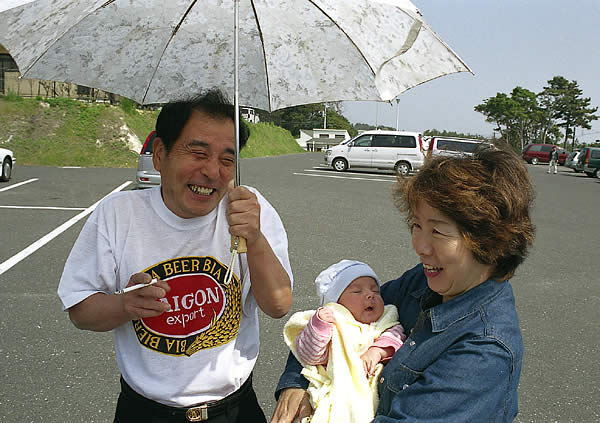
I was horrified to see a cigarette in the same picture with Kaika. Kurt, keep him protected from the secondhand smoke. I mean this!
She was referring to this photo of Kaika with his maternal grandparents, in which my father-in-law has a cigarette dangling from his fingers. I do admit I paused before including the photo in the packet I sent her, for fear it might get her back hairs to stand up. My mother has always been a vigilant anti-smoking advocate, especially as it relates to children. When I was a kid, long before the term “secondhand smoke” entered the common lexicon (according to this article, the possible effects of secondhand smoke, or ETS as it’s officially known, first came into public knowledge around 1984), my mother had no problems turning to cigarette-smoking passengers on a bus, for example, and asking “Could you please not smoke here? It’s not good for my children.”
My father-in-law doesn’t smoke in the house, nor the car. In point of fact, Naoko is just as vigilant as my mother, and it was her concern about secondhand smoke that forced him outside the house to indulge his habit, several years ago. Unfortunately, as my mother wouldn’t know, and for the time-being I’m not going to tell her, the real problem is not with my father-in-law (or sister-in-law, for that matter, who also smokes), but with this entire country, where there exist very few non-smoking places, and few laws to protect those of us who don’t smoke.
Let’s take Kaika to the local department store. It’s supposedly no-smoking in there, but in reality one can smoke in the food court, which takes up half of the entire first floor. Coffee houses? Forget about it! With the well-publicized exception of Starbucks, you might as well cut to the chase and give the kid a cigarette directly. Restaurants? Well, some (but not all) have no-smoking sections, but little good do those actually do. You can segregate customers in tiny token no-smoking sections, but you can’t segregate cigarette smoke.
Recently some measures have been in the news recently, such as Tokyo’s Chiyoda Ward banning smoking on its streets in the summer of 2002, or private railway stations in Tokyo banning smoking on train platforms on May 1st of this year. However, in the case of the former, the impetus for the ban was not the dangers of secondhand smoke, but rather to help cut down on cigarette butt litter, and because smoking in public is “bad manners.” In the case of the private railway stations’ ban, the action was taken by these companies, according to this Foreign Press Center Japan article,
[…] in line with the Health Promotion Law that went into effect on May 1. The new law imposes a legal obligation to prevent passive smoking, which refers to people unwillingly inhaling the secondhand smoke of others and can be extremely unpleasant and irritating for nonsmokers. It covers places used by the general public, including gymnasiums and department stores, as well as train stations.
This is all well and good, and indicates an increased awareness of the problem of secondhand smoke in a nation where 30 million people smoke, including nearly 50% of all adult males. (I suppose one should look on the bright side: in 1966, 85% of adult Japanese males smoked!) But the fact that the Ministry of Health and Welfare, which promulgated the new “health promotion” law, couldn’t even see fit to get rid of all the cigarette vending machines in its own headquarters building, seems to indicate that the government is not prepared to put its money where its mouth is.
Rather, it talks out of both sides of that mouth, and puts the money into the state coffers. Japan Tobacco, the 3rd largest cigarette maker in the world, and ostensibly privatized since 1985, is in fact still two-thirds owned by the Finance Ministry, although it is planning to sell off its equity share, at some point. According to this article, the government rakes in $18 billion U.S. a year on cigarette tax (60% of Japan’s $2/pack price is tax).
And so, despite the fact that over 100,000 Japanese each year die from tobacco-related illnesses, and that the cost of medical treatment for illnesses related to cigarette smoking is ¥1.3 trillion ($11 billion U.S.), I can’t see any ministry of the government getting really serious about this nasty killer, as long as it’s in their financial interests to look the other way, and there are Diet members and ministerial bureaucrats around to protect those interests.
So Mama, Naoko and I will do our best to protect Kaika from secondhand cigarette smoke, but please realize we’re fighting an uphill battle.
This year, the Osaka Board of Education has declared no smoking by anyone (teachers, guests, parents, etc.) anywhere on school grounds. Although a lot of prinicipals and teachers complained, many of them have actually been forced to quit or at least cut down. It’s a step in the right direction especially now that students can walk into the teachers’ room or the principal’s office without being hit with the secondhand smoke bomb or an ashtray full of smelly cigarette butts. Cheers!
I always give people nasty looks (and I’m a big foreigner: I just stop and stare them down, sometimes standing in front of them) when they smoke in no-smoking areas. When I’m with my wife (who doesn’t like my neo-confrontational approach), I often ask her in a rather loud voice why Japanese people insist on smoking on the train platform or ignore signs, or I lament the passing of Japanese politeness and consideration for others, or suggest that perhaps the smokers are illiterate and thus can’t be blamed. Another favorite is to get a smoker’s attention, then look at the no-smoking sign, look back to them, again at the sign and at them, then sigh and shake my head. It really works.
I’m tempted to carry a squirt gun and put out the cigarettes myself. I occasionally smoke, but I take care not to disturb people. I hate it when people walk with a cigarette as well, tempting me to get a big lungful of smoke and blow it in their face. But when I first came to Japan i wasn’t considerate in this respect, so I guess its a karmic payback of sorts.
Smoking should be outlawed entirely. Hell, I’d gladly donate the money I should’ve been paying NHK these past 2.5 years to the gov’t in exchange for a ruling like that. It’s a small price to pay considering how many lives it’d save in the long run.
Nutrimentia — Holy crap… I was rolling on the floor imagining you squirting out some sarariman’s cigarette… Hahaha!
I must say, that would be an incredibly sweet moment.
I often worry about the effects of second hand smoke while out in public with my children. I am utterly disgusted by the habit. Sadly, my father is a life long smoker and I refuse to even step into his house to due the smell or allow my children to enter.
Smoking should be banned but that will never happen, at least in the US. The tobacco companies have deep pockets which reach into the pockets of the government. Tsk Tsk.
I hate smoking, and when drunk, often confront people smoking where they shouldn’t be. Would I do that on the New York subway, or the London tube? Would I hell.
I’d be too scared of what might happen.
I think we become so used to politeness/good manners the rest of the time, that we demand good behaviour ALL the time when in Japan.
I asked a friend from Chicago if he was worried about putting his kids through school here (bullying etc). His reply was that he remembers kids in his high school class dying of drug overdoses, and being involved in gangs.
So Kurt, I’m completely with you, and truly believe that Japan needs to do more about passive smoking. But we have to ask ‘how does it compare to other cities as a ‘dangerous’ place to raise children?’