It’s the start of the Aki (Fall) Sumo tournament here in Tokyo and after more or less taking the last basho off, I can feel myself getting back into the swing of things, and look forward to making it down to the Kokugikan for at least one if not two days of action this basho. Of course, the other days I will be glued to the nightly highlights show broadcast on NHK. (The basho runs from September 12 – 26.)
There are many compelling stories this basho, starting first and foremost with whether or not Yokozuna Asashoryu can win his fifth consecutive tournament and continue his quest to be the first rikishi in history to win all six bashos in a single calendar year. He is also attempting to break the record for the most bout victories in a year.
His 19 year old Mongolian countryman Hakuho is slowly but surely being touted as perhaps the next Yokozuna, and is coming off consecutive double-digit win tourneys. At Maegashira #3, Hakuho is now ranked high enough that he is virtually guaranteed to meet the Yokozuna for the first time on the doyho — in short, a most anticipated bout. Ozeki Tochiazuma seems to be finally fully healthy, and in my book is the leading contender to upset Asashoryu’s record-setting plans. Further down the banzuke, there are several newcomers to the top division that folks will be following, namely the Bulgarian Kotooshu who has already become a fan favorite due to his kawaii looks (the dreaded “David Beckham of Sumo” has been uttered more than a few times already).
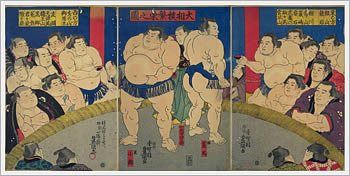
The above ukiyo-e print is of a special exhibition bout between Koyonagi on the left (in the middle panel) and Arauma on the right, from sometime in the middle of the 19th century. Both rikishi had long, distinguished careers: Koyanagi was active from Tenpo 6 (1835) to Ansei 3 (1856), reaching as high as the Ozeki rank, while Arauma’s career spanned from Tenpo 3 (1832) to Kaei 7 (1854), his highest ranking being that of Sekiwake. (This was in an era which saw only two tournaments per year, with these being only 10 bouts long (in contrast to today’s 6 yearly tournaments of 15 bouts duration each).)
Interestingly enough, both rikishi hailed from the same part of Chiba prefecture east of Tokyo, and apparently this helped give rise to a spirited rivalry between the two which made them two of the most popular rikishi at the time. In fact, the pair were so popular that they were immortalized in the lyrics to a famous children’s song of the time. It is said that along with Ozeki Tsurugisan, who is one of the off-dohyo rikishi depicted in the far right panel of this print, the three were lauded as the preeminent rikishi of that time. (Tsurugisan sounds like he’s worthy of his own post: at one point in his career, he turned down a chance to become Yokozuna, claiming that his dohyo form wasn’t good enough. That didn’t stop him however from wrestling until the ripe age of 48!)
The above print triptych was done by Kunisada (Toyokuni III) sometime between the years 1844 to 1850 (based on the seal/signature analysis found on this page). Click on the above image for larger versions of the triptych.
So much for Tochiazuma. With that knee injury he’s kyujo and thus kadoban next basho. I was really disappointed about that, as I was really looking forward to seeing the Tochiazuma-Hakuho bout today. Oh well.
I’m liking Hakurozan down in Juryo quite a bit, and see a great Roho/Hakurozan future in Makuuchi. Should be interesting to have Russian brothers from different heyas competing.
And of course I’m thrilled with Takanotsuru’s start this basho. He just may stick in Makuuchi for a while this time while Toki is down in Juryo.