
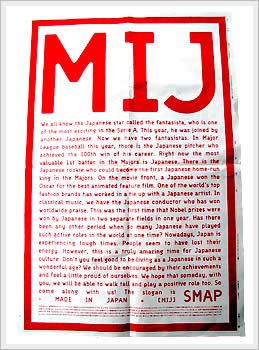
The above is a full page ad that was published in yesterday’s Yomiuri Shinbun, sponsored by the hugely popular Japanese boy-band, and television mainstay, SMAP. “MIJ” stands for “Made in Japan,” and the ad is a admonishment to Japanese to feel proud of themselves, and of the recent achievements of some Japanese in the fields of sports, film, music, fashion, and science. As the crux of the copy says (click on the above image for a larger, and more readable, photo of the ad),
Has there been any other period when so many Japanese have played such active roles in the world at one time? Nowadays, Japan is experiencing tough times. People seem to have lost their energy. However, this is a truly amazing time for Japanese culture. Don’t you feel good to be living as a Japanese in such a wonderful age? We should be encouraged by their achievements and feel a little proud of ourselves. We hope that someday, with you, we will be able to walk tall and play a positive role too. So come along with us. The slogan is – MADE IN JAPAN = [MIJ]
The ad’s appearance coincided with a new SMAP television program broadcast last night called, unsurprisingly, MADE IN JAPAN, although to be fair, nowhere in this ad is the television show mentioned or promoted. I didn’t see the program, but according to the tv schedule and the little bit of it that Naoko saw, it featured the band members each participating in a different aspect of traditional culture, such as working at a small Japanese chopsticks factory. According to Naoko, the band members have come to realize that they, like many of the young adults and teenagers they count as their fans, know precious little about their own culture, and that rather than look towards the West for inspiration, Japanese should start appreciating their own cultural output and achievement.
Given this however, I do find it curious that they chose to publicize their message in English, in a Japanese newspaper (the Japanese version of the ad’s copy is printed at the bottom of the page, in small type). Further, I also wonder about the idea of using those Japanese who “have played such active roles in the world” as the underpinning of the ad’s message. (Interestingly, none of these achievers is referred to by name, although it’s easy to work out who each one is.)
Certainly Japanese should feel pride that the likes of Ichiro and Miyazaki and Seiji Ozawa and Tanaka Koichi (Nobel prize winner) are succeeding on the world stage. But perhaps, by focusing on those who have had success outside of Japan, the ad is ultimately sending a mixed message. In a way, the ad seems to imply that, unless or until one’s achievements are recognized by the rest of the world, they’re really not achievements, or only half-achievements not worthy of pride, at any rate. Exhorting Japanese to feel pride in themselves, to look inward rather than outward, is all well and good, but as long as the West is posited as the arbiter of success and achievement, the standard by which all else is measured, I’m skeptical of how much good messages such as these will do, no matter what language they’re written in?
Very insightful argument and a cogent analysis:
“Japanese to feel pride in themselves, to look inward rather than outward, is all well and good, but as long as the West is posited as the arbiter of success and achievement, the standard by which all else is measured, I’m skeptical of how much good messages such as these will do, no matter what language they’re written in?”
I think this is great.
Japan is currently suffering from a dearth of soul. They have a lot to be proud of, but they’ve lost their spirit to a large extent.
The real problem is not that they look to the world for approval, but that they don’t get involved *enough* in the world. I’d like to see a Japanese-run world-wide news network like DW or CNN. Things like that would connect Japan into the global community even more. Unfortunately, there’s too much xenophobia and isolationism left to do some of these things… They need get out into the world, and let others into Japan as well.
This ad campaign is also featured along the construction hoardings of the Dojunkai Aoyama Apartment complex redevelopment on Omotesando Dori. And it’s HUGE – about 20m long and 3m high. Same separation of English and Japanese text as well. Initially I thought it was a conceptual art project to accompany the other photography installations that now line the street 😉
It’s in English probably for no other reason than English is kewl. This is why so many Japanese songs have English in them too.
About the West being the arbiter of success and achievement – I would take that one step further. It’s not the West it’s the States or England. Most Japanese musicians especially don’t care too much about Australia or Europe when it comes to seeking fame. In fact in Australia many people struggle to get attention in the West as well. Why else did Little Johnny send Aussie boys to the Gulf?
But there may be another point in here somewhere (I should really have a cup of coffee before I coment on other peeps blogs hey?) – a lot of SMAP or really any of the big J-pop bands have considerable success in the rest of Asia, and it’s well known that most Asian countries communicate in English on at least a business level – this may steer it to being less of a cry to the West, and more of a general use of the language which seems to have become the international one – English.
Gosh I didn’t really clarify anything but make the issue more complex – I’m off to have a coffee now…(^^)
Yeah, it is pretty weird that it’s written in English. But I’m not sure I see the problem with wanting the be successful on a world scale more than on a national scale. Isn’t that a desire in every country?
I haven’t seen the show, but I like your description of it. A friend was telling me about an Enka singer who visited her town and told the people there that Japan’s strongest resource was its culture. He was sad that while “japonisme” once pervaded art and design around the world, the Japanese were now being too influenced by western culture and ignoring what was special about their own.
I saw about 5 minutes of Kimutaku making natto last night and thought “huh?”, so now I know what that was about. National pride is an uncomfortable topic in Japan, so this is a tough message to sell. Despite the economic slump, I often say that Japan’s economy is better than the U.S.’s, because it’s more humane without the huge income gap, and health insurance is more affordable. I would definitely like to see Japan’s government be more opinionated and forceful with the U.S.
But Kimutaku may not be the best way to do it. Boy band, father of 2?
I never knew what “MIJ” meant but ‘thanks to you’ I do now. Just when I was beginning to doubt the youth of Japan, SMAP goes and does a wonderful thing. Go figure.
More people listen to Kimutaku than to any politician I suspect.
Especially since he’s blonde again (^^)
Kurt – Could this be somehow related to turning around the recent spate of suicides by young people ?
Excellent post and stimulating discussion! I don’t watch much TV and I only read the news online, so I missed this one entirely. I think the English text was just for flair- it’s much more noticable that way.
George- I highly doubt it. The two seem highly unrelated to me.
I would add Sadako Ogata, ex-UN High Commissioner for Refugees, to SMAP’s list of impressive Japanese, (not to mention that SMAP’s list is all male.)
What other Japanese women role models are there?
p.s. Kurt- you need to update your copyright to cover 2003.
If the ad is written in English in a Japanese newspaper, it probably means the same thing as the other things written in English means — nothing. Nobody seems to care what’s written if it’s in English, and look at it as part of the design.
Anyhow, I can read English and there is something that I agree with the message that the ad gives. Us young people don’t know a lot about our own Japanese culture. I don’t know a lot either, maybe except for the food culture. Just like when China was very “in” a couple hundred years ago, now the master of the Japanese culture is the West. We all learn English starting elementary/middle school. And take pop/rock music for example. Can you see ANY piece of music that does not include a line or two in English? But as the Japanese has done in the past, we have a wonderful sense of taking in foreign things and converting it Japanese-style, more delicate and in better quality. Like with cartoons, machineries, etc. In a way it’s a personality of Japan. And what Japan is, (or any country for that matter) is how Japan is seen from the world outside. We could be having a prosperous time all by ourselves, but the recognition of a wonderful culture is only achived by the interaction with other countries. I’m sure that the foreigners discovered many things they did not know about Japan by actually staying in Japan. Well, the great creations and contributions need to approved by the rest of the world for a country to be renowned.
But again, Japanese has been stressing “playing active roles in the past” ever since the Bubblye bursted. But really, I think the main problem of these social problems is the stupid uniformity in schools, which bans unique personality. For goodness’ sakes, the students are still wearing the old navy uniforms that they did during the war. And they should stop the university entrance exams which consists of memorizing dumb, dumb things like famous peoples’ names, years, places, and actually give us tests that measures REAL academic skill of the people! Really!!
PS Kaika is sooo cute! =D What color are his eyes/hair?
This is scary: an entertainment show trying to promote ideas. You never know very well: do they really promote ideas or do they promote their TV show? I’m afraid this MIJ advertisement is less about intellectual thinking and more about surfing on the waves of popular trendy, superficial moods.
Kurt, the guys at work are telling me that this “MIJ” press is all about SMAPs new album. Crass commercialism after all.
Gen-
I don’t think the fact the SMAP has a new album coming out necessarily is such a big deal. I suppose we’ll have to see what exactly the album is about. Until such time, I’m willing to give them the benefit of the doubt.
Just tonight I was watching one of the late-night sports shows, and they had a “MIJ” segment with one of the SMAP guys (a taped segment), in which the trials and tribulations of one of Japan’s first good soccer players was detailed (from what I gathered, he’s trying to have a comeback and make the national squad). Though is played like a commercial, it was part of the sports program.
At any rate, I’m surprised my post garnered som many comments and opinions, and glad it did. There’s another post to write from these varied comments, but I don’t have the energy or time to do it. But I’m appreciative for the feedback…..