
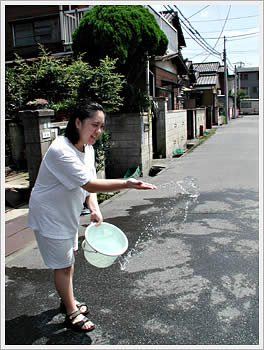
Today at noon there was an environmental experiment called “The Oedo Uchimizu”, whereby Tokyo residents were encouraged to water the sidewalks and streets of their city in an attempt to bring down the temperature.
Uchimizu is an old Japanese custom which, as the project’s website explains,
[…] is a […] well-known example of the use of water in Japan’s daily living. People sprinkle water, especially in the summer time, in their house entrances and gardens or in front of their shops to lay the dust or to ease the heat.
The idea is that if enough people were to simultaneously do this, the city’s temperature would decrease by a couple of degrees. To promote recycling, participants were asked to use rainwater or old bathwater, rather than water from the tap. Although we live in Saitama (prefecture to the north of Tokyo), Naoko felt compelled to take part in this event.
I had been unaware of this old practice until Naoko told me about it, but now I’ve been noticing that among some, it’s still quite a common thing to do. The other day while wandering around Tokyo University’s Hongo campus, I saw a security guard watering the asphalt around his post with a huge tea kettle, as if he were watering plants.
Sprinkling at noon seems a rather odd choice of timing. The water will evaporate in no time. This makes much more sense in the evening, which is also the time when the city releases the accumulated heat of the day and when things get uncomfortable.
I doubt that a 2 degree drop can be achieved within that one hour, but then I am not “a water expert”. Maybe we need to suggest some alternative plans, like tiling houses with mirrors to reflect the sun.
But seriously, the best way to achieve cooling is to stop sealing every square foot of town with concrete and asphalt; build natural airflow into buildings to reduce release of heat from air cons. It’s a vicious circle we have gotten ourselves into here.
Naoko said the same thing, it seemed silly that it was timed for noon. I suppose they felt they could get folks on lunch break to participate, and perhaps noon was more amenable to getting TV coverage, which not to be cynical, but was probably as much a goal of the project as reducing the temperature.
But yeah, I agree with you, these types of “mukashi” (“older days”) remedies play well, but seem to say “we’re stuck with the concrete and asphalt, so let’s deal with it. perhaps it might be a better idea to think bigger picture…. (to be fair, the project’s more extensive Japanese site (http://www.uchimizu.jp/) might be taking this approach, but I can’t read it).
The idea seems as if it was thought of by children, it is so playful in a way. Of course it adds to that nicely photographable image we have of Japan…
I have been to the swimming pool yesterday, and even there the ground was very warm next to the pool itself. It must take a lot of water to cool down the ground.
Thinking the reverse, one would think that solar power would feature much more prominently here.
Dirk
In the Kamegawa neighborhood of Beppu, where I lived, splashing water in front of the house was a common morning ritual for keeping down the dust. Water glistening on rock is visually and psychologically refreshing.
Although evaporation provides a momentary cooling feeling, this stops as soon as the water dries up. Early settlers to the Las Vegas valley used to hang wet sheets in the doorway of their cabins for the same reason.
M wrote:
“Water glistening on rock is visually and psychologically refreshing.”
This last point is not something to underestimate, the psychological value of sprinkling water around you. Not dissimilar to those wind chimes (i forget what they’re called now) that ryokans (trad. Japanese hotels) hang out, the main purpose of which according to Japanese I’ve talked to is to make one “feel” cooler.
Counter to this however, Japanese (certainly my family at least) love to mutter to themselves “atsui” (hot) (or more colloquially “atchee”) over and over again. I can’t imagine that that does anything to psychologically refresh them. And to my ears, it only makes the heat worse to have a bunch of people fanning themselves and muttering about how hot it is.
Just came across this info:
“Did you know that trees and vines could create a cool microclimate that reduces the temperature by as much as 9 degrees? During photosynthesis, large amounts of water vapor escape through the leaves, cooling the passing air. “
The evaporation is in fact releasing the heat of the pavement, i.e. cooling. If the ground is not allowed to heat-up the city will obviously be cooler, although I wonder if by two degrees C. Maybe they were talking Fahrenheit ?!! Or perhaps it’s simply mind over matter – the power of belief is strong indeed.
Anyway, why do you think there are so many horror shows, ghost stories and scary dramas on Japanese TV during the summertime ?? It actually pre-dates TV, but they show them because as people become nervous or scared they sweat. Sweating is the body’s natural cooling system. As the sweat evaporates it releases the heat from the body.
And now you know the rest of the story.
Yes, the plant thing is the answer (without tearing down all the buildings), and is becoming popular here. Roof gardens are becoming more common, apparently!
http://metropolis.japantoday.com/tokyo/485/feature.asp
Here in kyoto, the older houses called machiya (Cult 3D tour) have a long, narrow floorplan, and sprinkling water in the garden (often centrally located) and the resultant rising vapor will cause a draft of air to be pulled along the tooriniwa (the long entryway you shoot through in the animation) into the house, replacing the hotter air that has been cooking under the roof.
The uchimizu is nice in the evening.
The problem is, lots of obachan in Kyoto do the uchimizu out of habit even in the winter, where it freezes and makes you slip!
Ahobachan!
thanks for the post. very interesting. I lived in Japan 1997 to 2000 and always wondered why i saw building owners and employees spaying water outside.
I always thought it was very dangerous as well. Japanese buildings enjoy marble on the sidewalks outside the front door. Moisture and marble make for an easy slip and fall! I guess they don’t have to worry about someone suing the building or home owner in Japan.