
There seem to be a rash of articles on camera-equipped cellphones lately, mostly about the potential misuse of them and attempts by various bodies and associations to legislate their use.
Yesterday, Gen Kanai posted about two of them:
Japan’s ‘digital shoplifting’ plague
Korea Concerned over Cameraphones
Last week, Business 2.0 ran an article entitled “Are Camera Phones Ready for Their Close-Up?”, the subhead of which read “Everyone loves the new devices. But their misuse is raising questions.”
The BBC article that Gen linked to is about a new campaign by the Japanese Magazine Publishers Association to stop what they sensationalistically call “digital shoplifting” or “information theft,” that is, taking photos of magazine spreads with one’s camera phone. These publishers feel that if someone snaps a photo of a new item in a fashion mag to send to his/her friends (“look at this new Louis Vuitton bag!”), they are being deprived of magazine sales. Excuse me while I roll my eyes!
As I pointed out in a comment on Gen’s site, it seems to me that this snapping of photos of magazines like this is just an extension of the tachiyomi phenomenon seen in convenience stores across Japan. tachiyomi means to read while standing up, and refers to the prevalent practice among all generations of folks here in Japan to read magazines and comic books in stores (while standing up), without ever buying them. While not exclusive to Japan of course, this phenomenon does seem to reach new heights here. (Aside: I would love to know more about this cultural phenomenon. Are their any good sociological articles in English anyone can point me to?)
While many convenience stores, and bookstores, display signs admonishing customers not to peruse magazines without buying them, it seems to be hardly ever be enforced. My sense is that this new “campaign” against taking pictures of magazines with cellphones will end up the same way. After all, are they going to install surveillance cameras for this purpose, or assign a security guard cellphone watch duty? I hardly think not. And furthermore, according to the BBC article,
Japan’s bookshop owners have already said their staff cannot tell the difference between customers taking pictures and those simply chatting on their phones.
(The use of “chatting” might be misleading. Surely what the owners are referring to is text chatting by phone, rather than verbally chatting). Nevertheless, that the publishers consider this a serious enough problem that needs addressing via a “campaign” should give one pause.
As is often the case in Japan, when certain folks want to legislate behavior, they tie it to manaa, or “manners.” The posters the publishers will be asking bookstores and the like to put out supposedly, according to the BBC article, warn shoppers to “be careful of their ‘magazine manners’.” Additionally, in the BBC article, there was this paragraph near the bottom that amused me:
And only this weekend, newspaper ads warned phone users to avoid walking and writing emails at the same time.
And sure enough, in today’s Yomiuri Shinbun is such an ad:
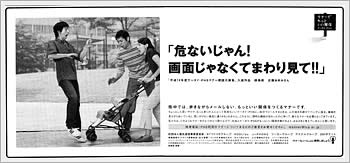
The headline of the ad campaign, which apparently was chosen among entries solicited from consumers during a “cellphone/phs manner campaign” last year, and is sponsored by all the major cellphone service vendors (DoCoMo, KDDI, Vodaphone, etc.) reads abunai jyan! gamen jyanakute mawari mite!!. A rough translation would be: “Hey watch it! Look around you, not at your cellphone screen!!” Not surprisingly, a baby in a stroller is featured in the ad. (Aside: Am I the only one who thinks they messed up with the framing of the picture in the ad? The couple on the right is partly cut off and there’s a lot of “empty” space on the left hand side of the photo. Click on the image above for a larger scan and see for yourself.)
In jest, I wonder if Adam and co. shouldn’t hastily add a panel discussion to this Saturday’s International Moblogging Conference line-up about this new “manner” campaign. Surely I’m not the only moblogger who has typed up a moblog post while walking down the street. Hell, I ‘ve moblogged from my bicycle on past occassion, and I’m not the only one to do so.
Seriously though, all this recent focused attention on the possible ills of camera phones is surely something that will come up at the conference. It’s easy to turn up one’s noses at the reactionaries in our midst, but there are some important issues about privacy and ownership and copyright, and manners to be discussed, and the sooner they’re discussed, the better equipped we’ll all be to proceed rationally towards acceptable uses of this new-fangled technology.
