One person’s corrugated is another’s dilapidated

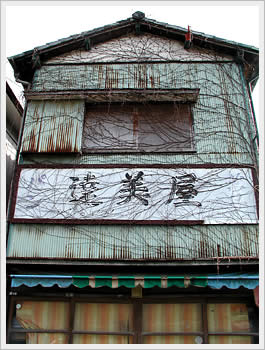
The front of a neighborhood store no longer in business, Warabi, Saitama, Japan (April 3, 2003)

Jeremy at Antipixel posted an image of a corrugated tin house in his neighborhood, and waxed somewhat lyrical about this material therein (and in the comments). I mentioned in his comments that until I started to pay a bit of attention to my neighborhood last year (ironically occassioned by some of Jeremy’s writings about Japanese architecture), I hadn’t taken notice of the fact that a lot of the homes around here employ the material.

Reading his post I thought it would be interesting to take another trip around the neighborhood, and do a “photo trackback,” as it were, to his paean to corrugation. What I discovered was that I hadn’t really noticed the extent to which my neighborhood has been corrugated. I saw so much of it on my little walk that it was as if the neighborhood itself had been “shape[d] into folds or parallel and alternating ridges and grooves” (to borrow American Heritage’s definition of corrugate). Not only were many of the homes faced with it, but whole blocks seemed to be fenced in by the stuff. As I commented on Jeremy’s post, I tend to associate corrugated tin with dilapidation, poverty, the downtrodden and threadbare, and find little redeeming about the stuff.

At any rate, I took some pictures, one of which is above. It’s of an old storefront (and presumably home above) that has long been closed. The remaining pictures I have posted here (see the first 7 images in the gallery).
Cherry blossoms and futons

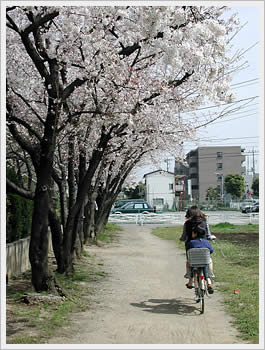
Cherry blossoms in Toda, Saitama: click for larger image (85K)

Such is the reality of Kaika in his first month of life that we won’t be doing any hanami (cherry blossom viewing) parties this Spring, or even going to the park to see them. Ironic considering Kaika was named partly for “kaika,” meaning blossom, and a word heard a lot on the weather and “sakura-watch” news reports these days. So I’ll take any view of cherry blossoms I can get, including the above view I snapped on the way home from a trip to the drugstore to buy Kaika more powdered milk formula.

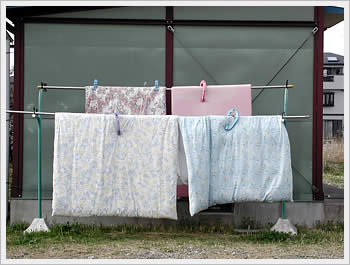
The image below is completely kankeinai (unrelated), snapped this one about a half an hour ago while walking the dog. Hanging futons are a common site in Japan (and a commonly ugly site if you ask me), but you don’t often see them hanging this close to the ground, in these parts anyway.

Hanging futons, Toda, Saitama: click for larger image (50K)

Learning about one’s parents, at long last

I don’t really like to single out particular blogs from the Japan-based blogroll to the right (I don’t feel it’s important to establish which ones I enjoy, and which ones I, well, enjoy less), but among my recent finds, I wanted to make special mention of (and offer encouragement to) Meladramas. Its author, Pamela MacCarthy, is an accomplished jazz vocalist and painter, and a Japan resident of 12-plus years. She’s only been keeping a blog for the last month or so, and sporadically at that, but what there is, I really enjoy. I’m hard pressed to describe her writing without resort to cliche, but for some reason when I was thinking about it Pound’s “petals on a wet, black bough” came into my head. Apparitions and impressions, with lots of space between the lines.

Of the sage writing included therein, MacCarthy’s entry for March 21st, occassioned by her teenage son’s birthday, resonated strongly with some feelings I’ve been having of late. She paraphrases a Chinese proverb:

You learn more about your own parents when you finally become one…

and writes, “Having a baby is a good way to get to know yourself.” Since Kaika’s birth two weeks ago, I have been thinking a lot about my parents, and looking through old family snapshots and letters in a new light. The joy they must have felt when I was born, the hopes and aspirations they must have thought, the worries and hardships they must have suffered through. At the moment these thoughts oppress me, I who for much of my adult life has so blithely sloughed off my parents’ love, especially that of my mother. There’s more to this story, of course, a lot more. For the moment, however, I lack the needed strength with which to further reflect on this, here, in public.