Searching for the secrets of longevity in Sugamo

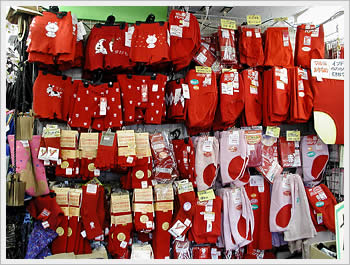
Maruji's red underwear section, Sugamo: click for larger image (90K)

Yesterday Naoko and I took the Toden-Arakawa streetcar down to obaachan no Harajuku, or Sugamo, in Tokyo’s Toshima ward. obaachan no Harajuku means “Grandma’s Harajuku.” (Harajuku is an area of Tokyo famous for its trendy boutiques and always teeming with (mostly young) people). The main attraction of Sugamo is its shopping street, which retains a shitamachi (old Edo-era Tokyo neighborhoods) atmosphere, and which sits on the old Nakasendo highway. This street attracts lots of elderly women, though by no means exclusively so, especially on the 4th, 14th, and 24th of each month when there are fairs held. They come for the shopping, and also for Koganji Temple. And some come for akapantsu, or red underwear, as pictured above.

I don’t know the exact history, but the red underwear is a creation of the Sugamo store Maruji, where the above picture was taken. The marketing pitch is that if you wear red underwear, you will be full of energy and vigor (genki hatsuratsu in Japanese). Apparently, it has something to do with the belief, from Chinese medicine, that 3 or 4 centimeters below the navel there is a pressure point. The red color serves to keep this pressure point warm, which in turn will warm your entire mind and body. So they say.

Sugamo’s Kogangi Temple, which dates from the 16th century, is famous for its Togenuki Jizo, a small Kannon-bosatsu statue, and guardian deity of children. Many people come to Sugamo to visit this statue, and bathe it. togenuki means removing a splinter or thorn, and it is said that if you have an affliction in a part of your body, you should wash the corresponding part of the statue and it will get better.

Click “more” below for more images from yesterday, including a photo of someone washing the jizo statue as described above.
Continue reading “Searching for the secrets of longevity in Sugamo”

Burma portraits No. 1

Two boys, Pyin u Lwin, Burma (Myanmar), June, 2001: click for larger image (84K)

Two boys, Pyin u Lwin (formerly Maymyo), Burma (now Myanmar) (June, 2001). 35mm, Kodak Ektachrome slide film, PhotoCD, Photoshop.

This was taken in the countryside on the outskirts of Pyin u Lwin, a former British hill station established and coined Maymyo by the British, who would retreat to there from the heat of Mandalay in central Burma (now Myanmar). I was walking back from a local Shan village when I came upon these two boys. No doubt they were startled, though I can’t remember exactly their reaction. And I must have asked them to stop and allow me to take their photo, though I don’t remember that either. Why is it that I have forgotten such things?

I didn’t notice until much later, when looking at the developed slide, the younger boy’s t-shirt, which reads “Patience, My Ass” and underneath that, “I’m Gonna Kill Something.” This kind of discordance is common enough in Southeast Asian countries, where bales of used clothes are commonly imported from Western countries and sold very cheaply. The irony isn’t so much that local residents end up obliviously wearing statements so at odds with their disposition, but that more often than not, the used clothes that have been imported into a region like Southeast Asia, are in fact re-exported clothes that were originally produced by that very same region.

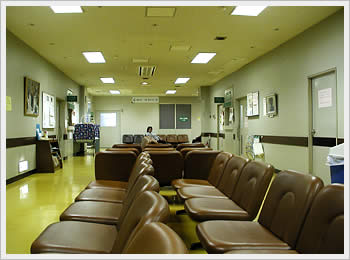
An empty hospital — I’m not complaining, mind you

Here’s a rare site, an empty Japanese hospital! Now to be fair, this is just one section of the hospital, but on this particular day (last Tuesday the 3rd), at this particular time (around noon), the place was truly deader than a door nail. (Hmmn, that’s kind of an unfortunate conceit given the subject). Naoko (who is way down there holding down the fort) said it was on account of the wind, which was blowing awful hair day fierce on this day. Considering that we sometimes have to wait over 2 hours for Naoko to get her routine ultrasound done, I was grateful for the emptiness. But it did make me wonder about the possibility that National Health Care has given rise to a whole group of folks who, windy days notwithstanding, at the drop of even the tiniest real or imagined symptomatic hat, rush to the hospital irrespective of whether their ailment warrants it.