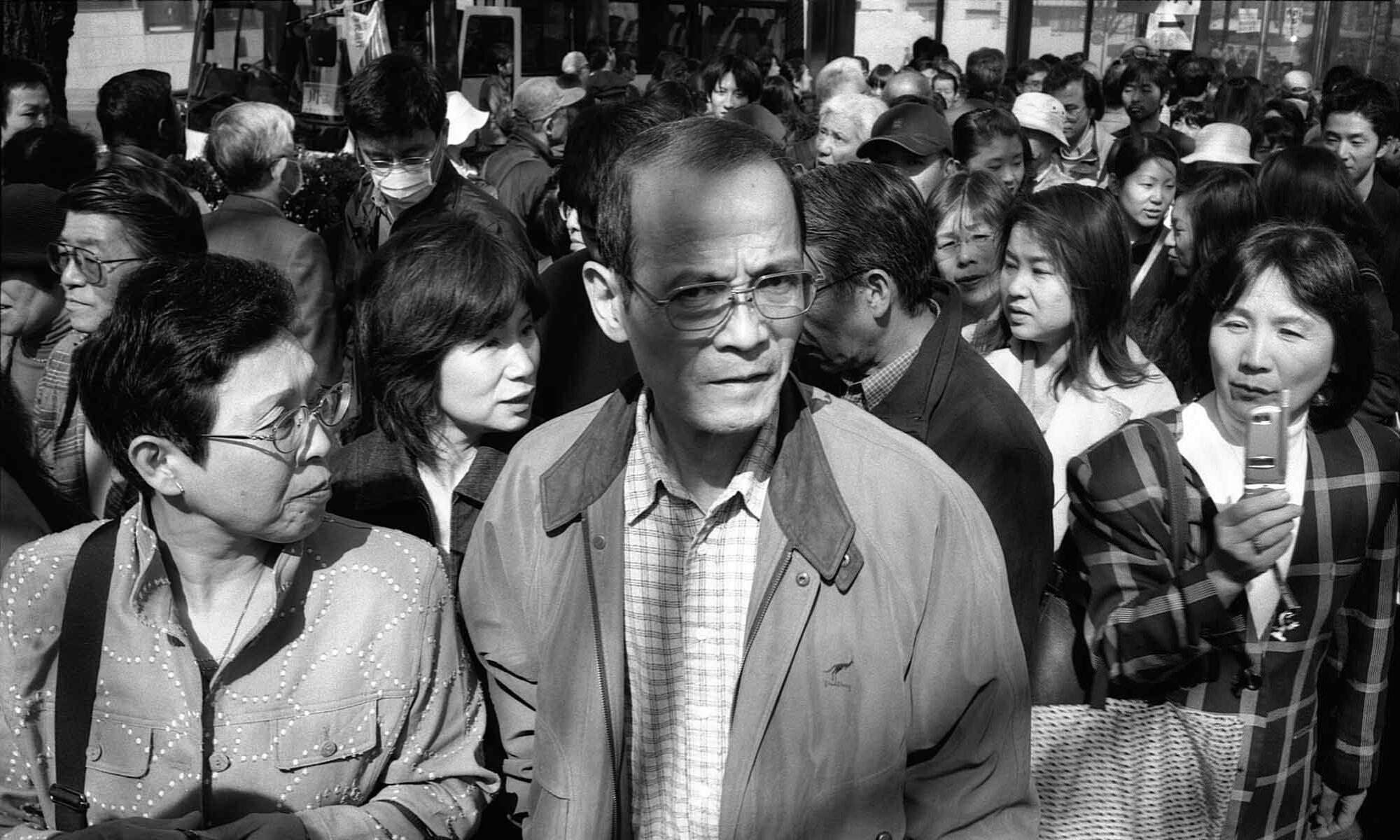
According to a survey of Japanese citizens conducted by the Asahi Shimbun for their Japan Almanac 2002, when asked to pick which of the two feelings, hope or misgivings, were more dominant when they thought about the future, 73% of those surveyed chose misgivings. And when asked to choose one word to describe their feelings about current times, 30% chose konmei, or confusion. (By contrast, stability and freedom came in at 6% and 5% respectively). Down on the list, but significant I think, 6% of respondents chose collapse to describe current times in Japan.
That 36% should see either confusion or collapse when they took a look at their current situation or that of their country should hardly be surprising given a country whose economy has yet to come to terms with the bubble that burst and is floundering in a decade long recession, or where revelations of a new goverment or corporate scandal are daily occurrences, to say nothing of the gradual aging of the population due to its declining birth rate. (According to the Japan Almanac 2002 referenced above, Japan’s birthrate as of 2000 was 1.35. To maintain its current population, the birthrate needs to be 2.1.)
I proffer this information in light of what I and others have noticed as a trend in the photography (or should I say “photo collecting”) among certain Japanese, that is the proliferation of sites documenting the abandoned ruins of hotels, factories, hospitals, etc. that dot the modern Japanese landscape. (To wit, gmtPlus9 linked to a few just the other day — see entries for July 16th. Further exploration can start at the links page of Ruin-Japan.). And it’s not just web sites either; photographer Shinichirou Kobayashi has practically built his oeuvre on the subject, with at least two books (Deathtopia and Ruins) and even a recently-issued DVD from Daiei.
It’d be convenient to say that all this dwelling in abandoned buildings (pardon the pun) has gotten me bitten by the same bug, but frankly I was bitten quite a while ago. I still remember the thrill of happening quite by accident upon the remnants of the turn-of-the-century utopian colony Llano in hinterland Los Angeles (and realizing I had been there before via the writings of Mike Davis), or discovering again seemingly by accident the recreational detritus of Salton Sea (and too recognizing it as being the previous photo stomping grounds of Richard Misrach).
There’s a telling pattern here, and one I’ve mentioned before: if you think you’re on to something new and unchartered, chances are it has not already been discovered, but documented ad nauseum. All of which brings me to my own “ruins” discovery this past weekend when Naoko and I ostensibly went on a little onsen (hot spring) getaway to Tochigi Prefecture a couple of hours north of Tokyo. I say “ostensibly” because I admit that while the thought of a relaxing in an onsen in a smallish mountain town was uppermost in my thoughts, I did have an ulterior motive for going, and that motive was the tantalizing possibility that I too might be able to catch the Japanese ruin-hopping bandwagon and see some of my very own ruins.
So imagine my glee (and my wife’s concomitant disappointment!) when not 5 minutes after leaving the Tohoku Expressway to head into the mountains we should come upon an abandoned pachinko parlor named “Parlor Pateo”. Huge unlit neon sign, an expansive parking lot with weeds starting to sprout up through the asphalt, holes in the glass wall big enough to allow entry — ah, this was the mother lode I’d been looking for to claim my spot amongst the “ruin” maniacs. So dutifully I made my way in and snapped as many photos as I felt comfortable doing (I was less hampered by the thought of tresspassing than I was by the need to preserve some space on my memory cards to document the rest of our onsen getaway). The next day I went back, this time with a tripod and video camera.
In the end I think I’d have to conclude that satisfying and fruitful as my discovery was, a pachinko parlor was frankly almost too good a discovery. If I had my choice, I would have picked something a little more downmarket in the postmodern cliche department. Given the choc-a-bloc saturation of bright, neon-lit, smoke-filled, cacophonous pachinko parlors within the Japanese landscape (first time visitors to this place can be forgiven if they think that Japan’s physical landscape — to say nothing of it’s emotional one — is defined by pachinko parlors, karaoke joints, and vending machines), it felt a little too pat to gingerly maneuver through silent and cracked open machines with tiny silver balls still lodged in their feeders or scattered all over the floor among the glass and adult manga (comic) books and cigarette butts, or the entrance door which had recently been on the receiving end of someone’s target shooting practice. Same thing with Love Hotels: as much as I’d love to stumble onto a ruined one, such as this one that gmtPlus9 linked to, after the orgasmic thrill of the find, I wonder if I’d respect myself in the morning. Is there anything one can say about a ruined Love Hotel (or the plentiful ones still standing and operating for that matter) that hasn’t already been said and re-said so many times before?
We did come upon other more prosaic ruins during the trip (an abandoned supermarket, several old buses left to rot, an abandoned karaoke pub), though none proved as accessible as the pachinko parlor (and frankly, with each new discovery Naoko’s patience with my little “side-project” kept diminishing). Still, within a 50-square kilometer area, only on main roads, we came across this much abandonment. No wonder this niche area of ruin photography is seemingly endless.
One wonders as well how many people have been before me to the abandoned Parlor Pateo in Tochigi-ken. Normally you’d suspect some kids out for a little smashing fun would have been the first to smash open the glass, but I think it’s an equally safe bet to imagine that some intrepid photographer who probably does nothing on his weekends but drive around looking for these things was the first to break through the glass, thereby allowing himself and countless other followers like myself entry. And I’m sure that there are galleries already uploaded of this ruined pachinko parlor. I’ve done a cursory search, but given the extent of these sites it would require a significant amount of net time to look through all of them for, ahem, my pachinko parlor in Tochigi.
I’m working on making a film out of the video footage I shot at the abandoned pachinko parlor. In the meantime, if you’d like to see my inaugural entry into Japanese ruin photography, I have uploaded a small gallery here.