At the fireplace of the “Masters”

Yesterday I went to the Bridgestone Museum of Art for the first time, and perhaps it’s a slightly heretical notion but it felt strangely comfortable to be surrounded by some tried and true names of the Western art canon contained therein. It seems like it has been a real long time since I last cozied up to the likes of Rembrandt and Monet (indeed, at least 3 years). The Bridgestone played its role of host very well, with an understated feel of a gallery rather than museum, with well-installed galleries, and with accomodating bilingual captions for each work and well-translated museum cards as well.

Currently on view is the exhibition “Masterly Visions,” culled from the museum’s permanent collection. It begins with Rembrandt, and in 9 rooms makes it’s way at an Art Appreciation 101 pace to the abstractions of Miro and Klee. Additionally, there are two rooms of Japanese work from the first half of the 20th century, done in a Western style.

While the years and art periods went by at breakneck speed, the exhibition was curated in a way that it never seemed overwhelming, and while ultimately much of the work from the acknowledged “masters” failed to impress for its own reasons — in Renoir’s case, I realized that his work has become inseparable from kitsch for me; for Picasso, one sensed these were not among the artists’ stronger works or they tried too hard to illustrate the diversity of his career — there were some wonderful discoveries.

Raoul Dufy. That’s his Poiret’s Mannequins at the Race Track in 1923 (1943) pictured above, and while it can’t really be faithful to the real thing, hopefully one can get a sense of the wonderful color here. I latched onto this piece in part because earlier Renoir had turned me off to color, to his color, which seems so tawdry, so many gimcrack baubles. (Is that a fault of the work or the fault of the posters and calendars in the age of mechanical reproduction it’s hard to say. Not surprisingly, it is a Renoir female that graces the promotional material for this exhibition.) And then here comes Dufy with this overwhelming green, and garish red, and yet it works so well, it’s porous and celebratory, as one looks at it one feels like one is swimming in the ocean as the tentacles of seaweed part before you. And those mannequins, like mermaids, teetering between real and fantasy, are they the attraction here, the horse-racing a mere backdrop, or will they snap out of it and step aside so we can stomp on that verdant field?

Georges Rouault. The five Roualt pieces in the show shared a room with Picasso, but for me they dominated, not the other way around. The explanatory panels clue us in to Rouault’s Christianity, and how his work often resembles stained glass. This is true enough looking at them (and indeed, Rouault was apprenticed to a stained glass artist as a teen), especially the piece Christ at the Court of Justice (1935), with its thick black lines surrounding each figure and crystalizing them in ambivalent spatial relationships. But looking at his work, one can’t help but feel that were these stained-glass windows, they would be the windows tucked away, soot-covered and nearly opaque, celebration blunted like a pre-restoration Michelangelo Sistine Chapel.

Christ in the Outskirts

The work reproduced above is called Christ in the Outskirts (1920-4), and was quite different from the other four Rouault works shown. Here is a De Chirico-esque landscape with tiny figures against a portentous backdrop, only minus the clean lines. I found this work rather unsettling, perhaps because my expectations of a painting with Christ in it were being challenged, upended. I couldn’t reconcile the title with the painting, or the figures, and the position of the figures left it ambiguous for me whether they were at the end of the road or the beginning. A painting I could look at a long time, but sadly the gift-shop postcard will have to suffice.

Other highlights for me included two small, delicate paintings by Odilon Redon, and a wonderful beach landscape by Eugene Boudin, which on account of its position next to a bank of Renoirs, helped to restore some sense of solemnity to those proceedings. It was these, and the Dufy’s, and Rouault’s, that proverbially stole the show for me, and so while I momentarily enjoyed the warm blanket of the well-known “masters,” it was these new discoveries that continued to warm me as I left the museum for the slightly colder world outside.

Demons in the backyard

Kawanabe Kyosai rakuga, circa 1874

Last week we took a bicycle ride to the other side of our tiny city of Warabi to visit a small museum housed in a former residence. I wasn’t really paying attention earlier when Naoko explained the exhibit on view there, but as I began to walk around the first room after paying our 300 yen entry I was pleasantly surprised to find some exquisite ukiyo-e prints on the wall, in a distinctly different style from that of say Hiroshige or Utamaro. They were clearly of the 19th century, yet very fresh and alive. They reminded me a bit of Kuniyoshi or Hokusai’s manga.

When we were escorted to the makeshift cafe/bookstore after finishing looking at the exhibition, it all became clear, as there were various exhibition catalogues and books on the artist, who was none other than Kawanabe Kyosai (1831-1889). And as it turned out, the museum was the Kawanabe Kyosai Kinen Bijitsukan (Kawanabe Kyosai Memorial Museum). How it ended up that our humble little city — better known to most Japanese as one of the most densely populated spots in all of Japan, or for its reputation as a haven for yakuza — became host to this wonderful little treasure I do not know (presumably Kawanabe’s descendents eventually settled here and at some point the house was turned into a museum), but it heartens me that there exists this cultural oasis a bicycle ride away. Kawanabe’s great-granddaughter Kusumi Kawanabe is the director of the museum.

The exhibition we saw there (on view until October 25th) is entitled Edo • Meiji tanoshimu shomin or “The amusements of the ordinary folk of Edo (Tokyo) during the Meiji era” (roughly), and uses Kyosai’s work to focus on how Edo residents amused themselves in the beginning years of the Meiji Restoration. Elephant rides, childrens’ sumo, string games, hunting for mushrooms — these and other pastimes are depicted wittily by Kyosai. You can get an idea of the exhibition by clicking on the links on this page from the museum’s website (though be forewarned, an idea is all you get as these images are rather poor representations).

Kyosai is an interesting character, in part because after studying with Kuniyoshi (he entered into his apprenticeship with Kuniyoshi when he was only 6 years old!) and then breaking out on his own, he enjoyed rather free contacts with Westerners living in Japan (who were more influenced by he than he was by them, it should be noted). The most important of these, British architect Josiah Conder, learned printmaking from Kyosai, and later wrote the first English-language appreciation of Kyosai (in 1911).

There is scant decent reproductions of Kyosai’s work available online. For starters, you can try:

Waseda’s Database (30 images)
The Art of the Print (7 images)
Castle Fine Arts (5 images)

Or you can seek out Timothy Clark’s OOP Demon of Painting: the art of Kawanabe Kyosai.

On the museum’s English site (excuse the sloppiness) you’ll find directions complete with pictures on how to get to the museum (it’s only a half-hour outside of Tokyo, in Saitama).

Gearing up for Honbasho

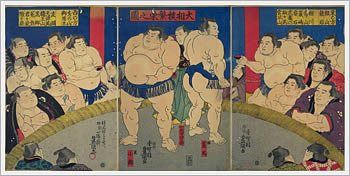
Koyanagi versus Arauma, circa 1844-1850: click for larger

It’s the start of the Aki (Fall) Sumo tournament here in Tokyo and after more or less taking the last basho off, I can feel myself getting back into the swing of things, and look forward to making it down to the Kokugikan for at least one if not two days of action this basho. Of course, the other days I will be glued to the nightly highlights show broadcast on NHK. (The basho runs from September 12 – 26.)

There are many compelling stories this basho, starting first and foremost with whether or not Yokozuna Asashoryu can win his fifth consecutive tournament and continue his quest to be the first rikishi in history to win all six bashos in a single calendar year. He is also attempting to break the record for the most bout victories in a year.

His 19 year old Mongolian countryman Hakuho is slowly but surely being touted as perhaps the next Yokozuna, and is coming off consecutive double-digit win tourneys. At Maegashira #3, Hakuho is now ranked high enough that he is virtually guaranteed to meet the Yokozuna for the first time on the doyho — in short, a most anticipated bout. Ozeki Tochiazuma seems to be finally fully healthy, and in my book is the leading contender to upset Asashoryu’s record-setting plans. Further down the banzuke, there are several newcomers to the top division that folks will be following, namely the Bulgarian Kotooshu who has already become a fan favorite due to his kawaii looks (the dreaded “David Beckham of Sumo” has been uttered more than a few times already).

The above ukiyo-e print is of a special exhibition bout between Koyonagi on the left (in the middle panel) and Arauma on the right, from sometime in the middle of the 19th century. Both rikishi had long, distinguished careers: Koyanagi was active from Tenpo 6 (1835) to Ansei 3 (1856), reaching as high as the Ozeki rank, while Arauma’s career spanned from Tenpo 3 (1832) to Kaei 7 (1854), his highest ranking being that of Sekiwake. (This was in an era which saw only two tournaments per year, with these being only 10 bouts long (in contrast to today’s 6 yearly tournaments of 15 bouts duration each).)

Interestingly enough, both rikishi hailed from the same part of Chiba prefecture east of Tokyo, and apparently this helped give rise to a spirited rivalry between the two which made them two of the most popular rikishi at the time. In fact, the pair were so popular that they were immortalized in the lyrics to a famous children’s song of the time. It is said that along with Ozeki Tsurugisan, who is one of the off-dohyo rikishi depicted in the far right panel of this print, the three were lauded as the preeminent rikishi of that time. (Tsurugisan sounds like he’s worthy of his own post: at one point in his career, he turned down a chance to become Yokozuna, claiming that his dohyo form wasn’t good enough. That didn’t stop him however from wrestling until the ripe age of 48!)

The above print triptych was done by Kunisada (Toyokuni III) sometime between the years 1844 to 1850 (based on the seal/signature analysis found on this page). Click on the above image for larger versions of the triptych.