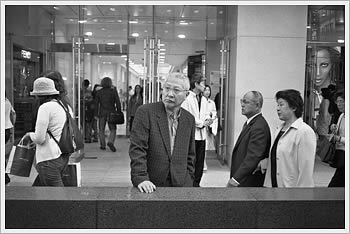
Caught in the twilight

Ginza, Tokyo, April 10, 2004: click for larger image

Ginza, Tokyo, April 10, 2004. Bessa R2, CV 35mm f/2.5 ‘Pancake’. Fuji Neopan 400 Presto.

Not quite sure how it happened, but the above photo (click on it for a larger view) won the most recent Salon held biweekly over at the Street Photography Mailing List, the theme of which was “twilight.” While in the short past that I’ve been entering the Salons I’d no doubt felt a tinge of disappointment when previous entries had been passed over, I always felt greater relief, for no other reason than that I didn’t relish the idea of having to judge a whole bunch of photos myself. (The Salon winner selects the theme for the next Salon, and then sits in judgement of the entries for that theme, with commentary about each expected.) So much for that now! In case you’re interested, I’ve selected “engagement” as the next theme. Photos are due Monday, May 10th.

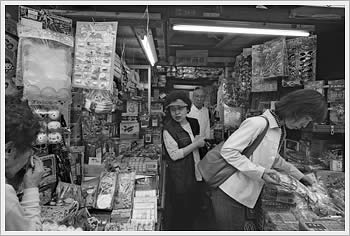
The last vestiges of a sweet tooth succor

Old style toy shop, Nippori, Tokyo, April 17, 2004: Click for additional images

Old style toy shop, Nippori, Tokyo, April 17, 2004. Bessa-L, CV 21mm f/4, Fuji Neopan 1600. Click for additional images.

Last weekend we went to see something that in a short time will be no more: the last remaining vestiges of the once thriving Dagashiya Yokochou (literally “Mom and Pop Candy Store Alley”) in Nippori, near Ueno. At its height in the Showa 30’s (1956-66), the candy and toy stores in this area numbered around 120, but now just 7 stores remain, and in a short time, these too will go, as the area to the east of Nippori station awaits the wrecking balls that will precede imminent redevelopment.

The area became one of three main “sweets and toys” districts to spring up after World War II, when sugar was rationed under the U.S. occupation and enterprising black marketers, led by the Japanese mafia or yakuza, set up shops catering to the sweet tooths of a populace sloughing off the bad taste of war and destruction. The largest of these, Ameyoko in Ueno, which numbered some 300 candy and toy stores in its heyday, still thrives today though in a much different guise. (The third was in Kinshicho, out past Ryogoku in Sumida Ward.)

If you want to see the alley, and it is just that, a narrow 2 meter-wide alley, you’ll need to hurry. The wrecking balls are slated to lower their boom sometime in June.

Click on the above image to get to a few more photos from last weekend. Photos from others, as well as more information and background on Dagashiya Yokochou, can be found at these sites (in Japanese only):
http://www.maboroshi-ch.com/rep/inq_05.htm
http://gendai.net/woman/contents.asp?c=064&id=173
http://www.mixpink.com/spot_folder/nippori_folder/nippori.html
http://www.hey.ne.jp/~kaleido/…/kalaido_topics03.htm
http://www.shitamachi.net/wa/totteoki/020616.htm

The ever ephemeral sakura

Shinjuku Gyoen, Tokyo, March 29, 2004; click for gallery

Shinjuku Gyoen, Tokyo, March 29, 2004. Bessa R2, CV 35mm f/2.5 ‘Pancake’, Fuji Acros 100.

Better late than never, here is a gallery of cherry blossom photos if you’re interested. I made a conscious decision this year to try to capture the ephemeral blossoms in black and white. Not sure how successful this attempt was, but you be the judge. I was partly inspired by the B/W sakura photos of a Japanese photographer by the name of K-Funk (see the three different “sakura” galleries on this page). I did take some color photos, but decided to leave them out of the gallery (you can see one online here).

Without living here in Japan it is really hard to comprehend just how much everything revolves around the blossoms for the one or two weeks they bloom, not to mention all the predicting and tracking of the blossoms that occurs on the nightly news, numerous web sites, and several special edition magazines in the weeks leading up to the actual blossoming. Finding a Japanese person who’s apathetic toward the blossoms is about as hard as finding one who will say on record that they love the rain — in other words, good luck.

The Japanese concept of mono no aware (simplistically, the impermanence of things) is often mentioned in the context of the cherry blossoms. But some students of mine, they of an older generation, taught me a heretofore unknown adjective when they tried to explain the appeal of the blossoms: isagiyoi. The dictionaries define this as “gracious” or “sportsmanlike,” but perhaps we can say “accepting defeat gracefully.” These students couldn’t help adding that this was a word seldom used to describe today’s younger generation.