Thrice a champion but anonymous to some

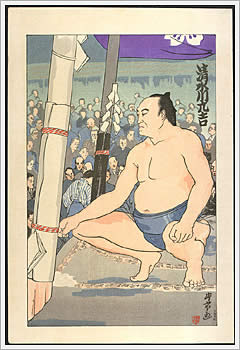
Sumo Wrestler by Unknown Artist c. 1930's: click for print listing

Sumo Wrestler by Unknown Artist. Woodblock print, c. 1930’s.

Found the above woodblock print at the worthwhile Hanga Gallery (hanga is Japanese for “woodblock print”), which I came to via Plep. The listing “Sumo Wrestler” by “Unknown artist” from “ca. 1930’s” was anonymous enough to get my curious juices flowing and I dug around for more information.

The rikishi depicted is Shimizugawa Motokichi, who hailed from Aomori prefecture in northern Japan, and whose Sumo career spanned 20 years from 1917 – 1937. When he retired at the age of 37, he had amassed a top-division record of 193-130, with three championships. For the last five years of his career he wrestled as an Ozeki, professional Sumo’s second highest rank. According to this profile of Shimizugawa, in 1934 his promotion to Sumo’s highest rank of Yokozuna was expected, but he dislocated his femur bone in a provincial tournament. As a result, he’s one of a handful of wrestlers in the modern era to win at least two tournaments as an Ozeki but not reach Yokozuna.

As of this writing, the above 8 x 12 in. print is available from Hanga Gallery for $150.

UPDATE (April 24, 2004): Yesterday I borrowed a Sumo photo book from the library and the above print is pictured in there. The artist is credited as Toyoichi Yamamoto, who lived from 1899 to 1987. In the 1950’s Yamamoto was on the faculty of Tokyo National University of Fine Arts, and among the works to his credit is a sculpture of Doukan Oota in Shinjuku Chuo Park (Tokyo). (Doukan Oota was a minister of the Daimyo Sadamasa Uesugi and built the original Edo (Tokyo) Castle in 1457. He was also an accomplished tanka poet. He was stabbed to death while taking a bath.)
Let’s hope for more like this

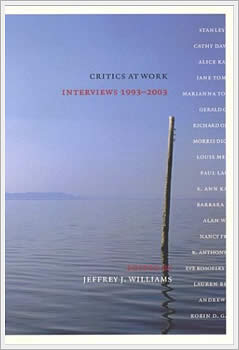
Critics at Work book cover

Above is the cover for Critics at Work: Interviews 1993-2003, edited by Jeffrey J. Williams and published last month by NYU Press. I haven’t read it and as such can’t really recommend it, though it’s surely interesting. I present it here as it represents the first time my photography has been published and I actually got paid for it. Yup, that’s my photograph on the cover.

Chalk yet another one up to the power of the Internet, or at least to the power of Google, that a photo taken in another lifetime (well, okay, only 4 years ago!) and left for dead in the back alleys of this here web domain can be resuscitated thusly, and actually produce dividends. Not a huge windfall mind you, after all the publication run for this bound-to-be-bestseller is only around 5,000 I believe, but nothing to sneeze at either.

Here’s the original photo, taken on Velvia slide film with my Canon EOS. You’ll see that the designer flipped the image for the cover. Although I don’t know how the finished product looks, judging from the proofs the designer sent me last Fall, my photo actually wraps around to cover the spine and back cover of the book as well.

Savvy Hmmn readers will recognize that this isn’t the first time my Salton Sea photos have attracted publication attention. There certainly is something about the place that attracts art designers and the like (as these examples show), not to mention photographers of course. At any rate, whether Salton Sea photos or perhaps something a bit more interesting to me these days, let’s hope for a few more of these things. At the very least they help to raise Naoko’s tolerance level for all the cameras and film and negs and scanners, to say nothing of the time involved.

Half a person or the sum of his parts?

Kaika, February 16, 2004: click for larger image (30K)

Kaika at home, February 16, 2004. Canon EOS Elan IIe, 50mm f/1.8 II, Konica Centuria 400.

Of late, spurred by some private conversations, as well as some online reading, I’ve been thinking about Kaika and his ethnicity, and namely his “status” in this country as “half,” which is to say half-Japanese. Now, we haven’t been approached by any modeling agency reps on the street like Mark’s wife was recently, but it’s clear that Kaika’s interracial ethnicity is something he’s already being defined by, at such an early age, whether he wants it or not, and whether his parents want it or not I might add.

Today as we were cycling around the neighborhood looking at cherry blossom trees, Naoko heard a woman remark to her friend, yappari haafu no ko wa kawaii yo ne, which roughly would be something like “ain’t it the truth that half-Japanese children are so cute.” What wasn’t said but is assumed is that “half” refers to children of Japanese and Caucasian parents. It’s mightly unlikely that the same would have been uttered if I were Filipino or Black, for example, regardless of how cute my kid was.

I can’t quite put my finger on it but there’s something that really rankles me about comments like these. Now, I have to admit that growing up in Hawaii, with it’s large Japanese-American and Caucasian populations (about 30% each of the state’s ethnic makeup when I lived there), it was generally accepted among me and my friends that children of Japanese and Caucasian parents were the cutest, and I remember when I saw John Lennon and Yoko Ono’s son Sean Lennon on TV the first time, just after the elder Lennon was assassinated, I thought much the same thing as this woman said today: yup, Japanese-Caucasian children really are cute, aren’t they.

Is it just a case that now that I’m on the other side of the fence I see it differently? I don’t know, but I think one of the things that bothered me today when Naoko told me about this woman’s comment was that the woman had said it loud enough to be heard. It struck me as very rude, although perhaps she didn’t realize how her voice would carry, or perhaps it was her way of throwing us a compliment. Maybe I’m wrong, but I can’t help but think that the same comment wouldn’t be uttered within earshot of a similar mixed race family, if at all, in the States. I’m not saying folks wouldn’t think it, I’m sure some of them would, just as I did when I was young and still do to some extent.

There are a lot of things we think privately or might share in a whisper with our companion, like “gee she’s fat” or “boy does he look like a geek,” that only the most insensitive among us would say loud enough to be heard by the object of them. Of course, these are not compliments and perhaps therein lies the rub. I’m sure most of these people who feel that “halfs” are so cute see nothing wrong, or at least problematic, in this sentiment. But why isn’t “he’s cute” enough, why the need to link the child’s cuteness to the child’s ethnicity? I have some further speculative thoughts on the subject, but I’d be curious to hear what others may think, especially those in a similar situation as Naoko and I.