If only they’d take care of my student loans

A friend of mine recently sent me an couple years-old advertisement for the Filmmaking Program at the San Francisco Art Institute, where we both attended. A typical ad one would find in an art journal or trade publication. He sent it to me because we’re both listed in a section entitled “MFA and BFA Degree Receipients (Selected 1970-2000):”
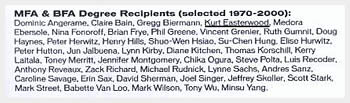
Detail of an advertisement for the Filmmaking Program, San Francisco Art Institute, circa 2001: click for image of entire ad (43K)

(Click on the above image for the complete advertisement).

But the fact that we made this short list of degree receipients (I wonder how many there have been over those 30 years) is only of passing interest. What’s interesting about the ad is that while my friend received his Masters of Fine Arts degree from the Art Institute, I didn’t even get a Bachelors at the place. In point of fact, I dropped out of the Institute about 12 units shy of graduating. So not only is my place on this list unwarranted, but they way they’ve organized it, one doesn’t really know if they “gave” me a BFA or an MFA.

Now, I’ve been known to stretch the truth of my college education on resumes and such, which is to say I usually list it like so:

Education
San Francisco Art Institute, Filmmaking
1988-1992

so that it sort of implies I graduated, but doesn’t explicitly state that I did. (In my defense, if the question came up, I told the truth, and have never tried to pass off a fake diploma.) But now I see that all these post-art school years, I’ve been underselling myself. Now if I could just get those pesky student loans I took out from that time to disappear in the same way that this degree has appeared, I’d be all set.

Why I dropped out of the Art Institute is a not-so-interesting story I really don’t want to go into at the moment. I don’t regret the time I spent there, I learned an incredible amount and not just about filmmaking, and met some very inspirational people, but in general I still have a lot of angst (for lack of a better word) about the place, though not about not finishing and getting my degree.

Actually, when I first enrolled, I never intended to stay long enough to get a degree, I just wanted to learn, and see amazing films, and be around people for whom film meant light and shadow captured on a strip of film that was run through a projector and sometimes produced meaning, something different from the packaged narratives I had been force-fed up till then. And so I went and studied and made films and eventually got close to finishing. But then, my interests changed, and the degree didn’t seem worth going through the motions for. And so I stopped going.

The image below is one I found online last week at the San Francisco Public Library’s Historical Photograph Collection, showing how the Art Institute looked in 1930 (when it was known as the California School of Fine Arts). Though there have been modern add-ons to the campus since then, it still looks almost exactly like this image, when looked at from this view. How many times did I enter the arched doorway at far left? (The school’s film and photography departments, when I was there, occupied this part of the campus).

artinstituteoldS.jpg

An Ozu day in Kamakura

Last Saturday I braved the heat and the crowds and made my way down to Kamakura, the once former capitol of Japan, and thus home to many wonderful temples and shrines, and to the Daibutsu (Big Buddha) statue. Kamakura is also home to many varieties of seasonal flowers, and it was one of them, the ajisai or hydrangea, that brought out the crowds in droves on this day. At the Meigetsuin temple, so reknown for it’s ample collection of hydrangea that its nickname is ajisai-ji or “Hydrangea Temple,” I could hear tourguides bellowing out through their bullhorns to their charges waiting in line that they would have to wait at least 1 hour before they could get into the temple. There were the requisite moans, but I didn’t see any of them get out of line.

Fortunately, I was in Kamakura for quite a different attraction, one much more subdued and less-traveled by comparison: an exhibition of miscellany related to the life and career of Japanese filmmaker Yasujiro Ozu, on view at the Kamakura Museum of Literature. The day before, I had been flipping channels on the TV when Naoko caught Ozu’s name on the screen and told me to stop. It was a news segment on the exhibition, which I had not been aware was going on. I was lucky, the exhibition was to end on the 29th of this month. There was still time to go see it, and so I did.

ozuexhibitionhallway_062103S.jpg

The museum is in Kamakura proper, not too far from the Daibutsu, but I began the day’s journey with a stop in Kita-Kamakura, and a visit to Engaku Temple, on the grounds of which is a cemetary with Ozu’s grave. Inspired by Jonathon Delacour‘s post “Visiting Ozu’s grave”, I had traveled down to Kamakura in July of last year in search of the gravesite, and after some missteps and wrong turns, and not a few rows of grave markers scrutinized heavily, I was finally able to find the austere granite block upon which is inscribed the Chinese character mu, which vaguely means “nothingness” or “non-existence.”

This time of course I was able to go straight there to pay my respects. In contrast to how the grave looked last year, on this occassion someone before me had left a kumotsu or “offering” of sake and beer and a couple packs of cigarettes. One of the cigarette packs was the Peace brand, and later at the exhibit the same distinctively packaged brand could be seen in a display of Ozu’s personal effects.

ozugrave_2_062103S.jpg

I continued on my way, with a vague plan to see the Hydrangea Temple, that is until I caught wind of the aforementioned tour guide’s announcement. So I passed the throng and continued my walk to Kamakura, meandering past some temples along the way, and continued to walk for a couple of kilometers to the Daibutsu (I had forgotten that when I first visited Kamakura in 1997, we had taken the Enoden train to the Daibutsu). After an almost obligatory visit to the Daibutsu, and some well-needed rest in the shade, I made my way over to the Kamakura Bungakukan, or Museum of Literature.

The museum is housed in a villa of the former Marquis Maeda, decendent of one of the most powerful feudal clans of the Edo era, and was originally built in 1890. The present Western-style structure dates from 1936, and was depicted by Yukio Mishima in his novel Spring Snow. While the property is large and spacious, the museum itself is quite tiny.

The Ozu exhibit, which was entitled mirai e gatari kakeru monotachi (loosely translated as “Things that speak to the future”), was of modest size, but did not disappoint. In two rooms, various examples of Ozu paintings and drawings were on display, as well as rare (to me, at any rate) photos of Ozu at various stages of his life. My favorite was a photo of Ozu as a 9-year old boy in a ceremonial sumo kesho-mawashi he had made out of paper.

ozuexhibitionmawashi_062103S.jpg

There were display cases with various paraphernalia related to Ozu’s directorial work, notebooks, diaries, screenplay pages with drawings on them, his Leica rangefinder camera, the viewfinder he used when directing, the tripod his crew used to get the famed “tatami-mat” low-angle shots, and Ozu’s trademark white pikebou, or pique hat. I lingered for as long as I thought reasonable, trying to stave off the ephemerality of the visit.

I bought the small book that accompanied the visit, as well as a postcard set of reproductions of some Ozu drawings and watercolors, and have scanned those along with some other bits from the exhibit, and put them online. I’ve also finally created a site with directions on how to find Ozu’s grave at Engaku in Kita-Kamakura, which I had intended to put up online last year but never did. Both these sites can be accessed from here:

Some pages about Yasujiro Ozu

Note: I created these pages in some ways as a test for making a web page using both English and Japanese, and used Mozilla’s Composer for this. Composer is not my WYSIWYG html editor of choice, but it was a dream when it came to inputting both Japanese and English and having them render properly, even in code view. The pages look fine on my system (Windows, using Mozilla 1.3), but as I’m new to this, I would appreciate any feedback from users who might have trouble viewing the pages properly.

ADDENDUM: I should have noted that this Ozu exhibit will end on June 29th, so if you’re in the Tokyo area and interested, you’ll need to hurry. Also, when at the museum, I saw small handbills advertising some sort of Ozu event on the 29th, but I’m not sure exactly what kind of event, nor could I find any information online about it.

Recent additions to my paltry Japanese vocabulary base

aramusha — reckless-behaving person, daredevil, rude-mannered samurai

This was part of the headline on a recent Sumo monthly magazine, which featured a picture of Yokozuna Asashoryu after he won the recent Natsu Basho. Asashoryu had upset many sumo fans, and the Japan Sumo Association, with his disrespectful and un-Yokozuna like behavior after a losing performance in one of his tournament matches. There were actually two headlines on the cover of the magazine, the other reading tsukisusumu, which means “to push forward with force or vigor.” However, the aramusha headline was in bigger font.

tanshinfunin — to commute over a long distance

An example would be living in Hokkaido but working in Tokyo, perhaps flying home on the weekends. This particular example was the plight of a student I interviewed recently, who flew home once a week to see his wife and two young children in Sapporo.

futsukayoi — hangover

It’s funny how you can study a language for the longest time and never come across certain words or expressions seemingly essential to one’s vocabulary. This is such an entry. I didn’t learn it on account of having one myself (at least recently); actually, I can’t remember the why’s and wherefore’s of how I picked this up. But I’m sure it’ll come in handy one of these days. I love the fact that a literal translation of the word would read something like “drunk on the second day.”

uwasa o sureba… — speak of the devil…

I heard a student utter this when I walked into the classroom recently. I grilled her on what she had said and what it meant, but she was unable to explain the meaning in English. But she insisted it had positive connotations. Later when looking it up I of course realized it only has positive connotations depending on what was being said before it was uttered. uwasa on its own means “rumor” or “gossip.”

suisui — swimming smoothly, unhindered
rakuraku — comfortably, easily

These were both used in an train advertisement for monorail service to Tokyo’s Haneda airport.

netto shinjuu — internet-assisted suicide

A new term, found in the “Changing Japanese” section of a recent Japan Times newspaper (each Thursday’s edition features Japanese lessons and related articles on the language). netto means “Internet,” and shinju means “double suicide” or a suicide committed with others. This term is an outgrowth of the recent spate of group suicides involving people who met through Internet sites.

fuan — anxiety, unease

I was watching one of the weekend sports shows and they had a very long segment on Japanese baseball’s Hanshin Tigers, who from the sound of it are the Chicago Cubs of Japanese baseball. In other words, they haven’t won a penant in a very long time (well, since 1985 at least). This year, at least at this point, almost halfway through the season, the Tigers lead their division by 9 games, with arch-rivals Yomiurui Giants in second. But Hanshin traditionally starts strong, and then goes into the tank in the second half of the season. They did this last year. Thus, Hanshin fans right now are full of fuan, or unease, that their lead will not hold up. fuan rendered in katakana script means “fan, ” ironically enough.

Definitions were garnered from my Canon Wordtank 3000 (which uses the New Anchor Japanese-English Dictionary), and Jim Breen’s WWWJDIC (and the Japan Times, where noted). I’m pretty much flying solo these days with respect to my language learning, so I would be ever so grateful if those with a better grasp of the language than I, could contribute, via comments, to this post. I.e., if I’ve gotten something wrong, or there are alternative ways to say the above, or additional meanings that would be relevant, etc., please add a comment so I and other learners don’t stray too far down the wrong path. Thanks!