Well, I never see anyone comment on their 6-month anniversary of anything, it does strike me as sort of lame, but excuse me while I indulge in a bit of lame-ness and pat myself on the back for having survived my first 6 months in Japan. My 6-month anniversary was last Friday, inauspiciously on a 13th. And because Naoko and I married the day after we arrived, Saturday was our 6-month wedding anniversary. We celebrated by going out on a rare “date”. Because of our wildly opposite schedules (she works early in the morning, I work at night), we don’t go out together much (finances also play a part in this — it can be prohibitively expensive just to go in to Tokyo for the day). Having had my fill of CSS designing, I proposed that we should go out, and so on her choice we went to Hiroo, an heretofore part of Tokyo I hadn’t been to. It’s home to many foreign consulates and embassies, and so many foreigners live there, and on the whole I was not terribly taken with the sight of outdoor cafes full of Americans. But it’s known for having a couple of good international supermarkets and so we bought a few things there. We then had our first Mexican (or California-ized Mexican actually) food since leaving San Francisco, and boy did it hit the spot.
Now I fibbed a bit when I said we “celebrated our anniversary with a date”. I actually hadn’t realized it was our 6-month wedding anniversary until we were eating and reminiscing about how long it had been since we’d last eaten burritos and all of a sudden it dawned on us that we had gotten married 6 months ago to the day. But silly me, I flubbed the opportunity to play it off like I knew it all along (Valentino I’ll never be). But it’s funny how fortuitous it was to arrange this date on this day (perhaps some little romantic angel was sitting on my shoulder nudging me on unbeknownst to me).
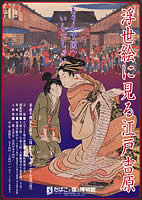
After our lunch, we went over to Shibuya to the Tobacco and Salt Museum. If you live in or visit Tokyo, you really should check out this museum, a wonderful cultural oasis in an otherwise over-the-top consumerist Shibuya, and at only 100 yen for entry, a bargain. (Kitty-corner from the museum is a 100-yen per bowl udon eatery, so this can make for an exceptionally cheap date.) I wanted to go to the museum because their current Special Exhibition is on “Edo-Yoshiwara in Ukiyo-e printings”. I’ve written about Yoshiwara before, and how I’ve long been fascinated with this old “pleasure-quarter,” which I was introduced to via ukiyo-e prints. And so it was quite a treat to see so many exquisite examples of prints documenting the area, and its various courtesans and denizens.
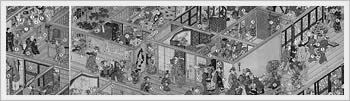
Particularly wonderful were a couple of large prints by Kunisada, which provided wonderfully detailed views into the brothel establishments themselves. For one of these I’ve scanned the tiny black and white image from the exhibition brochure, but after much searching, I’ve found this print online here at the National Diet Library’s Rare Books Image Database. (On that page you’ll find thumbnails which link to decent-sized jpegs of the print in 5 parts.) It’s a cross-section of a Yoshiwara brothel and through humor and wonderful little details it really brings to life what one of these establishments must have been like. Also enjoyable were a series of 12 portraits by Keisai Eisen of various courtesan, each one representing a month of the year. I couldn’t find these online, but this is a good page on Eisen and another of his Yoshiwara prints.
Although we spent a good deal of time at the exhibit, I plan on going back soon (at 100-yen entry, why not!), and in the same day stop by one of my favorite gallery spots in Tokyo, the Ota Ukiyo-e Gallery in Harajuku, which is currently running an exhibit of prints entitled “The manners and customs of Yoshiwara”. Perhaps this might also be the time to once again wander down to the present-day remnants of Yoshiwara, a tawdry 2 blocks of “soaplands”.