Gearing up for Honbasho

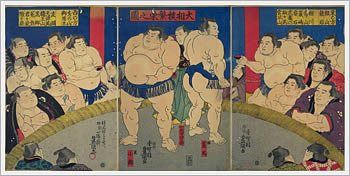
Koyanagi versus Arauma, circa 1844-1850: click for larger

It’s the start of the Aki (Fall) Sumo tournament here in Tokyo and after more or less taking the last basho off, I can feel myself getting back into the swing of things, and look forward to making it down to the Kokugikan for at least one if not two days of action this basho. Of course, the other days I will be glued to the nightly highlights show broadcast on NHK. (The basho runs from September 12 – 26.)

There are many compelling stories this basho, starting first and foremost with whether or not Yokozuna Asashoryu can win his fifth consecutive tournament and continue his quest to be the first rikishi in history to win all six bashos in a single calendar year. He is also attempting to break the record for the most bout victories in a year.

His 19 year old Mongolian countryman Hakuho is slowly but surely being touted as perhaps the next Yokozuna, and is coming off consecutive double-digit win tourneys. At Maegashira #3, Hakuho is now ranked high enough that he is virtually guaranteed to meet the Yokozuna for the first time on the doyho — in short, a most anticipated bout. Ozeki Tochiazuma seems to be finally fully healthy, and in my book is the leading contender to upset Asashoryu’s record-setting plans. Further down the banzuke, there are several newcomers to the top division that folks will be following, namely the Bulgarian Kotooshu who has already become a fan favorite due to his kawaii looks (the dreaded “David Beckham of Sumo” has been uttered more than a few times already).

The above ukiyo-e print is of a special exhibition bout between Koyonagi on the left (in the middle panel) and Arauma on the right, from sometime in the middle of the 19th century. Both rikishi had long, distinguished careers: Koyanagi was active from Tenpo 6 (1835) to Ansei 3 (1856), reaching as high as the Ozeki rank, while Arauma’s career spanned from Tenpo 3 (1832) to Kaei 7 (1854), his highest ranking being that of Sekiwake. (This was in an era which saw only two tournaments per year, with these being only 10 bouts long (in contrast to today’s 6 yearly tournaments of 15 bouts duration each).)

Interestingly enough, both rikishi hailed from the same part of Chiba prefecture east of Tokyo, and apparently this helped give rise to a spirited rivalry between the two which made them two of the most popular rikishi at the time. In fact, the pair were so popular that they were immortalized in the lyrics to a famous children’s song of the time. It is said that along with Ozeki Tsurugisan, who is one of the off-dohyo rikishi depicted in the far right panel of this print, the three were lauded as the preeminent rikishi of that time. (Tsurugisan sounds like he’s worthy of his own post: at one point in his career, he turned down a chance to become Yokozuna, claiming that his dohyo form wasn’t good enough. That didn’t stop him however from wrestling until the ripe age of 48!)

The above print triptych was done by Kunisada (Toyokuni III) sometime between the years 1844 to 1850 (based on the seal/signature analysis found on this page). Click on the above image for larger versions of the triptych.
Wright’s Imperial Hotel and the Great Kanto Earthquake of 1923

Naoko and I took Kaika to Hibiya Koen yesterday, where this weekend are events related to the 400th anniversay of the start of the Edo period. On the way home we stopped by the Imperial Hotel, which neither of Naoko nor I had been in before. I of course knew that there had been a version of the hotel designed by Frank Lloyd Wright, and was curious if anything of that incarnation remained in what now looks like a relatively drab modern hotel.

There’s nothing left, sadly (the hotel’s main entrance hall and lobby are preserved at the Museum Meiji-Mura), but there was a small exhibit down in the basement documenting the construction and life of Wright’s Imperial (1923-1967), and one tidbit struck me (in addition to a nice photo of Gregory Peck holding court in the hotel bar): the grand opening of Wright’s hotel was the same day as The Great Kanto Earthquake of September 1, 1923, which devastated Tokyo and Yokohama and killed 140,000. Wright’s structure withstood the quake and was hailed as a great achievement in “aseismic” architectural planning.

I figured there was a bit more to this story that meets the eye, so I did some searching and came across this interesting (and accessibly written) analysis of Wright’s design and and why it might have been able to withstand such a huge quake, from the National Information Service for Earthquake Engineering at UC Berkeley:

If one were to choose the building whose performance in the 1923 earthquake had the greatest influence on architectural historians and journalists and therefore the mass audience, it would no doubt be the Imperial Hotel. But if one were to look at the structural performance which was most noted and discussed among engineers, or to single out the examples which had the greatest effect on both the development of the state-of-the-art of seismic design and on the evolution of the modern aseismic building code, then the Tokyo buildings designed by Dr. Tachu Naito would be the obvious choice.

Imag(in)ing pregancy in the floating world

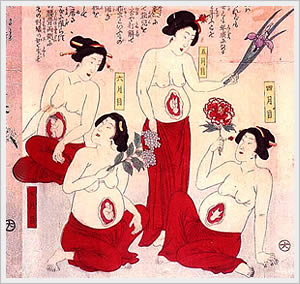
Detail from a Japanese ukiyo-e print showing the 10 months of pregancy: click to access complete print

The above is a cropped detail from a print entitled “Knowing the blessings of one’s parents,” by an unknown artist perhaps in 1882. The complete print depicts, from right to left, the 10 months of pregancy (above are months 4 to 7). This print comes from an online exhibition of ukiyo-e (Japanese woodblock prints) and yamato-e (Japanese painting) called “Japanese Art on the Subject of Medicine”, from the Digital Clendening online archive. This archive is the digitized portion of the Clendening History of Medicine Library, at the Kansas University Medical Center.

In addition to the above print, there are two other prints depicting prenancy, here and here. The latter one, by Shoshi, is particularly fanciful, depicting a pregnant woman with six heads and 12 bodies, and therefore carrying 12 fetuses.

There are a couple of other exhibits in the Digital Clendening site that I found particularly worthwhile: Chinese Public Health Posters (the first one about cholera is a doozie), and Portrait Collection, an exhibit of over 500 portraits of physicians and scientists.