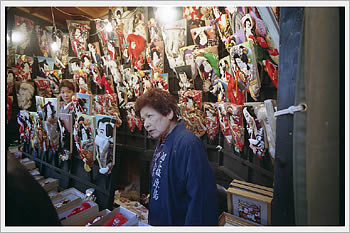
Shinjuku Gyoen, Tokyo, March 29, 2004. Bessa R2, CV 35mm f/2.5 ‘Pancake’, Fuji Acros 100.
Better late than never, here is a gallery of cherry blossom photos if you’re interested. I made a conscious decision this year to try to capture the ephemeral blossoms in black and white. Not sure how successful this attempt was, but you be the judge. I was partly inspired by the B/W sakura photos of a Japanese photographer by the name of K-Funk (see the three different “sakura” galleries on this page). I did take some color photos, but decided to leave them out of the gallery (you can see one online here).
Without living here in Japan it is really hard to comprehend just how much everything revolves around the blossoms for the one or two weeks they bloom, not to mention all the predicting and tracking of the blossoms that occurs on the nightly news, numerous web sites, and several special edition magazines in the weeks leading up to the actual blossoming. Finding a Japanese person who’s apathetic toward the blossoms is about as hard as finding one who will say on record that they love the rain — in other words, good luck.
The Japanese concept of mono no aware (simplistically, the impermanence of things) is often mentioned in the context of the cherry blossoms. But some students of mine, they of an older generation, taught me a heretofore unknown adjective when they tried to explain the appeal of the blossoms: isagiyoi. The dictionaries define this as “gracious” or “sportsmanlike,” but perhaps we can say “accepting defeat gracefully.” These students couldn’t help adding that this was a word seldom used to describe today’s younger generation.