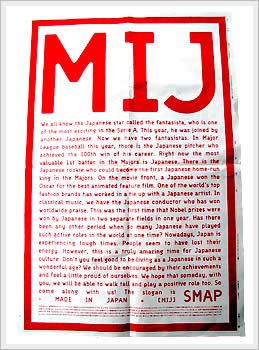
The above is a full page ad that was published in yesterday’s Yomiuri Shinbun, sponsored by the hugely popular Japanese boy-band, and television mainstay, SMAP. “MIJ” stands for “Made in Japan,” and the ad is a admonishment to Japanese to feel proud of themselves, and of the recent achievements of some Japanese in the fields of sports, film, music, fashion, and science. As the crux of the copy says (click on the above image for a larger, and more readable, photo of the ad),
Has there been any other period when so many Japanese have played such active roles in the world at one time? Nowadays, Japan is experiencing tough times. People seem to have lost their energy. However, this is a truly amazing time for Japanese culture. Don’t you feel good to be living as a Japanese in such a wonderful age? We should be encouraged by their achievements and feel a little proud of ourselves. We hope that someday, with you, we will be able to walk tall and play a positive role too. So come along with us. The slogan is – MADE IN JAPAN = [MIJ]
The ad’s appearance coincided with a new SMAP television program broadcast last night called, unsurprisingly, MADE IN JAPAN, although to be fair, nowhere in this ad is the television show mentioned or promoted. I didn’t see the program, but according to the tv schedule and the little bit of it that Naoko saw, it featured the band members each participating in a different aspect of traditional culture, such as working at a small Japanese chopsticks factory. According to Naoko, the band members have come to realize that they, like many of the young adults and teenagers they count as their fans, know precious little about their own culture, and that rather than look towards the West for inspiration, Japanese should start appreciating their own cultural output and achievement.
Given this however, I do find it curious that they chose to publicize their message in English, in a Japanese newspaper (the Japanese version of the ad’s copy is printed at the bottom of the page, in small type). Further, I also wonder about the idea of using those Japanese who “have played such active roles in the world” as the underpinning of the ad’s message. (Interestingly, none of these achievers is referred to by name, although it’s easy to work out who each one is.)
Certainly Japanese should feel pride that the likes of Ichiro and Miyazaki and Seiji Ozawa and Tanaka Koichi (Nobel prize winner) are succeeding on the world stage. But perhaps, by focusing on those who have had success outside of Japan, the ad is ultimately sending a mixed message. In a way, the ad seems to imply that, unless or until one’s achievements are recognized by the rest of the world, they’re really not achievements, or only half-achievements not worthy of pride, at any rate. Exhorting Japanese to feel pride in themselves, to look inward rather than outward, is all well and good, but as long as the West is posited as the arbiter of success and achievement, the standard by which all else is measured, I’m skeptical of how much good messages such as these will do, no matter what language they’re written in?