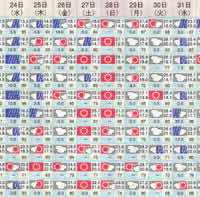
This is a couple of weeks old now, but I only just got around to scanning this from the August 27th
print edition of The Yomiuri Shimbun. What this graph is a detail of (click on the image for a larger view) is, in its entirety (it took up 80% of a single newspaper page), a summary of the summer weather for all of Japan from July 20th to August 25th.
Now I happened to scan the top part of the page, which is for Hokkaido, so there is an abnormally small amount of bright red squares, which denote hot, sunny days. Down in the Kansai (Osaka/Kyoto) and Kanto (Tokyo) areas of the page, it’s almost completely full with red squares. But you probably knew this already. Japan is unmercifully hot and humid in the summers. It’s a subject as old as the day is hot, and I’ve been ready to move on to other concerns for weeks now (like a lot of things, Japanese like to think their summers are the worse, but in reality this summer was more bearable that the summers I spent in Texas many moons ago).
But this post really isn’t about the weather, and neither was the full-page spread in The Yomiuri Shimbun. As considerate as it was for the paper to give its readership this visually appealing summary of Japanese summer weather, the real pupose of this page was to help Japanese students cheat on their homework. HUH? Come again? Yes, that’s right, this page is aiding and abetting, indeed sanctioning, cheating. Let’s call it institutionalized cheating. Alright, I’m laying on the hyperbole fairly thick, but let me explain.
You see, Japanese students get approximately 5 or 6 weeks off in the summer as their vacation (the school year begins in April). And during this time they get assigned homework, apparently lots of it, book reports, papers, etc. And many teachers assign summer vacation journals or diaries. Like students anywhere I suppose, there are probably those students who do this homework and some who don’t, and again like most students, there’s a lot of procrastinating involved and much midnight oil burned on the night before vacation officially ends and students return to school.
So what’s the weather report got to do with this? Well, as it was explained to me, the main purpose of publishing the summer weather for all of Japan is so that students will have an easily identifiable starting point with which to hurriedly craft their summer journals. Anyone who’s ever tried to keep a travel journal knows what a bitch it is to fall behind and have to go back and try to write about what happened two or three weeks prior (it’s usually the reason I never have been able to sucessfully keep a journal of any kind). So try writing about 6 weeks in the space of a night or two? The weather makes a nice lynchpin on which to build a journal around. But can you imagine these things? This is what I imagine:
July 25th, Thursday
— Hot today. 33.1 celsius. Went shopping with Aiko-chan. Got a haircut. Saw a cute boy on train. IM’ed with Michiko-chan. Met Kazumi-chan in Shibuya and saw a movie.
July 26th, Friday
— Hot today. 34.5 celsius. Went shopping with Mariko-chan. Bought a new blouse. Later went to karaoke with Tomoko-chan. Made stickers after.
You get the idea. Now, diaries have a long and rich tradition in Japanese life (see this article for a good overview of their place in Japanese literary tradition). But, as needs to be done with many aspects of the Japanese education system, someone needs to look at the real worth of this kind of homework, or more accurately, busy work. I’m not sure what troubled me more about this: that students are assigned these types of meaningless homework assignments, or that The Yomiuri Shimbun, a 125-year old paper with the largest daily circulation of any newspaper in the world, openly encourages its readership (or the sons and daughters of its readership) to flout the education system and to basically encourage students to crib and cheat. It further enlarges what many including yours truly see as the bane of Japanese education, and that is rote learning.
With the recent attention that blogging has gotten, and the increasing prevalence of a computer in the household (we now have three ourselves!), I wonder how long it’ll be before an enterprising and forward-thinking teacher (from the sound of it, a fairly rare commodity in Japan) assigns to his or her students the maintainance of a summer vacation blog. Would the results be any different I wonder? While the idea excites me, somehow I imagine that what would happen would be that the URL for Yomiuri’s online “summer vacation weather” page would be emailed around (or better yet, IM’ed via cellphone), and on the night of August 25th or whenever vacation ended that year, millions of students would be ALT-tabbing between the weather page and their blog software, copying and pasting, back-dating entries and basically doing what they always have done, cramming. To prevent this, the teacher would have to monitor the blogs as the vacation progressed, but would they? How many of these teachers are cramming themselves, busily preparing lessons and what not on the evening before the Fall term begins?