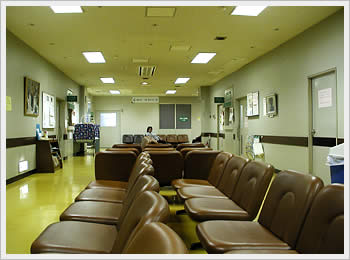
An empty hospital — I’m not complaining, mind you

Here’s a rare site, an empty Japanese hospital! Now to be fair, this is just one section of the hospital, but on this particular day (last Tuesday the 3rd), at this particular time (around noon), the place was truly deader than a door nail. (Hmmn, that’s kind of an unfortunate conceit given the subject). Naoko (who is way down there holding down the fort) said it was on account of the wind, which was blowing awful hair day fierce on this day. Considering that we sometimes have to wait over 2 hours for Naoko to get her routine ultrasound done, I was grateful for the emptiness. But it did make me wonder about the possibility that National Health Care has given rise to a whole group of folks who, windy days notwithstanding, at the drop of even the tiniest real or imagined symptomatic hat, rush to the hospital irrespective of whether their ailment warrants it.

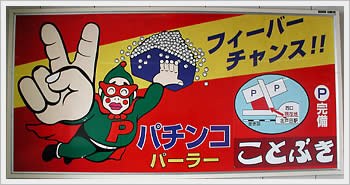
A fever chance among the din

click for larger image (54K)

I seem to have stumbled upon an advertisement theme…. The above image is an advertisement for a local pachinko parlor, and was taken at my usual train station. The name of the parlor is Kotobuki (it’s spelled out using hiragana there in the bottom right corner), which means “congratulations” and is often associated with weddings (the kanji character for kotobuki is often printed on wedding portrait albums, for example). That bit of writing above the map is fiibaa chansu!!, or “fever chance.” The meaning being that you will get a fever (in the positive “excitement” sense of the word) if you hit jackpot. The writing in the middle reads pachinko paaraa, or “pachinko parlor.”

I have only been in a pachinko parlor once (not including an abandoned one), 2 years ago while visiting Kyoto. Ever since seeing Wim Wenders’ Tokyo-ga, which features a sequence on pachinko, I had wanted to experience one for myself. But now that I have, I can’t say I have a hankering to visit another anytime soon. The din of those tiny silver balls rattling around in machines, the fog of cigarette smoke, the depressing monotony of it — not for me. My father-in-law plays, usually making a trip to the parlor on his day off. When he leaves the house, he always has a sheepish grin on his face and mutters something about going to his second job. Of course he has to ask for money from my mother-in-law before he leaves, and depending on her mood he might have to wait, or do some chore, before he can go. My mother-in-law usually puts on an air of disapproval about the whole thing, and admonishes him to get a more respectable hobby, but in reality she often joins him at the parlor.

See this article from an old Mangajin Magazine issue for a good introduction to the game of pachinko and its place within Japanese culture, as well as its shady side.

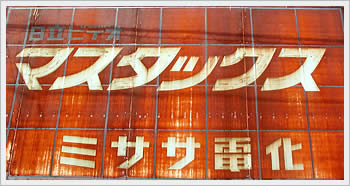
Rust never sleeps: an ad in the neighborhood

Hitachi masutakkusu ad, Toda (Saitama): click for larger image (51K)

And old rusted sign above a storefront-cum-house on the small street that serves as my thoroughfare to and from the train station. I pass by this sign everyday (conservative calculations would indicate I have passed it around 700 times up to now) yet until today I paid it no mind. One gets used to such ugliness in Japan, one gets numb to it, until one decides to take a picture. What struck me today was the rust, and the fact that I couldn’t for the life of me figure out what masutakkusu was supposed to mean. (It’s rendered in katakana, which is usually reserved for foreign-imported words, so it was likely some bastardization of some English word, or so I thought.)

In the upper left it says “Hitachi Video”, and this provided enough with which to do an internet search. (The bottom characters spell out “Misasa Denka,” or Misasa Electronics, the name of the company for whom the sign is — was? — for.) Masutakkusu was the name of one of the original VCR models manufactured by Hitachi is the late 70’s in the VHS format, to compete with Sony’s BetaMax, which had been introduced in 1975. I’m not sure, but I believe the Masutakkusu line of VCR’s was produced until the late 80’s. I say this because according to the official site of the Tsutenkaku Tower in Osaka, one of the city’s symbols which has, almost since its construction in the early 1950’s (actually re-construction, the first tower having been burnt down in a fire in 1943), featured Hitachi neon branding on all its four sides, in 1979 was already displaying “Hitachi masutakkusu.” But sometime between 1988 and 1990, it disappeared, replaced by signs for other Hitachi products. (Various images of the tower and the neon signage that has adorned it, are available here.)

Unfortunately, the mysteries of Hitachi branding remain unsolved. Why masutakkusu, and what was it supposed to represent, I have no clue. takkusu would most likely be romanized as “tax,” so perhaps the name was a take-off on or nose-thumbing to Sony’s BetaMax. Something like “MassTax.” Hmmn, that way it conjures up something entirely different, no? But such are the vagaries of katakana transliteration that it’s entirely plausible.

(You can catch up on the long-forgotten early history of home video development by way of this nice piece.)

P.S. I didn’t intentionally boost the orange hue of the photo via software. It’s that bright in real life.