Intelligent and entertaining writing about Sumo stable life

sumo101804_02_36_2S.jpg

With the first Sumo basho of the year just a few days away now, I crossed paths tonight with this wonderful ii timingu (good timing) find:

In the Hall of the Mountain Kings: One little man’s journey into the world of sumo wrestling

It’s by one Jacob Adelman, a grad student at UC Berkeley who has just spent a couple of weeks at Hanaregoma Beya in Tokyo’s Suginami Ward, not with the purpose of becoming a professional sumo wrestler but just to write about it for his Master’s thesis, and write about it he has done for the last 3 weeks in this blog. As Adelman explains it in his first post:

The idea for this project, like many things in my life, was born out of laziness. The two masters’ degree programs I’m in—journalism and Asian studies—each require me to write a thesis. When I started considering thesis topics, I tried to think of something that I could count for journalism and Asian studies, thereby saving myself the trouble of writing a second thesis. Everyone I ran the idea past was intrigued by it, though no one thought I might actually get a sumo “stable,” as the training houses are called, to let me in.

Through some tenuous connections Adelman is eventually allowed to temporarily join the Hanaregoma Beya. He is clear with his hosts as to what he’s up to (and even had he not, his uh, not exactly sumo-ish build would’ve let the cat out of the bag fairly quickly), and as he himself notes, it seems that many of the wrestler’s in the stable are eager to chat. And while Adelman originally had wanted to be treated as a rookie within the stable, in effect he was treated as a guest, and therefore had access to parts of the heya (and conversations with some of the rikishi) that most rookies will never have.

Adelman has used a blog to host his writings of the experience so as such, you’ll have to go to the December 2004 archive and scroll to the bottom to read the first post and then up from there if you want to read the story from beginning to end (seems he’s now left the heya but hasn’t written that post yet). I’ve made my way through about half of it and not only is it rather entertaining, but it gives good insight into the inner goings-on within a heya, the harsh conditions the rikishi (sumo wrestlers) live in (especially the lowest ranked among them), and the stratified atmosphere where the heya’s lone sekitori (salaried wrestler) verbally abuses the underlings as part of his de facto job description. (Adelman doesn’t mention him by name but this is Ishide, who won the Juryo yusho (championship) at the November basho in Fukuoka.) As Adelman writes,

I’ll bet that, once you get to know him, the Sekitori probably isn’t even such a bad guy. He probably spends so much time holed up alone in his room because he gets tired of being a creep. Being responsible for the torture and humiliation of a sprawling house full of overweight jocks is hard work. But it’s part of his job description and the prerogative of his rank.

If you have the slightest interest in the sport of sumo or in Japanese culture, I highly recommend reading some of Adelman’s posts. These aren’t your usual snippet blog posts either, each one is more or less an article unto itself. I look forward to reading the rest of it (particularly intriguing is some yakuza-ppoi character named “Iki” that drops into the heya from time to time) and seeing what conclusions Adelman has come to after his journey.

~ ~ ~

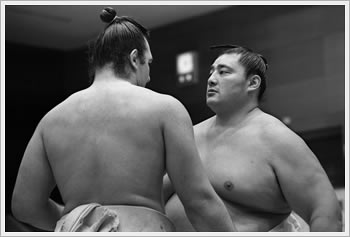
The above photo, just to be clear, does not depict any rikishi from Hanaregoma Beya but rather Kotonowaka (right), the elder sekitori of Sadogatake Beya (talking with his taller but rather young heya mate Kotooshu, from a jungyou (exhibition Sumo event) I attended last October. If you click on the above photo you’ll be taken to a gallery of photos I shot at this event that I recently uploaded.

Remembering Randy Bass:some thoughts on Ichiro and his pursuit of history

bass.jpg

I was watching the tube with the in-laws earlier tonight when the sports news came on, the lead story of which was Ichiro‘s pursuit of the Major League Baseball record for most hits in a season, which has been held for 84 years by George Sisler. Going into yesterday’s game, Ichiro needed 24 hits to tie Sisler’s mark of 257 hits. Alas, he didn’t get any hits in the game and remains on 233 hits, with just 16 games left in the season.

In the game Ichiro was intentionally walked twice, and this produced cries of kawaiisou from the in-laws (“kawaiisou” might approximate “you poor thing” or just “poor thing” in this case). I explained as best I could that Seattle’s opponent, the Anaheim Angels, were in the penant race and that an intentional walk was a legitimate strategy to win the game. Not that I like it mind you, obviously I want to see Ichiro get a chance to get a base hit like everyone else, but you can’t disparage the Angels for trying to win the game any way they (fairly) can. “But he’s going for the record,” they replied.

I then asked if they remembered what happened to Randy Bass some 20 years ago. Now, you’d have to be a fairly hardcore baseball fan, or to have lived in Japan, to know who Randy Bass was. In fact, there were two Randy Basses, the MLB Randy Bass, and the Japanese Pro baseball Randy Bass, and while they shared the same body that’s really where the comparison ended. After a bench-warming six-year career with 5 different teams, hitting a career .212, Bass quit the Majors and came to Japan to play for the Hanshin Tigers, one of Japan baseball’s oldest teams.

In six years for Hanshin, Bass (pictured here) tore up the league, winning two triple crowns, and leaving with a career .337 batting average and 202 home runs. 54 of those home runs came in the 1985 season, and the Tigers won their first penant in 20 years. The story of those 54 home runs, and why Bass didn’t perhaps have more than 54, was what I was asking my in-laws about.

Going into the final series of the season, sitting on 54 homers, Bass needed just one more to tie the Japan baseball single season record for home runs of 55, set by the great slugger Sadaharu Oh. The Tigers’ opponent for those final two games was the Tokyo Giants, their archrival, managed by none other than…Sadaharu Oh.

Did Bass see any pitches to hit during that final series of the year? Not a chance. In fact, in 9 plate appearances, he was walked 6 times. In the final game of the year, Bass was walked all four times he came up to the plate (though none of them were official “intentional” walks). At one point, with pitches being thrown so far out of the strikezone that it was as clear as day what was happening, Bass turned his bat upside down is disgust. The story goes that Giants’ pitchers had been warned that they would be fined if they gave Bass any pitches to hit. Who’s to say whether Bass would have been able to homer even had he had a decent chance to swing the bat. (I feel compelled to add, however, that Oh set the record in a 140-game season, while Bass was trying to break it in a 130-game season).

Whether Oh’s actions were motivated by personal reasons (“He ain’t gonna break my record as long as I have something to say about it.”) or a larger xenophobic one is beyond me to say. It’s complicated, to be sure (Oh himself is half-Chinese). Readers interested would be advised to seek out a used copy of Robert Whiting’s You Gotta Have Wa or Pico Iyer’s essay “Perfect Strangers” which appears in his book Video Night in Kathmandu.

One thing I know for sure: as the walks to Ichiro increase, as they surely will — after all, all of Seattle’s remaining games are against teams with a legitimate shot at the postseason, and Ichiro is Seattle’s biggest threat — so will the cries of “kawaiisou” and “kibishii” (idiomatically, “that’s harsh”) and “okashii” (“strange”). Perhaps there’ll be some idle speculation that Americans don’t want to see a foreigner break “their” record (a notion even I the cynic have no qualms about dismissing without a second thought). I can only hope that somewhere out there in the Japanese household, or on the various TV networks that serve them their news, some of them will remember Randy Bass.

~

As I’ve been writing this, the biggest Japan baseball story of this season has broke: the Japan professional players association has decided to go on strike, effective tomorrow (for now, the strike only effects games played on the remaining weekends of the season), for the first time in its 70-year history. The fans are overwhelmingly on the side of the players in this one: as I type this, one of the news shows is running a call-in poll on whether or not viewers support the strike or not. At the moment, 235,700 callers are in favor of the strike, while a measly 7,800 are not. There’s more to be said here of course, but I’ll save that for another day.

Gearing up for Honbasho

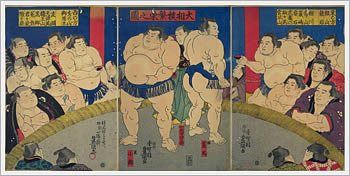
Koyanagi versus Arauma, circa 1844-1850: click for larger

It’s the start of the Aki (Fall) Sumo tournament here in Tokyo and after more or less taking the last basho off, I can feel myself getting back into the swing of things, and look forward to making it down to the Kokugikan for at least one if not two days of action this basho. Of course, the other days I will be glued to the nightly highlights show broadcast on NHK. (The basho runs from September 12 – 26.)

There are many compelling stories this basho, starting first and foremost with whether or not Yokozuna Asashoryu can win his fifth consecutive tournament and continue his quest to be the first rikishi in history to win all six bashos in a single calendar year. He is also attempting to break the record for the most bout victories in a year.

His 19 year old Mongolian countryman Hakuho is slowly but surely being touted as perhaps the next Yokozuna, and is coming off consecutive double-digit win tourneys. At Maegashira #3, Hakuho is now ranked high enough that he is virtually guaranteed to meet the Yokozuna for the first time on the doyho — in short, a most anticipated bout. Ozeki Tochiazuma seems to be finally fully healthy, and in my book is the leading contender to upset Asashoryu’s record-setting plans. Further down the banzuke, there are several newcomers to the top division that folks will be following, namely the Bulgarian Kotooshu who has already become a fan favorite due to his kawaii looks (the dreaded “David Beckham of Sumo” has been uttered more than a few times already).

The above ukiyo-e print is of a special exhibition bout between Koyonagi on the left (in the middle panel) and Arauma on the right, from sometime in the middle of the 19th century. Both rikishi had long, distinguished careers: Koyanagi was active from Tenpo 6 (1835) to Ansei 3 (1856), reaching as high as the Ozeki rank, while Arauma’s career spanned from Tenpo 3 (1832) to Kaei 7 (1854), his highest ranking being that of Sekiwake. (This was in an era which saw only two tournaments per year, with these being only 10 bouts long (in contrast to today’s 6 yearly tournaments of 15 bouts duration each).)

Interestingly enough, both rikishi hailed from the same part of Chiba prefecture east of Tokyo, and apparently this helped give rise to a spirited rivalry between the two which made them two of the most popular rikishi at the time. In fact, the pair were so popular that they were immortalized in the lyrics to a famous children’s song of the time. It is said that along with Ozeki Tsurugisan, who is one of the off-dohyo rikishi depicted in the far right panel of this print, the three were lauded as the preeminent rikishi of that time. (Tsurugisan sounds like he’s worthy of his own post: at one point in his career, he turned down a chance to become Yokozuna, claiming that his dohyo form wasn’t good enough. That didn’t stop him however from wrestling until the ripe age of 48!)

The above print triptych was done by Kunisada (Toyokuni III) sometime between the years 1844 to 1850 (based on the seal/signature analysis found on this page). Click on the above image for larger versions of the triptych.