I was too tired last night to write about our trip to Hitachi, and I have no time at the moment to upload more photos than the one above. (My digital camera was also acting up and I spent more time using the SLR, photos from which I’ll have to wait for a few days).
This trip to Hitachi was one of the best trips I’ve been on recently. Here are some impressions which might explain why:
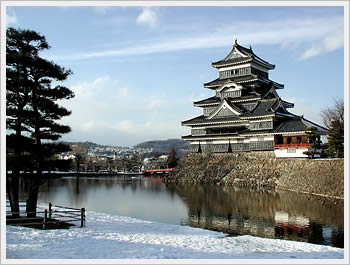
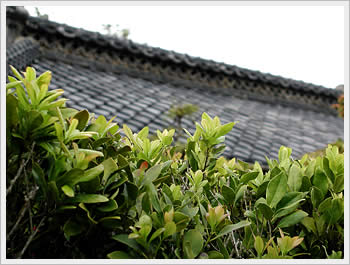
Hitachi isn’t going to win any beauty competitions that’s for sure, but I really liked the place. Perhaps it was my proximity to the ocean that was seducing me, but there was something about the place that was very familiar to me, a bit of suburban Honolulu mixed in with Santa Cruz, California (sorry that’s the best comparison I can come up with at the moment). Sure there are many factories and signs of Japan’s somewhat fading industrial might, but they were not the blight I was expecting. There is still plenty of factory housing (shataku in Japanese) to go around, most of it drab and depressing, but there were also scores of beautifully traditional Japanese-style homes to be seen, fabulous two-storied structures with san-gawara-topped roofs. I don’t know any of the history behind these homes, but I imagined that these were the homes of the industrialists that owned and ran the factories.
On a personal level the trip was also very satisfying, I achieved what in the end were my modest goals of not getting into arguments with Naoko or her mother, with so little effort as to make me wonder why I was so worried about it in the first place. In point of fact, meeting my mother-in-law’s brothers and their families, seeing her furusato (one’s hometown), and learning some of the history of her family, gave me a newfound respect for her. (furusato literally means one’s hometown, but it is also a Japanese concept representing the idealized old-country home that everyone longs to return to, a place more in tune with nature and traditional Japanese values like family and harmony, and as such it is as much an internal place of the mind as it is an actual physical place.)
In my previous post I mentioned that Hitachi was home to one of the largest mines in Japan. What I didn’t know was that Naoko’s grandfather, the same grandfather whose death was being memorialized which was the ostensible purpose of this trip (I was wrong before, it wasn’t the 10th anniversary of his death, but rather the 23rd), worked at the Hitachi Mine, and the family lived in a rented company house. We visited the site of that house, long ago torn down, deep in the hills of Hitachi. We traversed a winding highway past the main mine complex and on both sides of the road you could see the concrete slabs that used to support all the shataku apartment buildings that housed the mine’s workers. Some of the main mine site (notably tunnels and a smokestack) remains, and it was an awesome and toublesome sight for reasons I can’t really explain. Old and decrepit as it stands now, a mere shadow of its former self (the smokestack — a newer one — was actually only a third of the height as the first one), it continues to dominate the landscape, and I suspect in some ways it continues to dominate the lives of those who grew up in its shadow, literally and figuratively, like my mother-in-law.
We visited the elementary school where this picture was taken, as well as the beach where this picture was taken, and made a tour of the different places my parents-in-law lived in, and where Naoko’s first house was (sadly no longer there), and the hospital she was born in (also no longer there).
I was warmly welcomed by my mother-in-laws brothers and their families, after an initial awkwardness, which was probably more due to an innate shyness than any wariness of me as a foreigner (the flow of alcohol helped in this regard too). For whatever reason, Naoko is not particularly close to these people, so given that I would say my reception was very positive indeed. They were very kind to us and gave us a lot of monetary gifts, which is typical when a couple has a newborn child.
As I mentioned previously, the minshuku we stayed at was wonderful, a fabulous view of the ocean from high atop a hill, and only a 5-minute walk down to the beach (where the above photo was taken). As I wrote, it was built in the shape of a small castle. According to the woman the woman who started it, she loves old Japanese things and wanted to build something special, given the prominent hilltop location. I remember when we were driving to the hotel, both Naoko and I were remarking “Wow, look at that house,” and the next thing we knew the cars in our party ahead of us were pulling in to this place. We could hardly believe it. The price was quite decent too, 8,000 yen ($68 US) a night per person, which included dinner and breakfast. They had an onsen bath too, and Kaika experienced his first onsen. The water was a tad bit too hot for him, though.
Lastly, one resolution I made on this trip is that wherever it is, I want to someday live next to the ocean. I cannot adequately explain the feelings I have when I look at the ocean, smell the sea breeze, feel the stickiness of the sea spray on my palms, or the sand under my feet. But I do know that wherever it is, be it Hawaii, or California, or somewhere in Japan, this is my furusato, and someday I want to go back there.