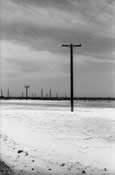
This side of 15 minutes and Harper’s Magazine

click to see rest of photos

Two weeks ago I was contacted by the Art Director of Harper’s Magazine. She had come across one of my Salton Sea photos online and was interested in seeing more of my work from there, as the magazine was looking for artwork to accompany a piece they’re putting together for an upcoming issue (presumably about Salton Sea though I’m not sure).

Not having any of my black and white work in a digital format (what I previously had put up online were actually scans from prints), I spent two solid days scanning over 80 medium format (6 x 4.5cm) and 35mm images on my modest Epson flatbed scanner (wholly inadequate for the undertaking but in the end performing like a champ). To scan one negative, and then to adjust contrast and remove dust introduced in the scanning process, took anywhere between 15 and 20 minutes, so you can add up the work I went through to get these to the point where Harper’s could take a look at them.

In the end, it was for naught. The deadline for the project was yesterday, September 12th, and given that I would have had to have had dupes made and FedEx’ed to New York before then, I knew the jig was up even before I received the “rejection slip” via email yesterday morning:

Dear Kurt:

As I am sure you have already imagined, we have run out of time to for this piece. I still don’t have the final editorial cuts yet and have not been able to make any art selections. So unfortunately, it doesn’t look like it is going to work out this time for us because of time. I sincerely appreciate your posting the black and white images on the website so that we could see them.

I wish you the best of luck with your current and future projects.

Now I have no idea whether they really ran out of time or if the between the lines meaning is that they found other artwork they’d rather run with, and I’m not going to waste time fretting over it. I was flattered just to have been contacted. That’s not to say I’m not disappointed, but the rue is more of the sanguine “it was fun while it lasted” variety.

The title of this post is facetious; I’m under no illusion that having my photos published in the 150 year old, “oldest continually circulating magazine in America” (so says their site) would have brought me fame or even 1 second of 15 minutes of it. But I did find myself pondering over the possibility of being published in a magazine probably best known now for its monthly Harper’s Index, but which has published (and continues to publish) work by some of the most renown authors in the field of arts and letters, writers like Mark Twain, Umberto Eco, James Baldwin, Henry James, Virginia Woolf, Walt Whitman, Joyce Carol Oates, Leon Trotsky, William Faulkner, David Mamet, Alice Walker, and so on and so on (a very incomplete sampling of authors published in the magazine can be found here). So yeah, it was kind of a big deal for me and predictably I got my hopes up though not fantastically so.

My use of the phrase “rejection slip” above is also facetious, and ironic as well. Back in the days when I fantasized about being a writer and would thumb through the well-worn pages of my Writer’s Market that my mother had given me, I often wondered how many manuscripts and I would have to send out before one of them was finally accepted for publication (and that at the sort of journals that paid you in copies of their magazine), and how many rejection slips I would amass in the process. So here it is in 2002, my dream of being a writer long displaced by other dreams and even more plebeian realities, and through absolutely no effort of my own, one of the most prestigious magazines in America contacts me about possibly publishing my photography in their publication. And I didn’t even have to include a self-addressed stamped envelope to get my pictures back! Of course it is a testament to the power of the internet, and to the self-publication model that characterizes weblogs and all manner of personal web sites. It also makes me wonder what would happen if I got off my ass and put myself and my work out there more.

I’ve left the page I created for Harper’s unchaged, and you’re welcome to take a look at it if you like.

Feeling itchy

Not literally, at any rate (for some reason, mosquitoes don’t take to me like they do to Naoko). No, feeling itchy that more than a week has gone by since my last post. Unfortunately I don’t have too much to report at the moment, I’m busy trying to find a Japanese language school, and trying to disclipline myself to self-study until I find one.

I did recently create some desktop wallpapers of some of my Japan 2002 photos, should you be interested, found here. I was inspired to create these by downloading some interesting wallpapers from Tokyo designer/photographer Tomatocow (after entering the main site, click on the “wallpapers” link). There are some other great Tokyo wallpapers available at panoramic photographer Tsutomu Kuriyama’s site.

Speaking of photography, after being lazy for the last couple of weeks, I have managed to upload a few days’ worth of photos, including a bunch from a bus tour the family took to Yamanashi prefecture a couple of hours away (though with traffic, it was a 4-hour trip each way). Ironically, one of the highlights of the tour was the impressive whirlwind mini-tour of Tokyo I got in the morning as the bus made its way west out of the city via the Shuto Expressway, and the companion view at night as the bus returned to the city, reversing the morning route. Passing through many of the main Tokyo hotspots, Ikebukuro, Korakuen and the Tokyo Dome, Kitanomaru Park and the Budokan, Akasaka, Meiji Shrine, Shinjuku, and being high-up on a bus already high up on the Expressway, I got a view of the magnificent and gigantic city that I hadn’t ever seen before.

On the way back from Yamanashi, before entering Tokyo, we could see way off in the distance fireworks, yet another fireworks festival (hanabi) during a summer teeming with them. I had no idea where it was, but the next day (Sunday) I was checking Antipixel, and Jeremy had uploaded some photos from a previous night’s Tamagawa hanabi festival. Considering that we had to cross the Tama river to get back into Tokyo, I’m fairly certain these were the fireworks we could see from the bus.

I’ve taken some photos at the two hanabi festivals I’ve been to recently, but sans a tripod, my shots have been disappointing. But Jeremy has really captured the essence of what the sky looks like on such an occassion. Definitely worth a look.

Gunkanshima and ruined lives

Ms. Fin has posted to the collaborative “visual representation” blog Spitting Image an interesting collection of sites about a Japanese island near Nagasaki named Hashima, but known by more people as “Gunkanshima” because it resembles a warship.

For over 80 years, Mitsubishi Mining Company used the island, having bought it in 1890 for 100,000 yen, to mine coal lying deep under the bottom of the sea within the vicinity of the island. In effect, until 1974 when mining operations abruptly stopped and residents of the island packed up and left, Hashima was a Mitsubishi company town, and within its 160 meters x 480 meters land area, as many as 5,000 people lived within its walls at the same time. According to Brian Burke-Gaffney’s well-researched article “Hashima: The Ghost Island,” published in the Summer 1996 issue of Crossroads: A Journal of Nagasaki History and Culture, in 1959 the population of the island reached 5,259, or 1,391 people per hectare (1 hectare = 2.47 acres) for the residential portion of the island. Writes Burke-Gaffney, “[…] this is said to be the highest population density ever recorded in the world.”

Ms. Fin links to the dare I say “requisite” Japanese photography sites documenting the extensive ruins that apparently still litter the island (Mitsubishi Mining, now called Mitsubishi Materials Corp., still owns the island and prohibits unauthorized access to it). As a whole, they form a nice, and beautiful at times, collection of photos. But as Ms. Fin writes, what these sites really are trafficking in is nostalgia, or “beautified nostalgia” as she puts it. With the exception of one site duly noted and praised by Ms. Fin (granted there may be others), there is precious little commentary or narrative about what life must have been like on this barren and isolated island, or the surely mixed emotions of those residents who had to leave the island in 1974 when Mitsubishi pulled the plug. Can any of the present-day photos of hollowed out buildings even begin to tell those stories? Are the approxmiately 1,200 laborers who died on the island due to mining accidents, having worked and starved to death, or by committing suicide, being remembered in these photos, or are these photos simply unwitting paeans to the former industrial might of Japan?

A might, it’s important to add, that was built in part on the forced labor of Chinese and Koreans and American POW’s during World War II (do a Google search for Mitsubishi Mining forced labor and be astonished at the myriad of accusations against not only Mitsubishi, but other Japan heavyweight corporations like Mitsui, Nippon Steel, and Sumitomo). With respect to Hashima’s mining operations, numbers are not conclusive, but it’s estimated that at the end of the war in 1945, there were 500 Koreans and 200 Chinese forced laborers on the island (these are numbers for those still living; perhaps as many as 150 forced laborers died during 1942-45 on Hashima).

According to this October 17, 2000 article [perhaps from the Japan Times?] linked here (scroll down to the bottom), some former island residents would rather not dwell on Hashima’s part in Japan’s forced labor history:

People who lived on the island after the war cannot stand the idea of their hometown being disgraced by the murky side of its history, said a midle-aged woman living near Takashima.

The woman, who spoke on condition of anonymity, added that people don`t feel free to be outspoken about forced laborers because most local residents are more or less still tied to the Mitsubishi group, which is sensitive about the issue.

Nevertheless, through lawsuits and other means, there are those who do want to revisit and seek redress. Just last weekend, according to this Japan Times article, two former Chinese forced laborers came to Japan at the invitation of Nagasaki University researchers, and were able to sail around Hashima island and even identify the site where they used to live. They were due to meet with Mitsubishi officials as well during their Japan visit, though it isn’t known whether they did or how they were welcomed.