Old documents, new documents

MoMA New Documents press release February 1967
From Page 1 of MoMA’s press release for “New Documents” exhibition of 1967

Though of course they wouldn’t have known it at the time, The Museum of Modern Art’s 1967 exhibition, New Documents, organized by John Szarkowski and featuring the work of Diane Arbus, Lee Friedlander, and Garry Winogrand, became one of a handful of truly landmark exhibitions in photography’s history.

And so it is with some measure of amusement that one notes the human frailty contained in this facsimile of the original press release for the show. With the typewriter just about clickety-clacking in our ear as we look at the Courier type, the after-the-fact insertion of the demonstrative pronoun “this” in fact demonstrates, by following the exception-that-proves-the-rule precept, the care with which these old documents were prepared, back in the day. One questions whether this sort of dodo markup will be understandable in another generation or two from now.

Allow me to use Stephen Shore to put a fine point to it:

There seems to be a greater freedom and lack of restraint. This is analogous to how word processing affects writing: one can put thoughts down in writing, even tangential thoughts, with a minimum of inner censorship, knowing that the piece can be edited later. The other side of this lack of restraint is greater indiscriminancy. Here’s a tautology: as one considers one’s pictures less, one produces fewer truly considered pictures.

Stephen Shore quote from “A Conversation with Stephen Shore,” by Jörg Colberg, Popular Photography, September 24, 2007

Merry Christmas, 2007

Dutch Royal Mail Christmas Postage Stamp Sheet (Fireworks)
Christmas stamps produced for Royal TNT Post BV (The Netherlands)
Design: Eric Kessels/ KesselsKramer
Original photos: Kurt Easterwood

If you can read Dutch, you can read about the above Christmas stamp for the Dutch postal system, of which I had very little to do with other than to supply the photos, here. (A barely understandable machine translation is also available courtesy of Google Translate.)
What I do know is that there were 750,000 of these sheets printed (in Australia, no less), and that for the first time (for the Dutch postal system), the stamps include some sort of sweepstakes (you scratch off the grey part). I’m not sure how the stamps were received, though the blog post referenced above does give off a hint of controversy about the concept.

Erik Kessels of KesselsKramer, with 2007 Dutch Christmas stamps
Erik Kessels, flanked by two Dutch celebrities, showing off his Christmas stamp designs in Amsterdam

Also makes me wonder if the Dutch have discovered email yet. 750,000 sheets at 20 stamps per sheet comes to 15 million stamps. That’s almost one stamp per every man, woman and child in the Netherlands, and this was not the only Christmas stamp produced. Not that I’m complaining, mind you! But perhaps it’s appropriate there is a Japan element (albeit unstated) to these stamps, given that Japan has its own posting frenzy during the year-end holidays, when up to 4 billion (!) New Year’s cards will be sent at the end of this week.

To everyone reading, Season’s Greetings for 2007, wherever you may be.

The further denuding of photography

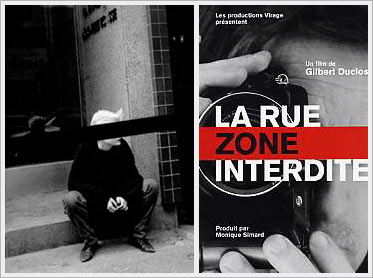
Gilbert Duclos, "Celebre inconnue, Montreal 1987" plus "Off Limits" poster

Green Cine Daily points us towards the 2005 documentary Off Limits (La Rue: Zone Interdite) by Montreal photographer Gilbert Duclos. In the late 80’s, Duclos was sued by a young woman who had appeared in one of Duclos’ street photos. The woman claimed that her right to her own likeness had been violated. She eventually won.

Off Limits looks at the issue of photographers being increasing hemmed in by laws designed to protect a person’s supposed right to their own image, and particularly droit de l’image laws in place in France. Duclos interviews William Klein, Marc Riboud, and Willy Ronis for his film, and these elder statesmen of the street or reportage photography tradition are not surprisingly pessimistic about the chilling effect such laws can have on photography as well as journalism.

French photojournalism now removes the faces of people in the street or in any other public setting, or pictures are simply staged. Editors at major magazines tell Duclos that they simply avoid publishing pictures that might trigger lawsuits, which means publishing far fewer pictures, which means that the street photography which has documented much of the 20th century has nowhere near the vitality in the country where it once seemed strongest.

The review notes that it is the United States that Duclos and others look to to protect the freedom of photographers to shoot and publish non-commercial candid images, though given the current climate one wonders how long it will continue to be the beacon in this regard.

RELATED: See my post from a couple of years ago on how “the right to one’s own likeness” comes up occasionally in Japan, mainly spearheaded by the entertainment industry out to protect their “assets.”