SMAP’s Made in Japan campaign

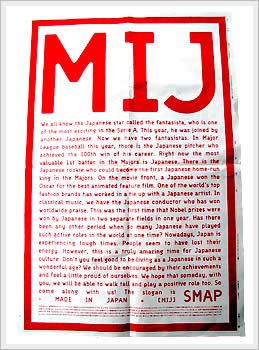
SMAP 'MADE IN JAPAN' advertisement, Yomiuru Shinbun, June 16, 2003: click for larger image (69K)

The above is a full page ad that was published in yesterday’s Yomiuri Shinbun, sponsored by the hugely popular Japanese boy-band, and television mainstay, SMAP. “MIJ” stands for “Made in Japan,” and the ad is a admonishment to Japanese to feel proud of themselves, and of the recent achievements of some Japanese in the fields of sports, film, music, fashion, and science. As the crux of the copy says (click on the above image for a larger, and more readable, photo of the ad),

Has there been any other period when so many Japanese have played such active roles in the world at one time? Nowadays, Japan is experiencing tough times. People seem to have lost their energy. However, this is a truly amazing time for Japanese culture. Don’t you feel good to be living as a Japanese in such a wonderful age? We should be encouraged by their achievements and feel a little proud of ourselves. We hope that someday, with you, we will be able to walk tall and play a positive role too. So come along with us. The slogan is – MADE IN JAPAN = [MIJ]

The ad’s appearance coincided with a new SMAP television program broadcast last night called, unsurprisingly, MADE IN JAPAN, although to be fair, nowhere in this ad is the television show mentioned or promoted. I didn’t see the program, but according to the tv schedule and the little bit of it that Naoko saw, it featured the band members each participating in a different aspect of traditional culture, such as working at a small Japanese chopsticks factory. According to Naoko, the band members have come to realize that they, like many of the young adults and teenagers they count as their fans, know precious little about their own culture, and that rather than look towards the West for inspiration, Japanese should start appreciating their own cultural output and achievement.

Given this however, I do find it curious that they chose to publicize their message in English, in a Japanese newspaper (the Japanese version of the ad’s copy is printed at the bottom of the page, in small type). Further, I also wonder about the idea of using those Japanese who “have played such active roles in the world” as the underpinning of the ad’s message. (Interestingly, none of these achievers is referred to by name, although it’s easy to work out who each one is.)

Certainly Japanese should feel pride that the likes of Ichiro and Miyazaki and Seiji Ozawa and Tanaka Koichi (Nobel prize winner) are succeeding on the world stage. But perhaps, by focusing on those who have had success outside of Japan, the ad is ultimately sending a mixed message. In a way, the ad seems to imply that, unless or until one’s achievements are recognized by the rest of the world, they’re really not achievements, or only half-achievements not worthy of pride, at any rate. Exhorting Japanese to feel pride in themselves, to look inward rather than outward, is all well and good, but as long as the West is posited as the arbiter of success and achievement, the standard by which all else is measured, I’m skeptical of how much good messages such as these will do, no matter what language they’re written in?
Second-hand smoke and Kaika

We received a thank you card from my mother today, thanking us for sending her a lot of photos of Kaika. Attached to the card, as if in afterthought, was a post-it note with the following written on it:

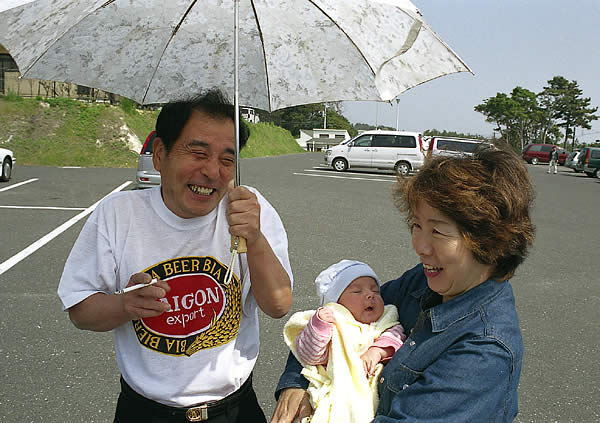
I was horrified to see a cigarette in the same picture with Kaika. Kurt, keep him protected from the secondhand smoke. I mean this!

She was referring to this photo of Kaika with his maternal grandparents, in which my father-in-law has a cigarette dangling from his fingers. I do admit I paused before including the photo in the packet I sent her, for fear it might get her back hairs to stand up. My mother has always been a vigilant anti-smoking advocate, especially as it relates to children. When I was a kid, long before the term “secondhand smoke” entered the common lexicon (according to this article, the possible effects of secondhand smoke, or ETS as it’s officially known, first came into public knowledge around 1984), my mother had no problems turning to cigarette-smoking passengers on a bus, for example, and asking “Could you please not smoke here? It’s not good for my children.”

My father-in-law doesn’t smoke in the house, nor the car. In point of fact, Naoko is just as vigilant as my mother, and it was her concern about secondhand smoke that forced him outside the house to indulge his habit, several years ago. Unfortunately, as my mother wouldn’t know, and for the time-being I’m not going to tell her, the real problem is not with my father-in-law (or sister-in-law, for that matter, who also smokes), but with this entire country, where there exist very few non-smoking places, and few laws to protect those of us who don’t smoke.

Let’s take Kaika to the local department store. It’s supposedly no-smoking in there, but in reality one can smoke in the food court, which takes up half of the entire first floor. Coffee houses? Forget about it! With the well-publicized exception of Starbucks, you might as well cut to the chase and give the kid a cigarette directly. Restaurants? Well, some (but not all) have no-smoking sections, but little good do those actually do. You can segregate customers in tiny token no-smoking sections, but you can’t segregate cigarette smoke.

Recently some measures have been in the news recently, such as Tokyo’s Chiyoda Ward banning smoking on its streets in the summer of 2002, or private railway stations in Tokyo banning smoking on train platforms on May 1st of this year. However, in the case of the former, the impetus for the ban was not the dangers of secondhand smoke, but rather to help cut down on cigarette butt litter, and because smoking in public is “bad manners.” In the case of the private railway stations’ ban, the action was taken by these companies, according to this Foreign Press Center Japan article,

[…] in line with the Health Promotion Law that went into effect on May 1. The new law imposes a legal obligation to prevent passive smoking, which refers to people unwillingly inhaling the secondhand smoke of others and can be extremely unpleasant and irritating for nonsmokers. It covers places used by the general public, including gymnasiums and department stores, as well as train stations.

This is all well and good, and indicates an increased awareness of the problem of secondhand smoke in a nation where 30 million people smoke, including nearly 50% of all adult males. (I suppose one should look on the bright side: in 1966, 85% of adult Japanese males smoked!) But the fact that the Ministry of Health and Welfare, which promulgated the new “health promotion” law, couldn’t even see fit to get rid of all the cigarette vending machines in its own headquarters building, seems to indicate that the government is not prepared to put its money where its mouth is.

Rather, it talks out of both sides of that mouth, and puts the money into the state coffers. Japan Tobacco, the 3rd largest cigarette maker in the world, and ostensibly privatized since 1985, is in fact still two-thirds owned by the Finance Ministry, although it is planning to sell off its equity share, at some point. According to this article, the government rakes in $18 billion U.S. a year on cigarette tax (60% of Japan’s $2/pack price is tax).

And so, despite the fact that over 100,000 Japanese each year die from tobacco-related illnesses, and that the cost of medical treatment for illnesses related to cigarette smoking is ¥1.3 trillion ($11 billion U.S.), I can’t see any ministry of the government getting really serious about this nasty killer, as long as it’s in their financial interests to look the other way, and there are Diet members and ministerial bureaucrats around to protect those interests.

So Mama, Naoko and I will do our best to protect Kaika from secondhand cigarette smoke, but please realize we’re fighting an uphill battle.

Kodachrome and Velvia San Francisco No. 6 — a lost friend

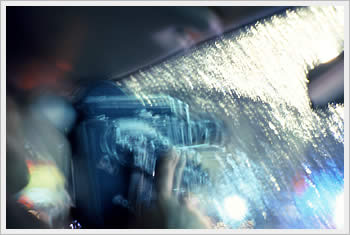
Friend shooting neon and rain, Polk Street, San Francisco, February 16, 1994: click for larger image

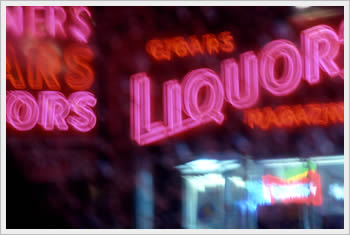
Neon signs, Werners (?) Liquor Store, corner of Geary and Larkin, San Francisco, February 17, 1994: click for larger image

These are bittersweet images for me, even in their abstraction. I’ve gone back and forth over posting them, writing about them. Actually, in a way all these slides that I’ve been showing here the last week have for me an edge of melancholy to them. (I don’t presuppose that feeling comes over the ether-net, but perhaps for some of you it does). All were taken during a not-very-happy period of my life, which is a euphemistic way to say that they were taken during a time when I was suffering from the disease that dare not speak its name, depression.

It’s easy now to look at these images and enjoy the warm glow of nostalgia, and wonder to myself what the fuss was about. But that edge of melancholy lingers. Actually, as I reflect on them in hindsight, these images from my San Francisco days gone by evoke, perhaps more so than melancholy, a tranquility that belies the disquiet that was churning beneath the surface at the time. A murky tranquility obfuscating the thousands of dollars in therapist bills, the anti-depressants, the suicidal fantasies.

I didn’t talk about all this to most of the people around me at the time, choosing out of shame or embarrassment to instead project my own masked tranquility. But there was one person I did talk to, which brings me to these photos. I was once friends with a filmmaker living in San Francisco, and we hung around a lot together in ’93 and ’94. He was considerably older than I, and I suppose in some ways was a bit of a father figure to me, but the wonderful aspect of our relationship was that he treated me not as an acolyte or apprentice, but as an equal. He would show me the film he was working on or raw footage he had shot, and listen attentively as I gave him my thoughts on what I had seen, what worked and what didn’t, in my eyes. He was neither graciously dismissive nor patronizingly receptive.

We often went shooting together, he with his 16mm Bolex, I more often than not with my 35mm still camera. At one point he was interested in capturing the colors of neon as seen through the drops of rain falling on a car windshield, and on rainy nights he’d call me up on the phone and then swing by and pick me up in his car for a night of this kind of shooting. The two images above come from back-to-back nights of this in February, 1994. We’d shoot, or he’d shoot and I’d watch, and then we’d drive somewhere and park for a while and talk, then shoot some more. Sometimes we’d stop at Coit Liquor in North Beach and pick up some Italian grappa. Or we’d frequent a particular bar we sort of mutually discovered, and occassionally get mixed up in some minor adventures, like the time we ended up in a Mission District apartment smoking joints through apples with two Mexican transsexuals. Needless to say, it was a heady time for me.

I opened up to him about the crap I was going through inside, and he listened, and sometimes gave advice. But mostly he listened. In his flat, in his car, or on the telephone, he was what I needed most at that time, someone to talk to, untethered to 45 minute intervals or a $50/hour check.

But if there’s one thing you lose when you’re in a depression, it is perspective, the ability to know when enough is enough. At some point, reaching out to him during a particularly tough time, he told me he couldn’t help me, that he needed a breather, that he didn’t have the energy to help me at that point in time, that our relationship and my needs were draining. I don’t remember exactly what he said but I have no doubt that whatever it was, it was said in his usual gentle and loving way. But, it was not what I wanted to hear, it was not something I could hear, in my self-obsessed perspective-out-the-window state. And so naturally I punished him, which really meant punishing myself, by removing myself as far as possible from his life.

It wasn’t so much a falling out as it was a falling away. Around this time I stopped paying my phone bill, and the phone company disconnected my phone. I was not to have another phone for the next 6 years. And because my doorbell was connected to a phone that no longer rang, I was able to self-destructively isolate myself, and effectively close the door on our friendship. From time to time he’d send messages through a mutual friend, or even postcards, but I never responded. One of these postcards was for a screening of the film he had made from the footage of the neon-imbued raindrops and much other imagery he had shot on our excursions together. He made some sort of reference to “our film” on the postcard, and so I went. But this meeting, like subsequent times when I’d run into him at a film screening, or at the museum, was awkward in the extreme, and it was obvious that what once was, was no longer. Not surprisingly, I couldn’t get into the film, couldn’t get past the footage and the memories and associations, and the sadness.

In the late 90’s, my depression was over, 6 years after it had started. One day I realized something that had probably been true for some time prior — I wasn’t depressed anymore. No magic cure, no big revelations, no secrets of contentment, no saviors. Somehow, I had gotten through it, but at a price: I lost a lot of friends along the way. Actually, “lost” implies that I unwittingly allowed this to happen, when in point of fact, I threw these friends away. Their number stretches to both hands, it pains me to admit. It’s not something I view casually, but on the other hand I’m not so sanguine to think it could have been different. You don’t go through 6 years of a disease, any disease, without losing something.