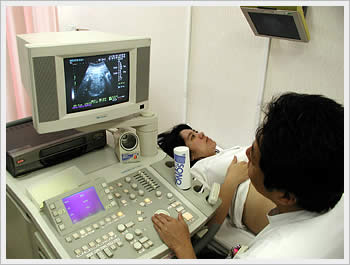
Naoko and I are getting closer to finalizing our choices for our child’s name. As I mentioned last week, we have chosen not to ask the doctor about the gender of the child-to-be, and so therefore our job of selecting a name is doubly hard. And in Japan, I’d say it’s even harder than that, but in a challenging, fun way. You see, we not only have the name to think about, but the kanji characters we will select to represent that name, the various meanings said characters might independently and collectively carry, the visual appeal (or lack thereof) these characters contain.
Of course we want to choose names that have meaning and resonance for both of us, reflecting Naoko and I’s unique histories as well as our commonalities, and our hopes and aspirations for the child, while at the same time trying to respect the fact that this child will forever carry this name, will forever write this name, will forever answer questions about how it’s spelt (and here in Japan, with which kanji it is written), and will forever have to deal with the consequences should we unintentionally saddle it with something that becomes the butt of jokes. (At thoughts like this, I invariably conjure up Joseph Heller’s brilliant Catch-22, and its character Major Major Major Major).
But on this last point, I don’t suppose there’s really that much we can do, kids being kids. I have a fairly unassuming name, yet of course it was molded into various perjoratives during my childhood by those who were so inclined. Let’s see, I suppose “Captain Kurt” (after Star Trek’s Captain Kirk) was the most popular, and I heard “Kurt Russell” (after the actor) from time to time. But in grade school, I probably heard more made up crap, stuff like “Kurticia,” an attempt to turn my name into a girl’s name on account of my long hair and perceived faggy-ness. In point of fact, my last name (Easterwood) was the easier target, with “Easter Bunny” leading the way, followed closely by “Clint.” (As an aside, while I’m tripping down grade-school memory lane once again, “ski-jump nose” was also quite a popular appellation for me, on account of my, well, ski-jump nose, which Naoko is certain, and not exactly happily so, the baby will be inheriting).
But beyond the cruel things that kids can do with each other’s names, I wonder how many of us have that big of a connection to our names. Speaking for myself, I have almost zero thoughts about the name Kurt. I never think about it one way or the other, indeed I’ve always been rather non-plussed by it. And while I know a little about the name’s etymological origins (according to Behind the Name, it’s German and is derived from Conrad, and means “bold counsel”), I know absolutely nothing about why my parents chose this name above all others (considering that my paternal grandmother’s family was from Germany, I may have been named after a distant relative, for all I know). Perhaps if I had something visual to associate my name with, like kanji characters, I would feel more warm about my name, but then again, perhaps not.
I mentioned before that I wanted to choose kanji for our child’s name that were rare and difficult, the thinking being that by learning how to read and write their name first, learning the rest of the kanji will symbolically be “downhill” and perhaps less daunting. One friend cautioned me that if I choose difficult kanji, the child might have problems in school, with teachers refusing to allow the child to actually write his or her name in kanji because they would be “ahead” of where the class would be in terms of it’s kanji education progress. (Japanese children learn a certain amount of kanji each of their 12 years in primary and secondary school, in yearly chunks (grades) prescribed by Education, Culture, Sports, Science and Technology Ministry). Naoko and I’s thinking on this is basically, let them try. I’ll be more than happy to visit the teacher and school on our child’s behalf to explain that neither our child nor his or her name is a nail that will be hammered down without a fight. That said, the government in their eminent wisdom limits the number of kanji parents can use for naming to 2,230 characters, so there are some limits. (Naoko says that the government will be relaxing this restriction sometime in the next year, increasing the number of kanji allowable for selecting).
But then again, we may not go the difficult route: I’d hate to hear the cursing of us parents when the child has to sign hundreds of traveler’s cheques or something! Either way, we won’t be choosing the characters based on stroke order numerology, which apparently many Japanese families still do, according to this good article on kanji and naming.
At any rate, the kanji have yet to be selected (in point of fact, some of the more difficult ones also happen to be somewhat ugly!). But I do take comfort in the fact that the names we’ve chosen (subject to change, of course, we still have over a month and half) don’t appear in any of the “most popular” names lists I’ve been perusing. These lists in and of themselves are fascinating to look at, and see how times have changed. My mother sent me an article last week and part of it talked about what’s popular now in America for baby names, compared to what was popular a few years ago. Apparently, unisex names like Madison are in, while Jennifer, which ruled the 70’s, is out.
In Japan, according to Meiji Life Insurance, in 2002 among their customers, Shun was the number one name for newborn males, while Misaki and Aoi were tied for the top spot among females. Meiji’s records for this (online anyway) go back to 1912, or Taisho 1 in the Japanese gengo calendar system (“Taisho” or “Great Righteousness” being the name Emperor Yoshihito ascribed to his period of reign). Perhaps not surprisingly, during the first 3 years of the Taisho period (1912-14), the most popular name for newborn males were Shouichi, Shouji, and Shouzo (“Righteousness 1,” “Righteousness 2,” and “Righteousness 3,” respectively).
When the Shouwa period started in the mid-20’s, the same thing happened. In Shouwa years 2 and 3 (Shouwa 1 lasted only 7 days, Hirohito having ascended to the throne on December 25, 1926), the most popular male names were Shouji and Shouzo (“Enlightened 2” and “Enlightened 3”, respectively). So what about the start of the current Heisei period, in 1989? sei (achieve) is not to be found in the top 10, while Hei (calm, peace) makes a few appearances, but not at the top. A clear sign as any that the allegiances of Japanese have changed in the intervening years.
For women, one sees something similar. From 1927 (Shouwa 2) to 1952 (Shouwa 27), a span of 26 years, the name Kazuko, featuring the kanji for “wa” (peace, harmony), was the number one name for newborn females for an astonishing 23 out of those 26 years. Scanning the various female name choices from the Taisho period through to today, another interesting sign of the changing times is to see how prevalent it was, up to around the mid-70’s, for girls’ names to end in the diminutive “ko”, or child (to wit, not only Naoko but also my mother- and sister-in-law are examples of this). Personally, I can’t stand this type of naming practice, just as I can’t stand certain Japanese words like “kanai” (wife, literally meaning “inside house”) or “shujin” (husband, also meaning master), so it’s good to see that this trend is changing. (In the Heisei era, among the top 10 names, you’d be hard-pressed to find very many names ending in “ko”.)
In the end, I suppose Naoko and I are trying to take the whole naming thing serious, but not so seriously that we start to lose a grip on reality (this post probably makes it sound like I have!). On this point, I came across the funniest thing I’ve read in a long time, Baby’s Named a Bad, Bad Thing: A Primer on Parent Cruelty, which is a catalog of various bulletin board threads concerning the naming of children, with the site author’s wickedly cutting commentary thrown in:
11. Kryslyn
Talk about textbook. We’ve got a name that’s really a cross-bred hybrid of two names, the requisite -lyn, the replacement of everything possible with a K or Y. Top it off with no obvious nickname to fall back on (Krys?) and no ethnicity to balance/account for the weirdness, and we may have engineered before you the ultimate bad baby name: simulateously strange, stupid, difficult and boring.