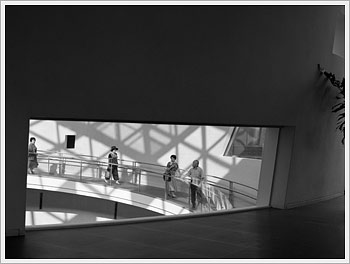
Nagasaki

nagasaki090703_05_12_1S.jpg

2 years ago I got one of those chowari (deep-discount) deals from ANA that allowed you to go anywhere in Japan (excl. Okinawa) for the roundtrip ticket price of $200. I figured I should choose someplace as far away as possible, someplace that even on the shinkansen would take over 5 hours to get to. Of the available flights remaining, that seemed to leave Nagasaki (Kyushu) and Hakodate (Hokkaido). I chose what was, for an American at any rate, the more historically resonant place.

Despite its history though, in my consciousness about the atomic bombs dropped on Hiroshima and Nagasaki, the latter has always seemed like the poor cousin, if one can trivialize it as such. When I think of mushroom clouds, obliterated landscapes, the effects of radiation, even now I think of Hiroshima. (I wonder if Hersey’s Hiroshima, which I read in high school, or Resnais’ Hiroshima Mon Amour, which I watched a few years later, were instrumental in this regard. Recently reading hadashi no Gen has helped solidify this.) As such, I had this idea that the city would be less travelled, both in real terms (get a random group of 100 Japanese together and I would be willing to bet a majority have been to Hiroshima, whereas only a bare smattering have been to Nagasaki), and less travelled in my consciousness as well.

Ah well, it seems foolish to try to talk about it, is there anything I could really say that hasn’t been said better by others at this point? With respect to the city of Nagasaki, however, there’s of course much more than the Atomic Bomb Museum or the Peace Park to see. About this trip what I remember most was the unrelenting early-September sun. It wasn’t humid like Kanto, thank heavens, but there seemed little respite from the sun. It didn’t help that I had decided I would “go Medium Format” for the trip, so I was toting around my heavy-ish Mamiya, and more b/w film than I could possibly shoot. And I brought a tripod. And just in case the 35mm SLR with film for that too. Seems a bit laughable now, especially considering that I never bothered to check if the battery for the Mamiya was okay (it wasn’t, which I discovered on Day 2, resulting in lots of over-exposed wasted film).

As a “shooting” trip it was hardly sucsessful, but the city itself remains indelibly etched, particularly the landscape. Topographically I couldn’t help but be reminded of San Francisco where I spent so many years. And up on Mt. Inasa, looking away from the city, towards the ocean, dotted with small isles, in the twilight I could almost imagine I was back on Santorini or looking over Halong Bay. Not entirely sacrilegeous thoughts, for the city itself has long been home to folks from other lands, and this history is everywhere you go, from the churches to the hillside estates of industrialists to the monuments dedicated to Christian martyrs.

Heartily recommended, Nagasaki. Nothing second cousin about it.

(Click the photo above for the gallery of what I was able to salvage).
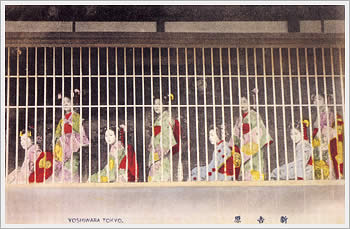
More slumming in Yoshiwara

click for larger image (61K)

Scan of a postcard reproduced in the book Yukaku, showing Yoshiwara prostitutes dressed not as prostitutes but in the common fashion of the day, circa 1907-1911 (so says the book caption).

One of the nice things about having a comments feature on one’s weblog, and which makes all the “blog spam” of late a tad more tolerable (these days, when I receive an email notification that a comment has been left, I more or less assume that it’s spam), is that posts one wrote over a year and half ago can still have some sort of life, or at least a comment left on one of these oldies serves as an indication that someone somewhere out there is still reading these old posts and finding them worthwhile enough to comment.

Such is the case with a comment I received the other day from a reader named Marc on my post Going downtown in search of Yoshiwara, which I wrote way back in July of 2002, a comment which provided me and anyone else interested with relatively clear instructions on how to find the famed Edo-era pleasure quarter. Now I had known from research I did subsequent to my original post that I had in fact come upon the edges of the old Yoshiwara district, and more or less knew how to get back down there, but I had never for one reason or another actually gone back to more properly explore the quarter and see exactly what had become of it. Marc’s comment became the impetus I was looking for, and so this past Saturday I set out to return to Yoshiwara, not really to discover anything I didn’t already know (the short of that is that present-day Yoshiwara is a Soapland enclave), but to sort of complete the circle as it were.

If I may flesh out Marc’s directions a bit (uh, excuse the pun), to get to Yoshiwara so that you actually enter the quarter the same way Edo-era denizens did:

— Get yourself to Minowa station on the Hibiya subway line. Depending on where in the city you are, the easiest way is probably to get to Tokyo’s Ueno station and catch the Hibiya line there. Minowa is two stops from Ueno in the Kita-Senju direction.

— Exit Minowa station by Exit #3 and when you hit the street, turn left. This is Meiji Dori. You should cross to the other side of the street and proceed in this direction (south). After two blocks Meiji Dori will veer left (east) but you want to continue to walk straight on Dote Dori. Roughly 10 blocks after leaving Meiji Dori, and about 4 past Nihon Tsutsumi street mentioned in Marc’s instructions, you will come to Yoshiwara Daimon street on your right, instantly recognizable by its curved nature very different from all the other streets around here. You’ll also see a huge Shell gas station on the corner, in case there’s any doubt. Turn right here.

— After a couple of blocks, where the road straightens out, is where the ooman or large gate in its various incarnations stood (judging by these photos), although these days Yoshiwara really starts a block further on (and this will be very clear to you from all the taxi cabs and all the uh, doormen).

(I’ve made a printable map drawing (47K) of the above in case I wasn’t clear enough.)

Back at the Shell station along Dote Dori there is a Yanagi (willow) tree with a plaque, but I just realized this from this web page, and didn’t actually see this myself. This is no doubt a “replica” of the famed mikaeri (to look back) willow tree which would have been at the entrance to the quarter, so named because this is where, after receiving his custom (how else am I suppose to phrase this?), the courtesan and her customer would part, each looking back at each other (immortalized from the courtesan’s perspective — tellingly — in Hishikawa Moronobu’s mikaeri bijin woodblock print).

From the Edo-era map that Marc referenced, it appears that what is now Dote Dori was once Nihon Tsutsumi (tsutsumi means embankment or dyke), and this would jive with this view of Yoshiwara from Hiroshige’s 100 Views of Edo series, the caption of which says Nihon Tsutsumi. Now, the street named Nihon Tsutsumi forms the northern boundary of the Soapland area. (I suspect, but don’t know for sure, that the Great Kanto Earthquake of 1923 changed this area substantially. To wit, here’s a before and after the earthquake view of Yoshiwara.)

And today? Well, naturally one needs to let one’s imagination do much of the walking, but certainly modern-day Yoshiwara is still worth a brief visit, if for nothing else than to give oneself a tiny window on what the high-end of the Tokyo adult entertainment scene looks like (your internal calculator will be overheating when converting exactly how much money 45,000 yen for a 60 minute “course” is).

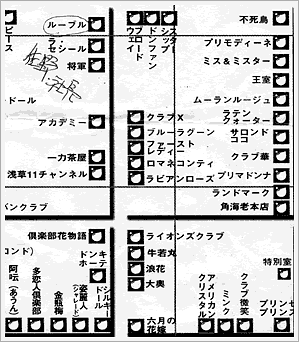
Surprisingly (to me, anyway), there were a few doormen who actually tried to lure me into their establishments, so not all of these places are strictly Japanese-only. Near the end of my stroll, a fairly persistent chap who obviously didn’t understand me when I tried to explain to him that the piece of paper in my hand was an Edo-era map of the quarter, even dug into his wallet to produce a current map of the area with all the parlors listed (reproduced below for educational purposes only, of course):

Detail of map of present-day Yoshiwara: click for whole thing (107K)

To make a day out of it, a visit to Yoshiwara can be combined with a visit to Asakusa and Sensoji Temple, which is basically what I did. From Yoshiwara it’s a 10-15 minute walk to Asakusa, where perhaps more interesting than the temple and it’s tourist-packed grounds is the adjacent Rokku district (look for the big WINS betting parlor to the west of the Sensoji temple complex), which is an area worthy of it’s own post. There’s a seediness (albeit a relatively benign one) to be found there which makes for a nice contrast with the antiseptic refined atmosphere of present-day Yoshiwara.

(I’ve made a printable map (71K) of the Minowa Station — Yoshiwara — Asakusa route for your convenience.)

Hitachi Family Snapshots No. 3

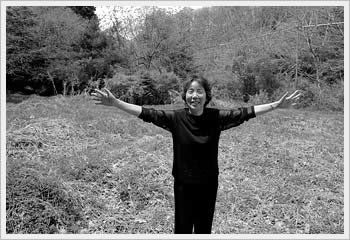
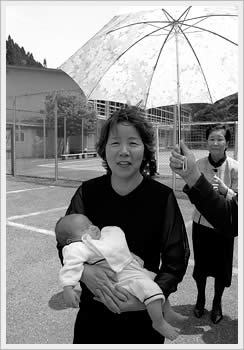
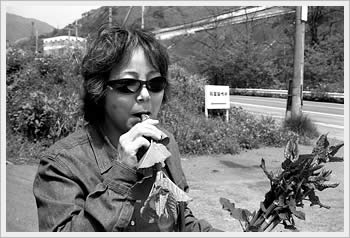
Continuing with more snapshots from Hitachi, this time of my mother-in-law, who was born and raised there. In the first image, she is standing on the site of the house she grew up in, a company house rented from Hitachi Mine, who her father worked for. The house was razed many many years ago. The second photo was taken at the location of her old elementary school, and the third across the street from one of the Mine’s old complexes. While I was taking some pictures she went up an embankment and pulled these stalks out of the ground and started munching on them, like a kid.

Mother-in-law, Hitachi, May 4, 2003 (71K)

Mother-in-law and grandson, Hitachi, May 4, 2003 (41K)

Mother-in-law, Hitachi, May 5, 2003 (54K)